

The United States electric grid is currently facing a transformative period defined by a historic surge in demand, a shift toward renewable energy resources, and an increasingly complex landscape of national security threats. As households and businesses express growing concerns over rising utility bills, a comprehensive new study suggests that the most effective tool for maintaining affordability and reliability is not found in local generation alone, but in the large-scale expansion of the nation’s transmission infrastructure.
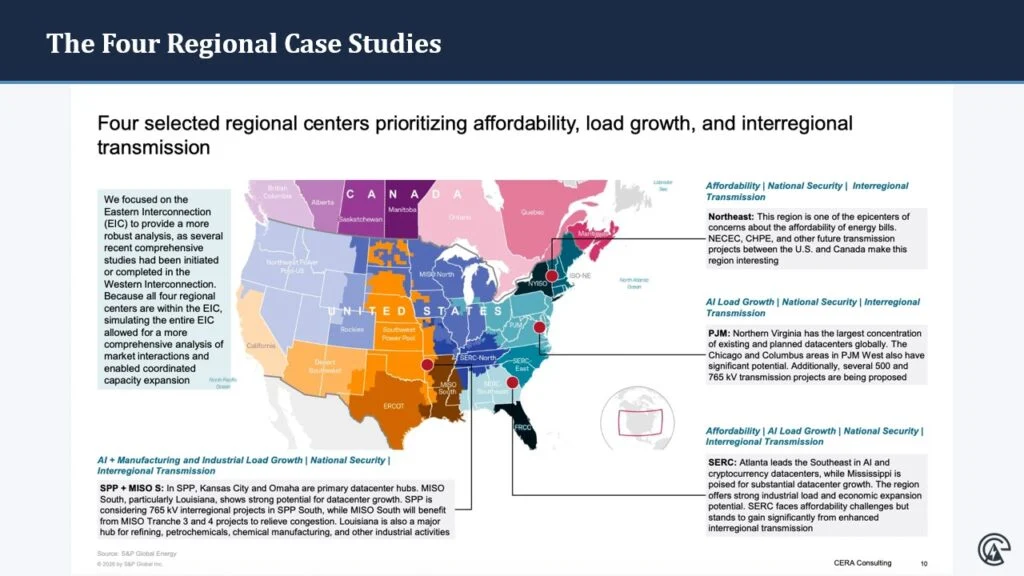
The report, titled “Powering Growth and Affordability: The Role of Transmission in Economic and National Security,” provides a rigorous data-driven analysis of how strategic investments in high-voltage transmission lines can stabilize the economy and protect the nation’s interests. Prepared by CERA Consulting, the specialized consulting arm of S&P Global Energy, the study was commissioned by a coalition of industry leaders and advocacy groups, including National Grid, the Electricity Customer Alliance (ECA), and Converge Strategies. By focusing on four critical regions of the Eastern Interconnection—the Northeast, PJM Interconnection, SERC Reliability Corporation, and the SPP/MISO South regions—the analysis offers a roadmap for navigating the "load growth" era that has surprised many utility planners in its intensity.
The Magnitude of Rising Electricity Demand
For the first time in nearly two decades, electricity demand in the United States is projected to grow at a rate that challenges existing infrastructure. The CERA Consulting study highlights a staggering forecast: by 2035, the regions analyzed could see 374 terawatt-hours (TWh) of new annual demand. Furthermore, the peak load—the maximum amount of electricity required at any single moment—is expected to rise by 45 gigawatts (GW).
This demand spike is not a product of residential consumption alone; rather, it is driven by a "perfect storm" of industrial and technological factors. The primary catalysts include the rapid proliferation of artificial intelligence (AI) and the data centers required to support it, a domestic manufacturing boom fueled by federal incentives such as the CHIPS and Science Act, and the ongoing electrification of the transportation and heating sectors. According to the study, approximately 50% of this projected growth is concentrated in just two areas: the PJM Interconnection (which spans the Mid-Atlantic and parts of the Midwest) and ERCOT (the Texas grid).
Without significant upgrades to the transmission system, the grid will be unable to transport power from areas of surplus to areas of high demand. This physical bottleneck leads to "congestion," a phenomenon where lower-cost energy—often from wind, solar, or efficient natural gas plants—is trapped in one region while another region is forced to run older, more expensive "peaker" plants to meet local needs. The report argues that building transmission is "consistently one of the most cost-effective approaches" to resolving these imbalances, providing a more affordable alternative to building redundant local generation in every high-demand pocket.
The Economic Case: A $15 Billion Opportunity
One of the most striking findings of the report is the sheer scale of the potential savings for American consumers. The analysis suggests that robust interregional transmission investments—those that connect different power markets and regional grids—could deliver up to $15.3 billion in customer savings through 2050. These savings are estimated to be two to three times higher than scenarios where transmission investment remains confined within regional borders.

The economic logic of transmission is rooted in its high return on investment (ROI). Across every scenario modeled by the researchers, transmission projects were found to deliver benefits that far outweigh their costs. On average, the study found that for every dollar invested in transmission, the system captures up to $1.89 in wide-ranging benefits. In the PJM region, which faces some of the most acute pressure from data center expansion, the benefit-cost ratio rises to 2.1. This represents a net present value of approximately $9.8 billion that could be captured for PJM ratepayers if transmission constraints are removed.
These benefits manifest in several ways:
- Reduced Congestion Charges: By clearing the "traffic jams" on the grid, transmission lowers the wholesale cost of power.
- Resource Adequacy: Interregional lines allow regions to share capacity. If one region experiences a heatwave while another has mild weather, power can be shifted, reducing the total amount of expensive backup generation that each region must maintain.
- Access to Low-Cost Energy: Transmission acts as a bridge to the "wind belt" and "solar belt," bringing zero-marginal-cost renewable energy to high-priced urban centers.
National Security and the Defense Industrial Base
Beyond the balance sheets of utilities and the monthly bills of consumers, the CERA Consulting report introduces a critical dimension to the transmission debate: national security. The United States military and its supporting industrial base are almost entirely dependent on the commercial electric grid.
The study points out that the PJM region alone is home to 75 major military installations. Furthermore, the geographic footprint of the study includes the nation’s most vital shipyards, aerospace manufacturing facilities, and technology suppliers. These entities constitute the "Defense Industrial Base," and their ability to produce the hardware and software required for modern warfare is contingent upon a reliable, uninterrupted flow of electricity.
The authors argue that a robust transmission network provides a critical "backup capability" during emergencies. In the event of a physical or cyber-attack on a specific power plant or a localized portion of the grid, interregional transmission allows for the rapid import of power from distant, unaffected regions. This redundancy is essential for military readiness and the continued operation of command-and-control centers.
Jonathon Monken, a senior partner at Converge Strategies and a former director of the Illinois Emergency Management Agency, emphasized this connection. "The electric grid is critical national security infrastructure," Monken observed. "Every command center, shipyard, and defense manufacturing site within this study’s geographic footprint runs on commercial power. Strengthening interregional transmission ensures power reaches what matters most, keeping our interconnected defense operations reliable when energy challenges emerge."
Resilience Against Extreme Weather and Emerging Threats
The call for transmission investment is also a response to the increasing frequency and severity of extreme weather events. Over the past decade, events like Winter Storm Uri in Texas and Winter Storm Elliott in the Eastern U.S. have demonstrated that "islanding"—the inability to move power between regions—can lead to catastrophic grid failures and loss of life.

The report suggests that a more interconnected grid is a more resilient grid. High-voltage lines allow the system to "flex" during weather anomalies, moving power across state lines to where it is needed most. This resilience also extends to cyber threats. A diversified and highly connected grid is harder to disable than a series of isolated local systems. By creating multiple pathways for electricity to reach its destination, the transmission network reduces the impact of "single point of failure" vulnerabilities.
Chronology of the Transmission Crisis
The current urgency surrounding transmission is the result of decades of regulatory and economic evolution:
- Early 2000s: The U.S. grid saw relatively low demand growth, leading to a period of "maintenance-only" investment.
- 2010-2020: The rise of fracking led to a shift toward natural gas, while state mandates began to push renewable energy. However, the transmission lines needed to connect these new resources lagged behind.
- 2021-Present: The post-pandemic manufacturing surge, combined with the AI revolution and federal climate policy, caused a sudden and dramatic revision of load growth forecasts.
- 2024: The Federal Energy Regulatory Commission (FERC) issued Order 1920, a landmark ruling requiring grid operators to conduct long-term planning for transmission. The CERA Consulting study serves as a data-heavy reinforcement of the need for the proactive planning mandated by FERC.
Analysis of Implications and the Path Forward
The implications of the "Powering Growth and Affordability" study are clear: the "status quo" of grid planning is no longer sufficient to meet the dual goals of economic competitiveness and national safety. However, building the necessary infrastructure is not without challenges. Transmission projects often face significant hurdles, including "NIMBY" (Not In My Backyard) opposition, complex permitting processes across multiple state jurisdictions, and intense debates over who should pay for lines that cross state borders.
The study argues that the cost of inaction is far higher than the cost of investment. If the transmission buildout continues at its current sluggish pace, the U.S. risks a future of "energy poverty" for manufacturing hubs and decreased reliability for critical defense assets.
To realize the $15.3 billion in projected savings, the report suggests that policymakers must prioritize interregional cost-allocation frameworks and streamline the siting process for high-priority lines. By viewing transmission not just as a utility expense, but as a foundational platform for the 21st-century economy and a pillar of national defense, the U.S. can ensure that the "solution in front of us" is finally put into action.
The findings of National Grid, the ECA, and Converge Strategies serve as a call to action for federal and state regulators. As the Eastern Interconnection prepares for a decade of unprecedented load growth, the message from the data is unequivocal: the shortest path to an affordable and secure energy future is a long-distance power line.
