

Delta Air Lines, consistently recognized as the most profitable carrier in the United States, is significantly bolstering its premium Delta One cabin experience through a series of ambitious upgrades, including a substantial expansion of its exclusive Porsche ground transfer fleet and the introduction of next-generation suites. This strategic investment underscores the airline’s unwavering commitment to its high-value customers, a demographic segment crucial to its financial success and competitive standing in the global aviation industry. The enhancements, ranging from sophisticated in-flight amenities to cutting-edge cabin technology, signal Delta’s continued leadership in the luxury air travel market, even as the industry navigates evolving passenger expectations and operational complexities.
The Escalating Demand for Elite Service: The Porsche Fleet Expansion
At the forefront of Delta’s immediate operational improvements for its most esteemed flyers is the notable expansion of its Porsche ground transfer service. This highly sought-after amenity, reserved for Delta’s top-tier Diamond Medallion members and other high-value passengers with tight connections or unique operational circumstances, allows for direct tarmac transfers between connecting flights, often bypassing traditional terminal transit. Currently operating with a fleet of 40 luxury Porsche vehicles, the airline has recognized a burgeoning demand that has outstripped its existing capacity. Ranjan Goswami, Delta’s chief marketing and product officer, confirmed to CNBC that the airline is increasing this specialized fleet by 75%, bringing the total number of vehicles to 70. "What’s happened over the last several years is the demand has continued to rise, and we realized that the 40 cars that we have weren’t enough to meet the demand. So we’re moving that fleet to 70," Goswami stated, highlighting the exponential growth in the number of passengers qualifying for and utilizing this elite service.
The Porsche program, which commenced in 2011 as a personalized gate-to-gate experience, has become a hallmark of Delta’s premium offering, symbolizing efficiency, exclusivity, and unparalleled customer care. The expansion reflects not only an increase in the number of eligible flyers but also a strategic response to the increasing complexity of hub operations and the desire to minimize stress for high-value customers. Industry analysts suggest that such bespoke services play a pivotal role in fostering brand loyalty among corporate executives, frequent business travelers, and affluent leisure travelers, segments that contribute disproportionately to airline revenues. The operational logistics of managing such a high-end ground fleet across major hubs like Atlanta, Detroit, Minneapolis, and Seattle are considerable, requiring seamless coordination between ground staff, pilots, and air traffic control to ensure timely and safe transfers. The decision to invest further in this costly, yet highly valued, service underscores Delta’s belief in its return on investment through enhanced customer retention and premium cabin sales.
Elevating the In-Flight Experience: A Glimpse into New Delta One Amenities
Beyond the tarmac, Delta is meticulously refining the in-flight experience within its Delta One cabins. The airline recently unveiled a suite of new amenities designed to elevate comfort, culinary delight, and overall luxury. Among these, new crockery, including a specially designed saucier, will be introduced, reflecting a move towards a more sophisticated and refined dining presentation reminiscent of high-end restaurants. This focus on detail extends to new Missoni mini pillows, a testament to Delta’s collaboration with luxury lifestyle brands to enhance cabin aesthetics and passenger comfort. Missoni, renowned for its vibrant patterns and quality textiles, brings a touch of Italian elegance to the Delta One experience, differentiating it from competitors.
The culinary and beverage programs are also undergoing significant enhancements. New food and beverage menus will feature elevated options, including the innovative serving of Champagne over sorbet – a sophisticated twist on a classic celebratory drink – and the addition of Blanton’s bourbon, a premium single-barrel whiskey highly prized by connoisseurs. These selections are not merely about offering expensive items; they represent a curated approach to in-flight dining, aiming to provide memorable and distinctive gastronomic experiences. The rollout of these new items is slated to begin later this month on flights originating from Los Angeles, a key market for premium travel, with subsequent implementation across other routes in the coming months. This phased introduction allows Delta to gather feedback and refine the offerings, ensuring a seamless integration across its extensive network. Such meticulous attention to cabin details and culinary offerings is a direct response to the evolving expectations of luxury travelers, who increasingly seek personalized, high-quality experiences that mirror the standards of five-star hotels and fine dining establishments.
The Future of Luxury in the Skies: Next-Generation Delta One Suites
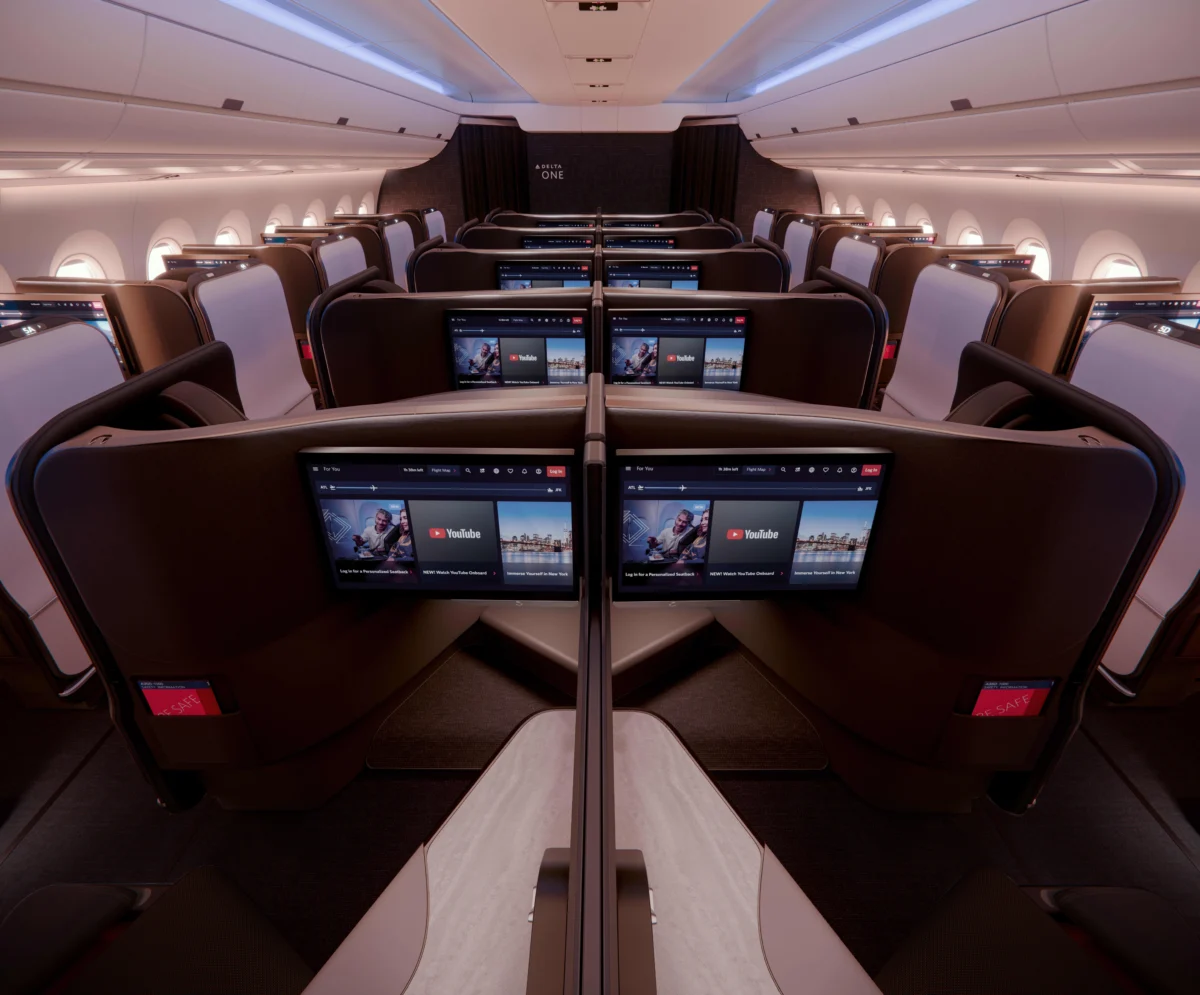
Looking ahead, Delta is preparing to debut a truly next-generation Delta One suite experience. These updated suites, which promise a significant leap in passenger comfort and technological integration, will feature a bigger, more immersive entertainment screen, offering enhanced resolution and content options. Crucially, the new lie-flat seats are designed to be more cushioned and lighter, balancing passenger comfort with operational efficiency and fuel economy. The lighter design, while maintaining structural integrity and luxury feel, can contribute to marginal fuel savings over the lifespan of the aircraft, aligning with broader industry trends towards sustainability without compromising premium offerings.
These cutting-edge suites are slated to launch early next year with the introduction of Delta’s first Airbus A350-1000 planes. The A350-1000, known for its advanced aerodynamics, fuel efficiency, and quiet cabin, provides an ideal platform for Delta to showcase its latest premium product. The larger screen and enhanced cushioning represent direct responses to passenger feedback and industry benchmarks, where in-flight entertainment and sleep quality are paramount for long-haul business and first-class travelers. The design philosophy behind these suites likely emphasizes privacy, personal space, and intuitive controls, all contributing to a highly personalized and restful journey. This significant investment in hardware underscores Delta’s long-term vision for its premium segment, recognizing that physical comfort and technological sophistication are key differentiators in the competitive global market for high-yield customers.
Strategic Vision: Delta’s Long-Term Premium Strategy

Delta’s commitment to premium service is not a recent phenomenon but rather a cornerstone of its business strategy, cultivated over nearly two decades. The airline has consistently invested in enhancing its premium cabins, recognizing that these segments are disproportionately profitable. While the current announcements focus exclusively on Delta One and do not include changes to coach and premium economy cabins, this strategic omission further emphasizes the airline’s laser-focus on its highest-paying customers.
Looking further into the future, Delta’s executives have indicated that the company is already contemplating adjustments and upgrades for its other aircraft. This includes smaller Airbus jets, which primarily serve shorter-haul international and transcontinental routes, and the Boeing 787 Dreamliners, which Delta has on order and expects to integrate into its fleet over the next decade. This forward-looking approach, planning for cabin enhancements years in advance, is critical in an industry with long procurement cycles for aircraft and cabin interiors. As Goswami articulated, "You got to keep looking at the next cycle of what customers want, and you got to start planning for it now." This proactive strategy ensures that Delta remains at the forefront of cabin innovation, consistently offering a product that meets or exceeds evolving customer expectations. The integration of 787 Dreamliners, known for their passenger comfort features like lower cabin altitude and increased humidity, will further enhance Delta’s long-haul premium offerings when they join the fleet.
Competitive Landscape and Industry Trends
Delta’s aggressive push into the luxury segment is not an isolated move but part of a broader industry trend. For over a decade, competitors like United Airlines have "followed suit," investing heavily in their premium offerings, recognizing the lucrative nature of high-yield passengers. Other carriers, including Alaska Airlines and Hawaiian Airlines, are also "leaning into demand" for higher-priced options, indicating a widespread acknowledgment across the aviation sector that premium cabins are vital for sustained profitability and market differentiation. Globally, airlines such as Emirates, Qatar Airways, and Lufthansa have long set benchmarks for luxury air travel, continually innovating with features like private suites, on-board showers, and Michelin-starred dining. Delta’s enhancements can be seen as a direct response to, and an attempt to surpass, these global standards, solidifying its position among the elite international carriers.
The financial imperative behind this strategy is clear: premium cabins, despite occupying a smaller footprint of the aircraft, generate a significantly larger portion of revenue and profit compared to economy class. According to industry data, business and first-class seats can account for as much as 30-40% of an airline’s revenue on long-haul routes, even though they represent only 10-15% of the total seat count. This disproportionate contribution underscores why airlines are locked in a "race to win over big spenders," continuously innovating to attract and retain this valuable customer segment. The market for luxury travel continues to grow, driven by an expanding global affluent population and a post-pandemic resurgence in both business and high-end leisure travel.
The Business Imperative: Why Premium Pays
Delta’s consistent profitability, even amidst volatile market conditions, is often attributed to its strategic focus on high-yield customers and premium services. By cultivating a loyal base of business travelers and affluent leisure flyers, Delta insulates itself somewhat from the intense price competition often seen in the economy class market. These customers are typically less price-sensitive and more willing to pay for enhanced comfort, convenience, and exclusivity. The expansion of the Porsche fleet and the upgrades to Delta One are direct investments in reinforcing this customer loyalty and attracting new high-value clients.
The process of developing and implementing these premium upgrades is meticulous, requiring extensive research, design, and testing. Goswami emphasized Delta’s focus on "details and quality" with its latest project for Delta One, ensuring that items, from sliding suite doors to new Delta-logo-emblazoned dinnerware, are "made to last." The company conducted rigorous testing, checking for chipping and durability, a critical step given the demanding environment of commercial aviation. This commitment to quality not only enhances the passenger experience but also reflects a long-term cost-saving measure by investing in durable, high-quality materials. There are, of course, lighter challenges, such as the potential for passengers to appreciate the new items "too much." Goswami lightheartedly noted, "I think people are going to love a couple of items, although we hope they don’t steal them," a humorous acknowledgment of the desirability of their new luxury amenities. This anecdote, while minor, speaks volumes about the perceived value and attractiveness of the new offerings.
Economic and Market Implications
Delta’s sustained investment in its premium offerings carries significant implications for its market position and the broader aviation industry. By consistently enhancing its Delta One product, the airline strengthens its brand image as a leader in luxury air travel, appealing to a demographic that values quality and exclusivity. This strategy helps Delta maintain a competitive edge against both domestic rivals and international carriers, many of whom are also upgrading their premium cabins.
Furthermore, this focus on high-yield passengers could influence airline design and service philosophies for years to come. As airlines compete for this lucrative segment, we may see further innovations in cabin design, personalized services, and ground experiences. The continuous refinement of premium offerings could also drive innovation in materials science for lighter, more durable, and aesthetically pleasing cabin components, as well as advancements in in-flight entertainment and connectivity. For Delta, these enhancements are not just about luxury; they are about solidifying its financial strength, ensuring customer loyalty, and setting new benchmarks for what premium air travel can and should be in the 21st century. The airline’s unwavering dedication to its top-tier customers underscores a profound understanding that in the highly competitive world of aviation, sustained profitability and market leadership are intrinsically linked to delivering an exceptional and differentiated experience for those who value it most.
