

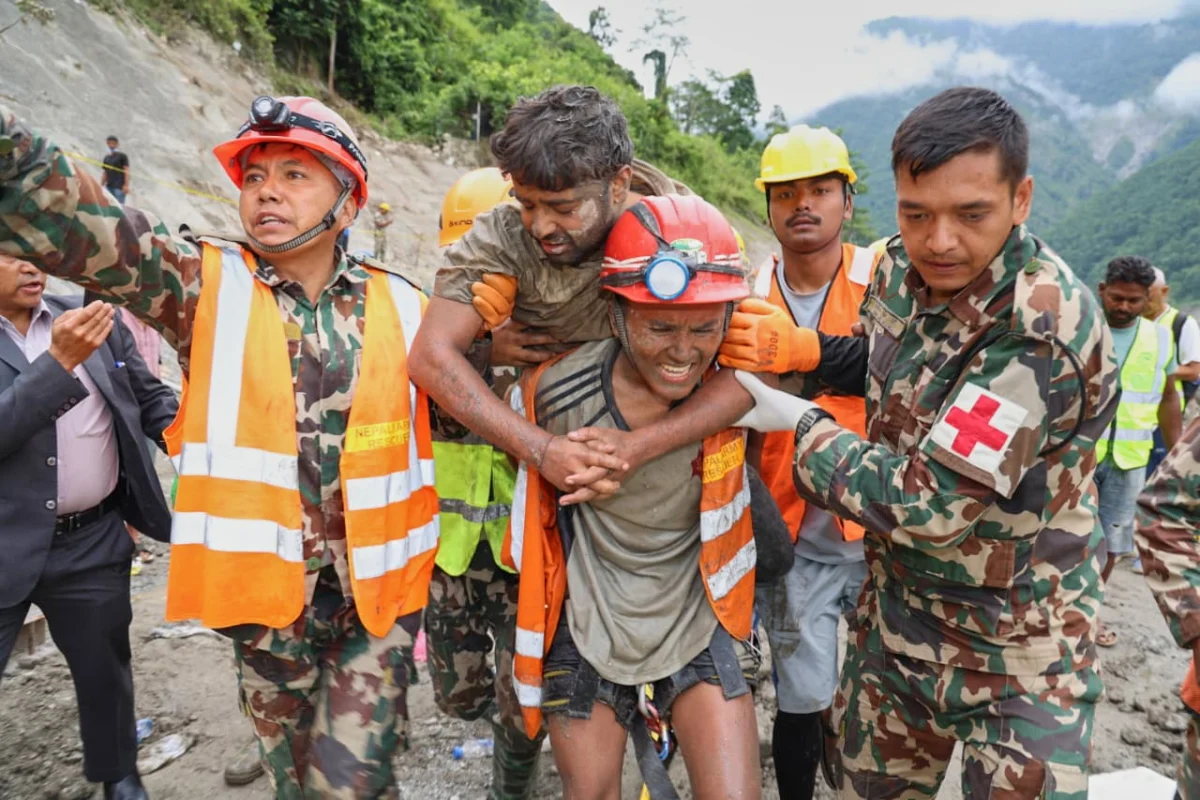
KATHMANDU, Nepal — In a rare moment of hope amidst a mounting national tragedy, Nepalese rescue teams on Friday successfully extracted two workers from an underground tunnel at the Trishuli-3A hydropower plant, nine days after a catastrophic glacial collapse triggered massive flooding across the Himalayan region. The rescue, which occurred in the Rasuwa district, has ignited a desperate, renewed effort to locate hundreds of other laborers still missing and feared trapped within the subterranean networks of the country’s extensive hydroelectric infrastructure.
The two survivors, identified by officials as a mechanical foreman and a mechanical supervisor, had been entombed in darkness since August 26, when a wall of water, mud, and boulders obliterated villages and infrastructure downstream. Search teams, comprised of Nepal Army personnel and specialized disaster response units, reported hearing faint voices emanating from the depths of the tunnel early Friday morning. Following hours of precarious excavation through thick sludge and debris, the men were brought to the surface. Images released by the Nepal Army showed a harrowing scene: one worker, caked in grey silt, being carried on the back of a soldier while others provided support on a treacherous, debris-strewn incline.
The survivors were immediately stabilized and airlifted by military helicopter to a specialized medical facility in Kathmandu. While the identity of the men has been confirmed to their families, the Prime Minister’s office issued a statement noting that one of the survivors remains in critical condition due to prolonged dehydration, lack of oxygen, and potential internal injuries sustained during the initial surge of the flood.
A Race Against Time in the Trishuli Corridor
The rescue at the Trishuli-3A project offers a glimmer of possibility for the families of approximately 115 other workers believed to be trapped in that specific tunnel complex. According to Brigadier General Raja Ram Basnet, a spokesperson for the Nepal Army, one of the rescued men provided a brief but vital testimony before being transported, suggesting that other colleagues were alive in pockets of the tunnel when he last had contact with them.
"I can’t explain what we are feeling at the moment. We are just grateful to God," Amir Maharjan, the brother of one of the rescued workers, told reporters as he prepared to meet his sibling at the hospital. His sentiment is shared by thousands across the nation, though tempered by the grim statistics provided by the Independent Power Producers Association of Nepal (IPPAN).
The Trishuli-3A plant is just one of 12 hydropower projects severely impacted by the disaster. Across these sites, authorities estimate that nearly 900 workers remain unaccounted for. Of that number, roughly 500 are believed to be trapped within various diversion and desanding tunnels that were inundated when the floodwaters struck. The logistical challenges of reaching these individuals are immense; many tunnels are blocked by hundreds of tons of sediment, and the risk of further collapses remains high as the geological stability of the region is still in flux.
Chronology of a Himalayan Catastrophe
The disaster began on the morning of August 26, 2026, following what climate scientists believe was a major glacial lake outburst flood (GLOF) or a massive glacier collapse in the high-altitude regions bordering Tibet. The resulting torrent descended with unprecedented velocity into the Trishuli and Sun Koshi river basins.
- August 26 (Morning): A sudden surge of water is detected in the upper reaches of the Himalayas. Within an hour, multiple hydropower dams report overtopping.
- August 26 (Afternoon): Entire riverside settlements are swept away. Communication with several hydropower construction sites is lost.
- August 27–31: Rescue operations are hampered by continuous rain and secondary landslides. The death toll begins to climb as bodies are recovered miles downstream.
- September 1: The Nepal Disaster Management Agency officially declares more than 5,000 people missing, including villagers, trekkers, and industrial workers.
- September 4: Rescuers hear voices at Trishuli-3A, leading to the first successful underground extraction since the disaster began.
The scale of the loss is staggering. As of Friday, the official death toll in Nepal stands at 1,287, with over 5,000 individuals still missing. The disaster has not been confined to Nepalese territory; the Chinese state news agency Xinhua reported on Friday that at least 31 people were killed and 531 remain missing on the Tibetan side of the border, highlighting the transboundary nature of Himalayan climate risks.
Economic Impact and Infrastructure Fragility
Nepal’s heavy reliance on hydropower for its national grid has left the country’s economy and energy security in a state of paralysis. The Nepal Disaster Agency estimated on Friday that the flooding has caused at least 387.5 billion Nepalese rupees ($2.5 billion) in damage to property and infrastructure.
This figure represents a significant portion of the nation’s GDP and includes the total destruction of several nearly completed power plants and severe damage to the national transmission line. For a country that has been working toward energy independence and the export of electricity to India and Bangladesh, the disaster is a generational setback.

Bikram Timilsina, Nepal’s Communication Minister, emphasized the government’s commitment to the rescue mission while acknowledging the gravity of the situation. "Our primary focus remains the lives of our citizens. We are waiting for the rescue of more and more people," Timilsina stated via social media, adding that the government is mobilizing all available resources, including international assistance for deep-tunnel sonar and thermal imaging equipment.
The Role of Climate Change and Glacial Instability
The August 26 event has reignited urgent discussions regarding the "Third Pole"—the Hindu Kush-Himalayan region—which contains the largest reserve of glacial ice outside the polar regions. Scientists have long warned that rising global temperatures are making these glaciers increasingly unstable.
Glacial lakes, formed by melting ice and dammed by unstable debris (moraines), are prone to sudden breaches. When these "natural dams" fail, they release millions of cubic meters of water in minutes. Preliminary satellite analysis suggests that the recent flood was likely triggered by a combination of a summer heatwave that weakened a glacial tongue and a localized extreme rainfall event, causing a massive ice-rock avalanche into a glacial lake.
"The infrastructure we are building in the mountains is designed based on historical hydrological data that no longer reflects the reality of a warming world," said Dr. Hemanta Shrestha, a Himalayan geologist. "The fact that 12 hydropower projects were hit simultaneously suggests that our risk assessment models for the Trishuli corridor must be entirely rewritten."
National Response and International Aid
The Nepal Army, the Armed Police Force, and the Nepal Police have deployed over 15,000 personnel to the affected districts. However, the sheer geography of the Rasuwa and Sindhupalchok districts makes the use of heavy machinery nearly impossible in many areas. In many cases, soldiers are using hand tools and small pumps to clear mud from tunnel entrances.
The international community has begun to respond, with India and China providing satellite data to help monitor further glacial movements. The United Nations and various international NGOs are assisting with the thousands of displaced persons who have lost their homes. However, the focus remains on the "miracle" at Trishuli-3A.
As the search continues, the psychological toll on the nation is mounting. In Kathmandu and surrounding districts, families of the missing have gathered at project headquarters, demanding updates. For many, the rescue of the two workers on Friday provides a painful mix of hope and anxiety.
The successful extraction of the two mechanical specialists proves that air pockets can exist within the flooded tunnels, and that the human spirit can endure unimaginable conditions for over a week. However, with hundreds still unaccounted for and the 10-day mark approaching, the window for finding further survivors is closing rapidly.
Looking Ahead: A Call for Resilient Infrastructure
As the water levels recede and the full extent of the mudflats becomes visible, the focus will eventually shift from rescue to recovery and reconstruction. The $2.5 billion damage estimate is likely to rise as technical teams gain access to the submerged turbine halls and electrical switchyards of the affected plants.
For Nepal, a country that viewed hydropower as the "white gold" that would fuel its middle-income aspirations, the August floods are a sobering reminder of the environment’s volatility. Future projects will likely face stricter environmental regulations and demands for enhanced early-warning systems that can provide downstream workers with the precious minutes needed to reach higher ground.
For now, the eyes of the nation remain fixed on the mud-clogged entrance of the Trishuli-3A tunnel. Every bucket of silt removed and every meter of progress made by the search teams is a testament to the resilience of the rescuers and the enduring hope that more of the 500 trapped workers might yet emerge from the earth alive.
