

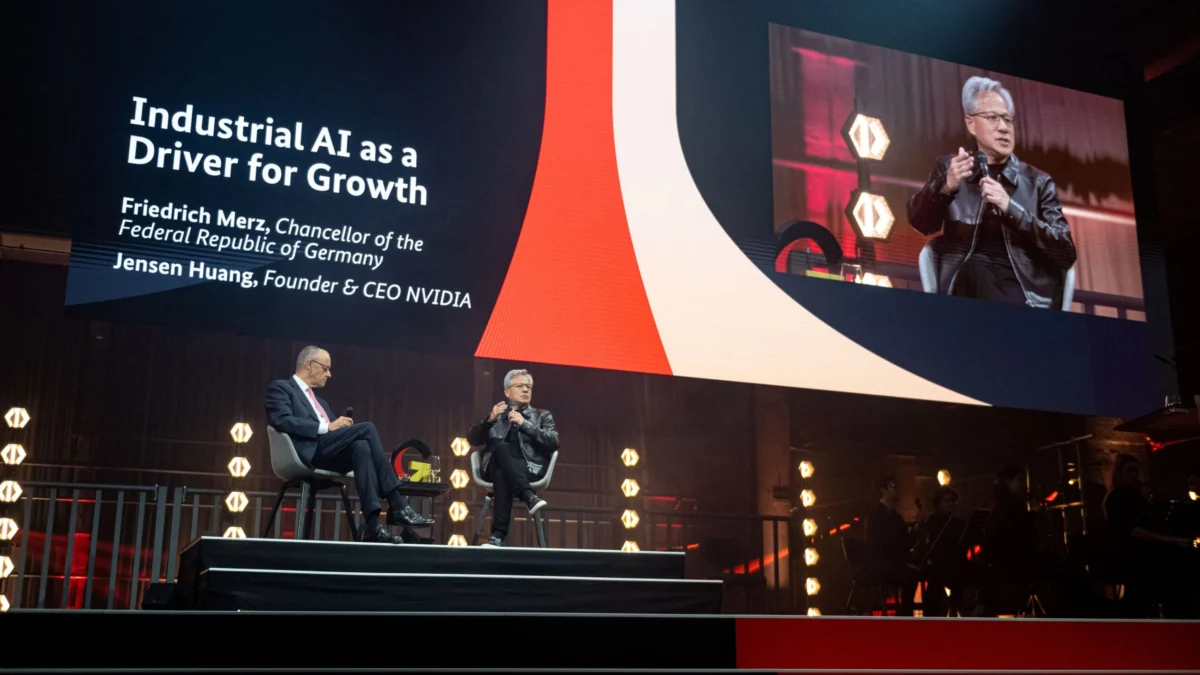
Berlin – In a candid moment that underscored the distinct priorities of the technology sector versus the political arena, Nvidia CEO Jensen Huang decisively rejected the hypothetical proposition of trading places with German Chancellor Olaf Scholz. The declaration came at the outset of a high-profile evening event, the first Investment Summit hosted by the German federal government, held in a repurposed power station in Berlin-Mitte. Huang shared the stage with Friedrich Merz, the leader of the opposition Christian Democratic Union (CDU), during an introductory segment designed to set a collegial tone for the summit. The moderator’s attempt to inject humor by asking what each man would do if they could assume the other’s role was met with Huang’s clear, albeit perhaps surprising, refusal to engage with the intricacies of German federal politics. "Chancellor? No, thank you," Huang stated, signaling a preference for his own domain over the complexities of national governance.
This firm stance from the chief of one of the world’s most influential technology companies, particularly given the backdrop of a summit aimed at attracting investment to Germany, may have been perceived as a subtle, if unintentional, critique of the current political climate. Reports and analyses have frequently pointed to challenges within Chancellor Scholz’s coalition government, characterized by internal disagreements and perceived inertia in driving economic reforms. For Merz, as the host and a prominent political figure, Huang’s direct refusal, while perhaps understandable from a business leader’s perspective, presented a moment of mild awkwardness on stage.
Merz, however, demonstrated a capacity for agile response. After a brief pause for consideration, he offered a more engaging and personality-driven counter-scenario. He proposed that if he were to step into Huang’s shoes, he would don his signature leather jacket – a sartorial element closely associated with the Nvidia CEO – and travel to Berlin to meet with the German Chancellor, with the explicit goal of securing investments for Germany. This response skillfully pivoted from Huang’s direct refusal to a proactive vision for economic engagement, aligning with the summit’s objectives and showcasing Merz’s own strategic thinking.
The Context of the German Investment Summit
The inaugural German Investment Summit, held on November 15, 2023, was conceived as a pivotal event by the federal government, aiming to revitalize Germany’s standing as an attractive destination for global capital. In an era marked by geopolitical uncertainties, evolving supply chains, and an accelerating digital transformation, Germany, as Europe’s largest economy, faced increasing pressure to demonstrate its resilience and forward-looking economic policies. The summit was intended to showcase Germany’s strengths, including its skilled workforce, robust infrastructure, and commitment to innovation, while also addressing investor concerns about regulatory hurdles, energy costs, and the pace of digitalization.
The choice of venue, a former power station in Berlin, was symbolic, representing a transition from traditional industrial power to a new era of innovation and economic dynamism. The attendance of high-profile business leaders, including Jensen Huang, alongside political figures, was a deliberate strategy to bridge the gap between policy and practice, fostering direct dialogue and creating tangible investment opportunities. The summit aimed to move beyond abstract discussions and generate concrete commitments, signaling a renewed commitment to economic growth and technological advancement.
Nvidia’s Role in the Global Tech Landscape
Nvidia’s prominence in the global technology sector, particularly its leadership in artificial intelligence (AI) and high-performance computing, makes Jensen Huang’s presence at such an event highly significant. The company’s graphics processing units (GPUs) have become indispensable for a wide range of applications, from gaming and professional visualization to scientific research, autonomous driving, and, critically, the training and deployment of AI models. The AI revolution, fueled by increasingly sophisticated algorithms and massive datasets, is fundamentally reshaping industries, and Nvidia is at the epicenter of this transformation.
The demand for Nvidia’s chips has surged, leading to unprecedented revenue growth and a significant increase in the company’s market capitalization. This demand is not only driven by the ongoing development of AI but also by the broader trend of digitalization across all sectors of the economy. For countries like Germany, which are actively pursuing strategies to enhance their digital infrastructure and foster innovation in AI, securing investments from or partnerships with companies like Nvidia is of paramount strategic importance. Germany aims to position itself as a leader in AI development and adoption, recognizing its potential to boost productivity, create new industries, and maintain its competitive edge on the global stage.
Merz’s Strategic Vision and Political Positioning
Friedrich Merz, as the leader of the CDU, has positioned himself as a strong advocate for economic liberalization and a more business-friendly environment in Germany. His party’s platform often emphasizes the need to reduce bureaucratic burdens, streamline regulations, and stimulate private investment. Merz has been vocal about the challenges facing the German economy, including the need for greater agility in adopting new technologies and a more decisive approach to industrial policy.
His response to Jensen Huang’s statement, highlighting his willingness to engage directly with business leaders and pursue investment opportunities, serves multiple purposes. Firstly, it reinforces his image as a proactive and pragmatic political leader focused on economic outcomes. Secondly, it subtly contrasts his approach with that of the current government, suggesting that a change in leadership might bring a more dynamic economic agenda. By referencing Huang’s iconic leather jacket, Merz also attempts to establish a more relatable and approachable persona, bridging the perceived gap between political elites and the world of tech entrepreneurship. His vision of securing investments for Germany aligns with the core objectives of the summit and underscores his commitment to revitalizing the German economy.
Data and Economic Implications
The German economy, while historically strong, has faced headwinds in recent years. Factors such as an aging population, rising energy costs, and a perceived lag in digitalization have contributed to concerns about its long-term competitiveness. Official statistics from Destatis, the German Federal Statistical Office, have indicated periods of stagnation and modest growth, prompting a national debate about the necessary policy interventions.
The Investment Summit was a response to these challenges, with the government signaling its intention to attract significant foreign direct investment (FDI). Germany has historically been a major recipient of FDI, but the competitive landscape has intensified, with other European nations and global economic powers also vying for capital. Data from the German Federal Ministry for Economic Affairs and Climate Action highlights the importance of FDI in job creation, innovation, and economic diversification.
Nvidia’s potential for investment in Germany is substantial. The company’s expansion plans, particularly in areas related to AI infrastructure, data centers, and semiconductor manufacturing, could translate into significant job creation and the development of cutting-edge technological ecosystems. Germany has been actively seeking to bolster its domestic semiconductor industry, a goal that aligns with Nvidia’s strategic interests in securing its supply chain and fostering innovation. Investments in AI research and development, data science, and advanced manufacturing could have a ripple effect, stimulating growth across various sectors of the German economy and enhancing its digital sovereignty.
Broader Impact and Analysis
Jensen Huang’s frank admission, while perhaps unintended, provides a valuable insight into the mindset of global tech leaders. Their focus is often on innovation, rapid execution, and creating scalable solutions. While they recognize the importance of political stability and supportive regulatory frameworks, their primary engagement with governments tends to be transactional, centered on facilitating business operations and fostering innovation ecosystems. The complexities and often slow-moving nature of political processes can be a source of frustration for leaders accustomed to the fast pace of technological advancement.
For Germany, the summit represents a critical juncture. Attracting significant investment, particularly in strategic sectors like AI and semiconductors, is essential for future economic prosperity and technological leadership. The interaction between Huang and Merz, though brief and informal, encapsulates a broader challenge: how to effectively bridge the gap between the world of global business and the intricacies of national governance. It highlights the need for political leaders to articulate a clear, compelling vision for economic development and to demonstrate a capacity for decisive action that can resonate with international investors.
The success of the Investment Summit will ultimately be measured by the concrete commitments secured and the subsequent realization of those investments. The engagement, or lack thereof, from key industry players like Nvidia, serves as a barometer for the perceived attractiveness of Germany as an investment destination. While Huang’s initial reluctance may have been a personal expression, it also underscores the imperative for Germany to continuously adapt its economic policies and regulatory environment to meet the evolving demands of the global technological landscape. The dialogue initiated at the summit, however, is a crucial step in fostering the necessary understanding and collaboration for future economic growth.
