

The global hydropower sector, a cornerstone of renewable energy for over a century, currently stands at a critical technological crossroads as aging infrastructure meets the increasing demands of a climate-neutral economy. Hydropower plants (HPPs) are the backbone of many national grids, providing not only consistent baseload power but also the essential flexibility needed to balance intermittent sources like wind and solar. However, the physical state of these assets reveals a looming challenge: the average age of hydropower plants in Europe sits between 42 and 46 years, while the United States fleet is even older, averaging approximately 64 years. In contrast, China’s rapid industrialization has resulted in a much younger fleet, estimated at just 20 years. To bridge this generational gap and ensure the continued reliability of these assets, the European Union has funded the Di-Hydro research project, an ambitious initiative designed to modernize and digitalize the hydropower sector through the integration of smart sensors, digital twins, and intelligent decision-making tools.

The Technological Imperative for Hydropower Modernization
The Di-Hydro project emerges from a necessity to transform traditional HPPs into "smart" facilities. Modernization is no longer just about replacing turbines or reinforcing dams; it is about the "digitalization of the flow"—the ability to monitor, predict, and control every variable of power generation and environmental impact in real-time. By developing sophisticated data acquisition techniques, Di-Hydro aims to shift the industry from reactive maintenance, where repairs occur after a failure, to predictive maintenance, where sensors identify microscopic defects before they escalate into catastrophic shut-downs.
Central to this transformation is the development of Digital Twins (DTs). A Digital Twin is a virtual representation of a physical asset that functions as a live digital counterpart. In the context of an HPP, this allows operators to simulate various scenarios—such as extreme weather events or sudden shifts in power demand—without risking the physical machinery. The Di-Hydro project integrates these twins with an intelligent decision-making tool that synthesizes data from societal trends, weather patterns, water flow rates, and environmental biodiversity to optimize power generation.

Structural Health Monitoring: The First Line of Defense
One of the primary focuses of the Di-Hydro project is Structural Health Monitoring (SHM). Hydroelectric machinery operates under immense pressure and constant vibration, making it susceptible to fatigue and mechanical wear. The Centre for Research and Technology, Hellas (CERTH), has spearheaded the development of a low-cost, low-power SHM sensor node designed for easy retrofitting. This "plug-and-play" approach is essential for older plants where invasive installations could disrupt operations or compromise structural integrity.
The SHM system utilizes an Acoustic Emission (AE) sensor architecture, specifically the Qawrums RAEM-2 system. AE technology is particularly effective because it detects elastic transient waves—essentially the "sound" of a material under stress. When a gear begins to crack or a bearing develops a fault, it emits a specific acoustic signature. By capturing these signals, the system can identify defects in rotating machinery and industrial drive trains long before they are visible to the naked eye.

To provide a holistic view of the machine’s environment, this AE system is paired with a multisensor unit based on the Sense HAT (B) board and a Raspberry Pi microcomputer. This unit tracks triaxial acceleration, gyroscopic movement, magnetic fields, barometric pressure, temperature, and humidity. These data points are automatically uploaded to a cloud server, allowing engineers to view the evolution history of amplitude, root mean square (RMS) values, and power levels.
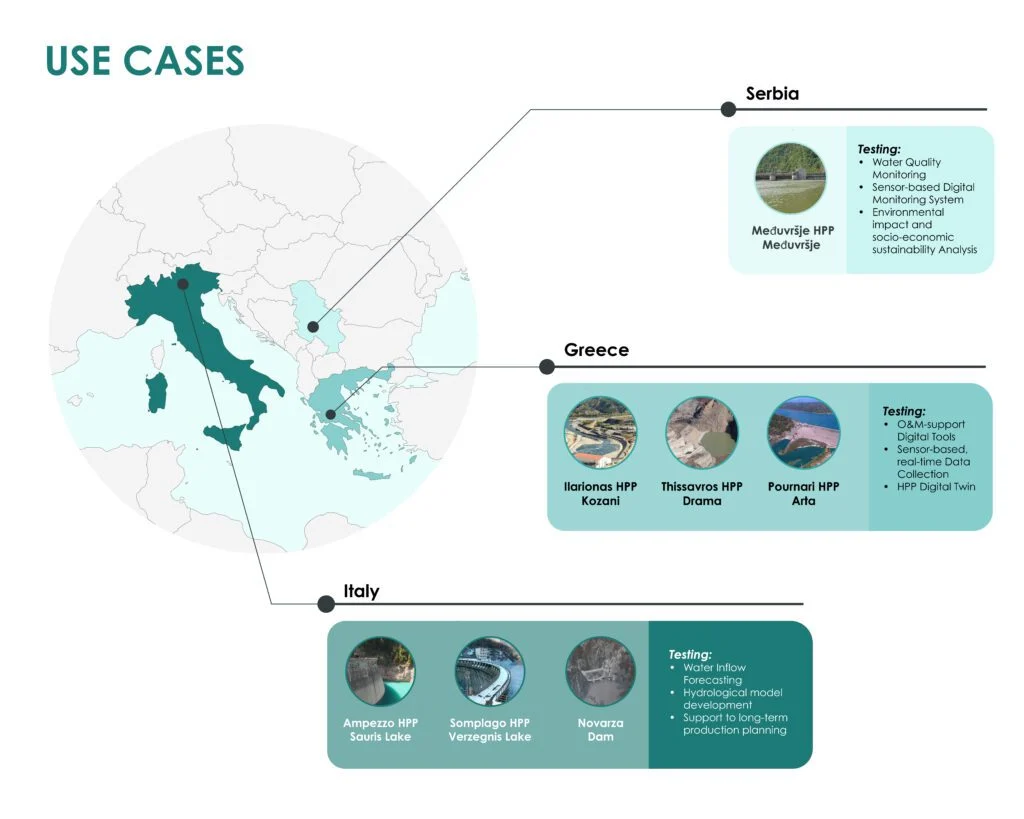
A successful pilot implementation of this technology is currently underway at the Ilarionas HPP in Greece. Operators there have installed these sensor nodes on drainage pumps and penstocks—critical areas that previously lacked automated monitoring. By targeting these specific components, the project demonstrates how digitalization can be surgically applied to the most vulnerable parts of legacy infrastructure.

Addressing the "Green Soup" and Environmental Biodiversity
Beyond the mechanical health of the plant, the Di-Hydro project addresses the profound environmental impact of hydropower operations. Reservoirs and river basins are sensitive ecosystems, and the presence of a dam can significantly alter water quality. A primary concern is water stagnation, which leads to thermal stratification—the formation of distinct layers of water with varying temperatures and oxygen levels.
In low-oxygen (hypoxic) zones, nitrification processes can intensify, altering nutrient cycles and leading to the accumulation of harmful nitrogen compounds. Perhaps the most visible manifestation of this imbalance is the formation of algal blooms, colloquially known as "green soup." These blooms are fueled by excess nitrogen and phosphorus in warm, stagnant water. Algal blooms are not merely an environmental hazard; they are an operational nightmare for HPPs. Rapid algal growth can clog piping systems and intake valves, forcing expensive de-clogging operations or even a total halt in power generation.

To combat these issues, the Di-Hydro consortium, including INOSENS and the BioSense Institute, has deployed a suite of environmental sensors. These include electrochemical sensors for ammonia detection, fluorescence-based sensors for monitoring algae levels, and specialized E. coli biosensors. These tools provide real-time data on temperature, turbidity, pH, conductivity, and dissolved oxygen, allowing for the early detection of microbiological or chemical imbalances.
Innovation in Remote Sampling: The Multiparametric Platform
Adding a layer of mobility to environmental monitoring, the AIMEN Technology Centre has introduced a portable multiparametric platform. Housed in a ruggedized suitcase, this platform allows researchers to conduct remote water sampling at any point across a reservoir.

The platform’s standout feature is a tryptophan-like fluorescence sensor. By targeting the natural fluorescence of E. coli, the device can estimate pathogenic contamination in a water sample within seconds. Furthermore, the suitcase contains a portable Digital Holographic Microscope (DHM). Utilizing laser interferometry and digital cameras, the DHM creates high-resolution holograms of water samples. Advanced image processing then converts these holograms into 3D images of microorganisms, such as cyanobacteria and green algae. This allows for a precise census of the reservoir’s microscopic biodiversity, enabling operators to track the evolution of the ecosystem in response to seasonal changes or plant operations.
The Synthesis of Data: AI and Machine Learning Models
The true power of the Di-Hydro project lies in the synthesis of these disparate data streams. The project has developed two interconnected Artificial Intelligence and Machine Learning (AI/ML) models to transform raw sensor data into actionable intelligence.

The first model focuses on biological assessment. It ingests data from the environmental sensors and the automated analysis of DHM images to predict future biological activity in the reservoir. If the model detects a trend toward an algal bloom, it can trigger early warnings.
The second model acts as the "brain" of the operation. It integrates the biological predictions with operational data from the plant’s existing Supervisory Control and Data Acquisition (SCADA) system. By correlating environmental changes with mechanical performance, the model can recommend specific actions—such as controlled water releases to increase oxygenation or adjusting power loads to mitigate stress on machinery. This level of integration ensures that environmental compliance and operational efficiency are managed as a single, cohesive objective.

Broader Implications and the Path to Climate Neutrality
The implications of the Di-Hydro project extend far beyond the technical modernization of a few European dams. As the world transitions toward a net-zero future, the role of hydropower as a flexible energy storage medium becomes increasingly vital. However, the social license to operate these large-scale facilities depends heavily on their environmental stewardship. Reservoirs are often shared resources used for drinking water, irrigation, and recreation. By providing tools that ensure high water quality and biodiversity protection, Di-Hydro helps align renewable energy production with the broader societal needs of local communities.
Furthermore, the economic benefits of predictive maintenance are substantial. For an industry with aging assets, the ability to extend the life of a turbine by five or ten years through better monitoring represents a significant saving in capital expenditure.

The Di-Hydro project, funded under the European Union’s Horizon Europe Research and Innovation Programme (Grant Agreement No. 101122311), serves as a blueprint for the global hydropower industry. By combining the expertise of research institutes like CERTH, BioSense, and AIMEN, the project demonstrates that even the oldest infrastructure can be brought into the digital age. As these technologies are refined and deployed more widely, the "digitalization of the flow" will ensure that hydropower remains a reliable, sustainable, and intelligent component of the global energy mix for decades to come.
