

Spring 2026 has ushered in an unprecedented confluence of challenges for the global aviation industry and the traveling public, as escalating fuel prices intersect with severe airport security delays caused by a protracted U.S. government shutdown. This dual assault on affordability and convenience is pushing consumer willingness to fly to its limits, forcing travelers like Genevieve Price, a 35-year-old naturopathic doctor from San Diego, to re-evaluate their travel habits. Price, a self-proclaimed "flight hacker" who typically leverages her Alaska Airlines frequent flyer status to secure perks on basic economy tickets for visits to her family in New Jersey, now faces a stark reality. Returning from Rome at New York’s John F. Kennedy International Airport, Price revealed her intention to cap future flight spending, such as setting a $900 limit for trips to Rome, where her partner resides. Her experience underscores a broader sentiment among consumers grappling with a rapidly evolving and increasingly costly travel landscape.
The Economic Headwinds: Fuel Prices Surge Amid Geopolitical Strife
The primary driver behind the sharp increase in airfares is a dramatic surge in jet fuel prices, a direct consequence of escalating geopolitical tensions. On February 28, 2026, a coordinated attack by the United States and Israel on Iran ignited a regional conflict that sent shockwaves through global energy markets. This military action in the Middle East, a critical artery for oil production and transportation, immediately triggered a sharp upward trajectory in crude oil prices, which in turn impacted refined products like jet fuel.
By Wednesday, March 26, 2026, the cost of jet fuel at major U.S. airports had soared to $3.98 per gallon, representing a staggering increase of nearly 60% compared to pre-conflict levels. This abrupt and substantial rise in operational costs has plunged the aviation industry, particularly carriers with significant exposure to Middle Eastern routes, into crisis. Airspace closures and heightened security concerns across the region have forced many airlines to cancel flights outright or reroute them along longer, more circuitous, and significantly more expensive paths, burning more fuel and extending flight times.
In response to these burgeoning expenses, airlines worldwide have moved swiftly to adjust their pricing strategies. Major international carriers such as Cathay Pacific, SAS, and Finnair were among the first to announce fare increases or the reintroduction of fuel surcharges on tickets. U.S. airlines, while initially more insulated from the direct impact of Middle Eastern airspace closures, quickly followed suit as global fuel prices became universally elevated.
Airline executives have been candid about the financial pressures. Scott Kirby, CEO of United Airlines, speaking to reporters at a company event in Los Angeles, projected that airfares could climb by as much as 20% over the course of the year. Despite this ominous forecast, Kirby noted that customer demand appeared to be holding firm, suggesting a continued willingness among travelers to absorb the increased costs. This observation was echoed by Ed Bastian, CEO of Delta Air Lines, who, at a JPMorgan industry conference earlier in the month, reported sustained strong demand in recent weeks. Bastian expressed confidence in Delta’s ability to "recapture the spike in fuel from its own sales," indicating a robust strategy to pass on costs to consumers while maintaining profitability.
The resilience of demand, particularly in the international and high-end leisure travel segments, has been a defining characteristic of the post-pandemic recovery for U.S. airlines. This robust demand has fueled years of growth, to the extent that some popular international destinations, from Japan to Spain, have even implemented measures to combat "overtourism," with local residents protesting the influx of visitors. However, this delicate balance could be disrupted by the current crisis. Airline leaders acknowledge the need for agility, with American Airlines CEO Robert Isom stating at the JPMorgan conference, "We’re certainly going to be nimble in terms of capacity to make sure that supply and demand stay in balance." United, preparing for prolonged elevated fuel prices, has already announced plans to trim approximately 3 percentage points from its capacity during off-peak travel times, targeting midweek and redeye flights, as communicated to employees by CEO Kirby.
Tangible Impact: Rising Fares Across the Board
The upward pressure on airfares is not merely a theoretical projection; it is already a tangible reality for travelers. A Deutsche Bank report issued on Monday, March 24, 2026, highlighted significant increases across various routes. Fares for transatlantic flights originating from the U.S., booked with three weeks advance purchase, were reported at an average of $1,059, marking a substantial 26.5% increase from the previous week. Domestic routes have not been spared either, with the report indicating similar spikes for transcontinental flights and journeys to and from Hawaii.
For many, these rising costs are forcing difficult choices. Mary Jean Erschen-Cooke, a nurse from Cuba City, Wisconsin, epitomizes this dilemma. While embarking on a 10-day trip through Japan with her husband Paul earlier in the month, she also had several domestic U.S. family trips planned for the year. "We haven’t booked our flights, but we should," she remarked, acknowledging the urgency. The couple is now seriously considering driving for some of these trips, a decision complicated by the fact that gasoline prices are also on the rise, creating a compounding financial burden for all forms of travel.
The Crisis at the Checkpoints: Government Shutdown Paralyzes TSA
Compounding the financial strain of higher airfares, travelers in spring 2026 are confronting an equally frustrating and disruptive challenge at U.S. airports: unprecedented security delays. These snarls are a direct consequence of a prolonged partial government shutdown, which has disproportionately impacted the Transportation Security Administration (TSA). The impasse in Congress over funding for the Department of Homeland Security (DHS) began on February 14, 2026, marking the second such shutdown in half a year and rapidly becoming the longest partial shutdown in U.S. history.
Since the shutdown’s commencement, TSA officers, deemed essential personnel, have been working without regular pay. This untenable situation has created a severe staffing crisis within the agency. DHS reports indicate that nearly 500 TSA officers have quit since the shutdown began, while elevated rates of call-outs – officers not reporting for duty, often due to financial hardship – have left airports critically short-staffed.

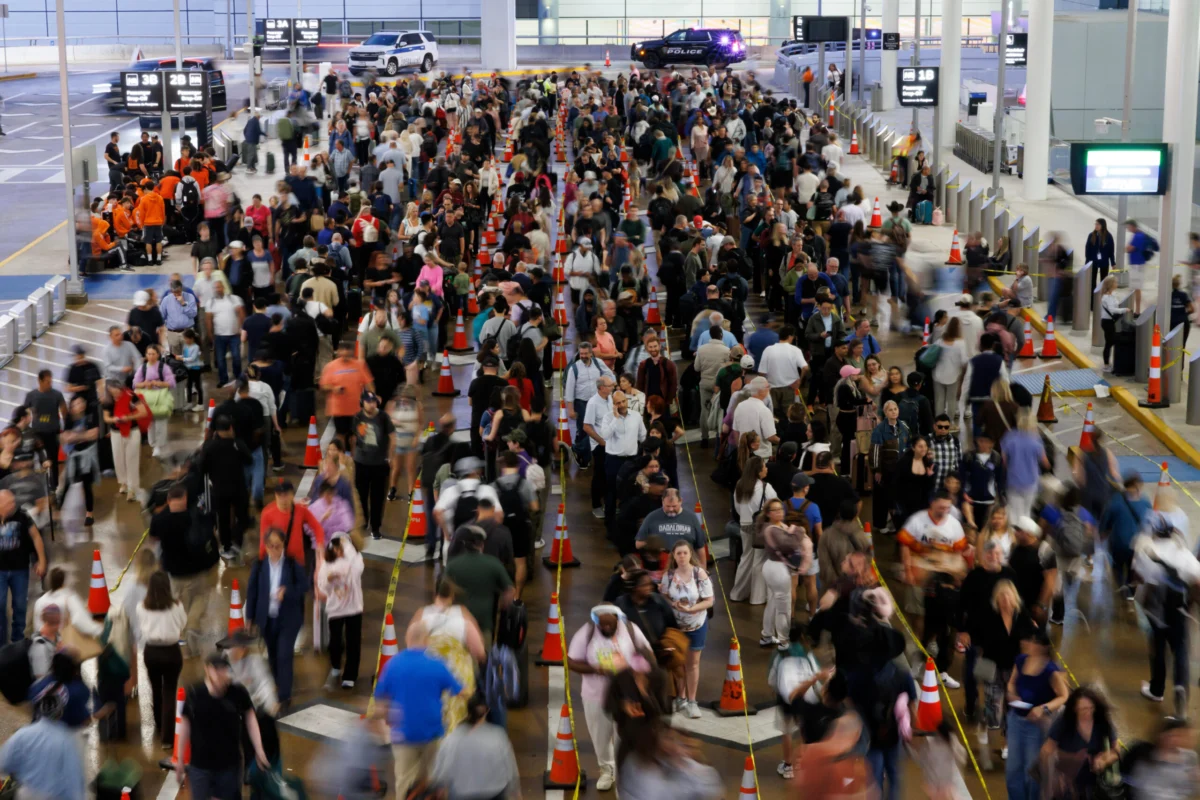
The operational fallout has been immediate and severe. Major airports across the U.S., including Houston’s George Bush Intercontinental Airport (IAH), New York’s LaGuardia and JFK airports, and Hartsfield-Jackson Atlanta International Airport, have reported hours-long security lines. In some egregious instances, wait times have exceeded three hours, an duration longer than many of the domestic flights offered from those very airports. Images and reports from travelers depict serpentine queues snaking through terminals, spilling out into public areas, and even extending outside airport buildings.
The disruption is not limited to standard security lanes. Even TSA PreCheck flyers, who pay for expedited screening, have experienced significant delays. Elizabeth Leddy, a 38-year-old classical pianist based in New York who flies several times a year, expressed her exasperation. On a Friday morning, PreCheck lines at LaGuardia Airport were reportedly running nearly 90 minutes. Leddy articulated a sentiment shared by many: if security lines consistently reached three to four hours, "I feel like I could just drive." This highlights a critical threshold for many travelers, where the perceived benefits of air travel are eroded by the arduous process of simply getting to the gate.
Political Maneuvering and Administrative Interventions
The government shutdown, and the resulting chaos at airports, quickly became a flashpoint in Washington. The Department of Homeland Security openly attributed the closure to Democrats, blaming their stance in congressional negotiations for the funding impasse. As the crisis deepened, legislative efforts intensified. By Friday afternoon, March 27, 2026, the Senate had managed to pass a potential deal aimed at ending the shutdown, though its ultimate fate in the House of Representatives remained uncertain.
Amidst the legislative wrangling, President Donald Trump also took direct action. He announced his intention to sign an executive order to ensure that the more than 50,000 unpaid TSA officers would begin receiving their paychecks. DHS confirmed this, stating that officers could expect to start getting paid as early as Monday, March 30, 2026. While this move offered a temporary reprieve for the financially strained workforce, it did not address the underlying funding dispute or the staffing shortages caused by resignations.
In a more controversial move earlier in the week, the Trump administration deployed Immigration and Customs Enforcement (ICE) officers to several U.S. airports. While ICE officers, who also fall under the DHS umbrella, continued to receive pay during the partial shutdown, the specific duties of these deployed agents were not explicitly detailed by DHS. ICE officers were observed at locations such as New York’s LaGuardia Airport on Friday morning, reportedly monitoring security lines.
This deployment sparked concern and criticism. Bernstein, a prominent financial analysis firm, commented on the situation in a note on Thursday, March 26, 2026. The firm acknowledged that "Even if this manages to slightly reduce wait times (we’re still reading about terrible wait times, so we’re far from big improvement), ICE presence could cause some individuals to fear traveling and upset TSA workers not getting paid." Bernstein’s analysis concluded with a cautionary outlook: "Seems possible passenger throughput softens over the coming days and TSA screening YoY growth for this week turns slightly negative." This underscores the potential for the ICE deployment, intended perhaps to bolster security or efficiency, to inadvertently deter travelers and exacerbate the industry’s woes.
Broader Implications: A Shifting Landscape for Travel
The convergence of soaring airfares and unprecedented airport security delays in spring 2026 represents more than just a temporary inconvenience; it signals a potentially fundamental shift in the landscape of air travel.
For Consumers: The economic pressure from higher fares, coupled with the psychological and logistical toll of hours-long security lines, will inevitably force many consumers to re-evaluate their travel choices. Budgeting for travel will become more complex, with the potential for longer planning horizons or a shift towards alternative modes of transport for shorter distances, as exemplified by Mary Jean Erschen-Cooke and Elizabeth Leddy. The premium on flexibility and predictability will increase, potentially driving more travelers towards travel insurance or premium services that mitigate delays, if such options remain viable.
For the Airline Industry: While executives like Kirby and Bastian have noted resilient demand, there is a delicate balance between pricing power and demand elasticity. Continued fare hikes, combined with a consistently negative airport experience, could eventually erode this resilience, leading to a downturn in passenger volumes. Airlines will need to remain exceptionally nimble in managing capacity, as American Airlines CEO Robert Isom suggested, to avoid oversupply in a softening market. The geopolitical instability impacting fuel prices also introduces a significant layer of financial risk and uncertainty, complicating long-term planning and investment strategies.
For Government Functioning and Public Trust: The repeated government shutdowns, particularly one impacting critical public safety and infrastructure functions like airport security, highlight systemic issues in governance. The erosion of public trust in federal agencies, especially those responsible for traveler safety and efficiency, can have lasting repercussions. The financial hardship imposed on federal workers, including TSA officers, also raises questions about the sustainability and ethics of using government shutdowns as a political tool. The deployment of ICE agents, while perhaps a temporary measure, also injects a new element of uncertainty and potential apprehension into the airport environment.
Global Impact: Beyond U.S. borders, the geopolitical conflict in the Middle East has already had a devastating impact on aviation in that region, forcing cancellations and costly reroutes. This regional crisis contributes to the global increase in fuel costs, creating a ripple effect that touches every airline and every passenger worldwide.
In conclusion, spring 2026 stands as a watershed moment for air travel. The simultaneous pressures of escalating operational costs driven by international conflict and the systemic breakdown of domestic airport security due to political paralysis present a formidable challenge. The adaptability of airlines, the resilience of consumer demand, and the capacity of political systems to resolve impasses will determine the trajectory of air travel in the months and years to come. For now, travelers must brace for an era of higher costs, longer waits, and a renewed emphasis on strategic travel planning.
