

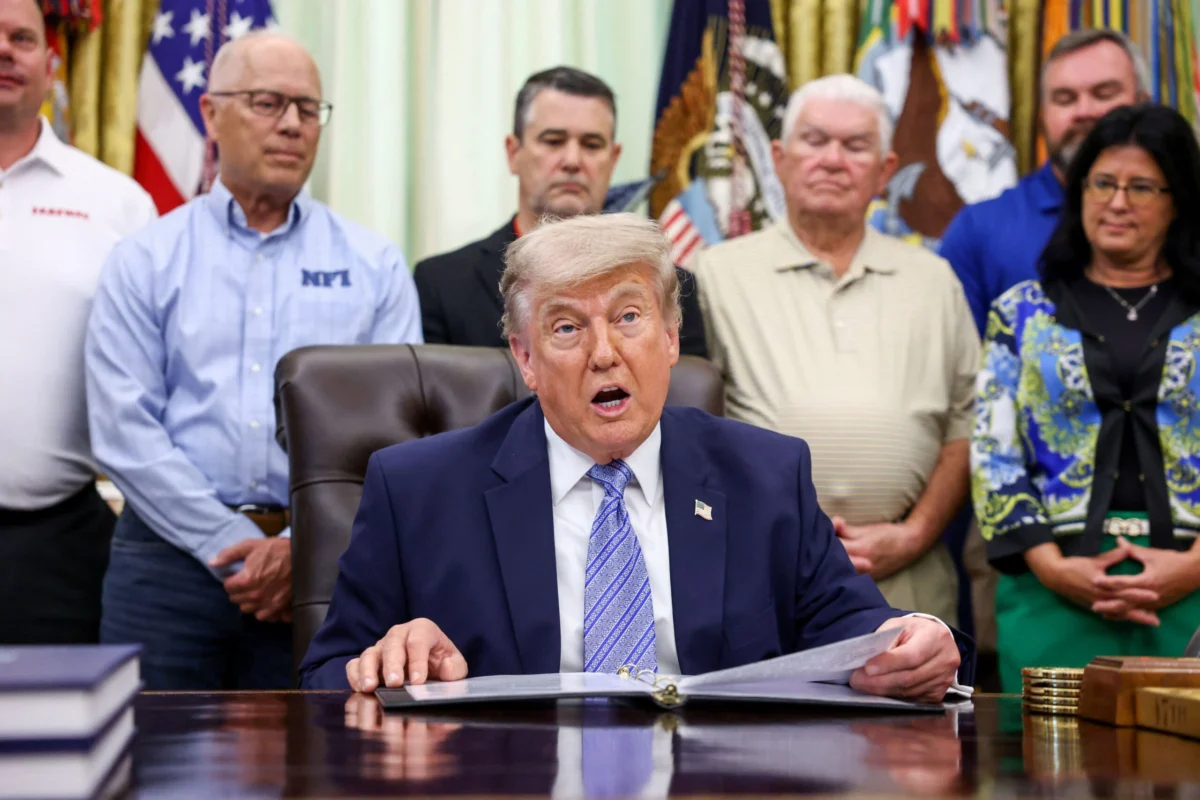
President Donald Trump on Thursday announced a significant policy reversal, delaying two key Environmental Protection Agency (EPA) regulations from the Biden administration that aimed to reduce emissions of hydrofluorocarbons (HFCs), powerful greenhouse gases widely used in refrigeration and air conditioning. Speaking from the Oval Office at the White House, President Trump, accompanied by EPA Administrator Lee Zeldin, asserted that the delay would alleviate financial burdens on American businesses and ultimately translate into substantial savings for consumers, particularly in grocery stores. The administration projected that these regulatory changes would save American businesses and families more than $2.4 billion, a figure that immediately sparked debate among industry stakeholders, environmental advocates, and economists.
The Administration’s Rationale: Cost Savings and Economic Relief
The core argument put forth by the Trump administration centers on economic relief. Administrator Zeldin articulated this stance in a statement, emphasizing, "Our actions allow businesses to choose the refrigeration systems that work best for them, saving them billions of dollars." He further elaborated on the anticipated trickle-down effect, stating, "This will be felt directly by American families in lower grocery prices." This messaging appears strategically aimed at inflation-weary consumers, particularly with the midterm elections approaching in the fall, where rising food prices have become a potent political issue. The administration posits that by easing compliance requirements for industries heavily reliant on refrigeration infrastructure, such as grocery retailers and food distributors, businesses will avoid costly upgrades, the implementation of new leak detection systems, and the transition to more expensive alternative refrigerants in some cases.
The delay specifically targets compliance deadlines outlined in a 2023 rule and a subsequent 2024 regulation, both finalized under the Biden administration. These rules were designed to curb leaks and emissions from refrigeration systems across a diverse array of sectors, from supermarkets and cold storage facilities to semiconductor manufacturing plants. The Trump administration’s move represents a direct challenge to the previous administration’s climate agenda, prioritizing short-term economic flexibility over environmental mandates.
The Science of HFCs and Global Climate Action
To understand the full scope of this policy shift, it is crucial to delve into the nature of hydrofluorocarbons (HFCs) and their role in global climate change. HFCs are synthetic organic compounds primarily used in refrigeration, air conditioning, aerosol propellants, fire suppression, and foam blowing. While they do not deplete the ozone layer, unlike the chlorofluorocarbons (CFCs) and hydrochlorofluorocarbons (HCFCs) they replaced, HFCs are extraordinarily potent greenhouse gases. Their global warming potential (GWP) can be hundreds to thousands of times greater than that of carbon dioxide (CO2) over a 100-year period. For instance, HFC-134a, a common refrigerant, has a GWP of 1,430, meaning one ton of HFC-134a released into the atmosphere is equivalent to 1,430 tons of CO2.
The international community has recognized the significant climate threat posed by HFCs. This recognition led to the 2016 Kigali Amendment to the Montreal Protocol, an international treaty designed to phase down the production and consumption of HFCs. The United States officially ratified the Kigali Amendment in September 2022, a bipartisan move that underscored a commitment to reducing HFC emissions. The Biden-era EPA rules were a direct domestic implementation of this international commitment, aiming to achieve a phasedown of HFC production and consumption by 85% by 2036. Environmental scientists and climate organizations consistently highlight that phasing down HFCs is one of the most cost-effective and immediate actions available to mitigate global warming, with projections suggesting it could avoid up to 0.5 degrees Celsius of warming by the end of the century.
The Biden-Era Regulations: A Closer Look at the Delayed Rules
The two regulations now subject to delay by the Trump administration were integral components of the Biden EPA’s strategy to address HFC emissions. The first, finalized in 2023, focused on a "technology transitions" approach. This rule established sector-specific restrictions on HFCs, phasing down their use in new refrigeration, air conditioning, and heat pump equipment. It mandated a transition to next-generation, climate-friendly alternatives, including "natural refrigerants" like CO2, ammonia, and propane, which have significantly lower GWPs. This regulation also set standards for leak detection and repair, aiming to prevent HFCs from escaping into the atmosphere from existing systems. The EPA, at the time of its promulgation, projected that this rule alone would save businesses and consumers approximately $4.5 billion over time through enhanced energy efficiency and the eventual adoption of lower-cost, more efficient refrigerants.
The second regulation, from 2024, built upon these foundations, likely expanding the scope of affected equipment or tightening compliance deadlines for certain sectors. Both rules were part of a broader strategy to incentivize innovation in refrigeration technology, reduce operational costs in the long run through improved efficiency, and align the U.S. with international climate goals. The industries targeted included not only the expansive grocery and food distribution networks but also specialized manufacturing sectors like semiconductors, which use HFCs in various cooling and cleaning processes. The delay of these rules effectively pauses this transition, allowing companies to continue using higher-GWP HFCs and potentially postponing investments in newer, more sustainable technologies.
Industry Responses and Economic Projections
The initial reaction from various industries to the Biden-era rules was mixed. While some large corporations, already investing in greener technologies, saw it as an inevitable transition, many industry groups, particularly those representing smaller businesses, voiced significant concerns about the immediate financial impact. The Food Marketing Institute (FMI), a prominent industry association for food retailers and wholesalers, had previously warned that the transition mandated by the EPA could cost the grocery industry billions in upfront equipment upgrades and compliance expenses. These costs would include replacing existing HFC-based systems with those using natural refrigerants or lower-GWP synthetic alternatives, training staff for new maintenance protocols, and implementing advanced leak detection systems.
For larger grocery chains such as Walmart, Kroger, and Costco, investments in "natural refrigerant" systems have been ongoing for years, driven by a combination of corporate sustainability goals, anticipated regulatory changes, and long-term operational efficiency. These large operators were generally considered better positioned to absorb the costs of transition. However, the burden was expected to fall more acutely on smaller regional grocers and independent stores, which often operate on tighter margins and have less capital for significant infrastructure overhauls.
Kroger CEO Greg Foran, speaking at a White House event prior to the official announcement, echoed the sentiment that an "orderly transition of equipment reduces both capital costs and operating costs, and at the end of the day that’s good for consumers because we’re able to take that and put that into lowering prices." His statement, while acknowledging the potential for savings, also highlighted the complexity of the issue.
Skepticism on Consumer Savings and Broader Economic Factors
Despite the administration’s strong assertion that the delay would lead to lower grocery prices for American families, significant skepticism emerged immediately regarding whether these savings would actually materialize for consumers. The changes announced by the EPA do not mandate grocers or other businesses to pass on any cost savings to shoppers. In a competitive market, companies may choose to retain these savings to improve their profit margins, invest in other areas of their business, or address other rising operational costs. When directly questioned about the likelihood of passing savings to consumers, Kroger CEO Greg Foran indicated that the company was "right in the middle" of making such decisions, aiming to ensure customers are "paying the right price," a response that offered little concrete assurance.
It is also crucial to contextualize the cost of refrigeration compliance within the broader spectrum of grocery operating expenses. Food inflation is a complex phenomenon driven by a multitude of factors, including labor costs, transportation expenses, commodity prices, energy costs, and geopolitical events. For example, recent increases in some of these expenses have been attributed to factors like the Iran war, which can impact global energy and commodity markets. While refrigeration infrastructure is a critical component of grocery operations, the costs associated with HFC regulations typically represent a relatively small slice of overall operating budgets compared to labor, rent, and inventory. Therefore, even if businesses realize the projected $2.4 billion in savings, the impact on individual grocery bills might be marginal and easily overshadowed by fluctuations in other, more significant cost drivers.
Moreover, a Bloomberg News report earlier on Thursday indicated that Kroger was already planning its biggest price cuts in years to compete more effectively with rivals like Walmart and Costco. This suggests that competitive pressures, rather than solely regulatory relief, might be a more potent driver for price reductions in the grocery sector, further muddying the waters regarding the direct impact of the EPA rule delay on consumer prices.
Broader Environmental and Policy Implications
The Trump administration’s decision carries substantial environmental and policy implications, both domestically and internationally. From an environmental perspective, delaying the HFC regulations means a slower reduction in emissions of potent greenhouse gases. While the immediate economic benefits are touted, environmental advocacy groups and climate scientists are likely to criticize the move as a significant step backward in the fight against climate change. They would argue that the long-term environmental costs, including accelerated global warming, increased frequency and intensity of extreme weather events, and associated economic damages (e.g., agricultural losses, infrastructure damage), far outweigh any short-term savings for businesses. The delay could lead to millions of additional tons of CO2-equivalent emissions over the coming years, hindering the U.S.’s ability to meet its climate commitments under the Paris Agreement and the Kigali Amendment.
From a policy standpoint, this action signals a broader shift away from climate-focused regulatory approaches that characterized the previous administration. It reflects a recurring pattern in U.S. environmental policy, where regulatory frameworks often oscillate with changes in presidential administrations. This creates uncertainty for industries, as businesses must navigate shifting compliance landscapes, potentially leading to stop-and-go investments in new technologies. It also risks undermining U.S. credibility on the international stage, especially given the bipartisan ratification of the Kigali Amendment. Other nations committed to the HFC phasedown might view this delay as a weakening of U.S. leadership on climate action.
Environmental groups, potentially joined by states with aggressive climate goals, are expected to challenge the administration’s decision in court. They would likely argue that the EPA’s rationale for delaying the rules is arbitrary and capricious, fails to adequately consider the environmental harm, and contradicts the agency’s mandate to protect public health and welfare. Such legal battles could lead to protracted litigation, further prolonging the uncertainty surrounding HFC regulations.
Looking Ahead: Political and Legal Landscape
The timing of this announcement, just months before the midterm elections, underscores its political significance. The administration is clearly aiming to connect this regulatory rollback to tangible economic benefits for everyday Americans, hoping to resonate with voters concerned about the cost of living. However, the efficacy of this strategy will depend on whether consumers actually perceive a reduction in grocery prices attributable to this policy, which, as discussed, remains highly uncertain given the multifaceted drivers of food inflation.
The delay of the Biden-era HFC rules marks a pivotal moment in U.S. climate policy, pitting immediate economic relief against long-term environmental imperatives. While the Trump administration champions the projected $2.4 billion in savings for businesses and families, the true impact on consumer prices remains speculative. Meanwhile, environmental advocates warn of the significant climate costs associated with postponing the transition away from potent greenhouse gases, setting the stage for potential legal challenges and further political debate over the nation’s approach to climate change and environmental regulation. The coming months will reveal whether these regulatory adjustments translate into the promised economic relief or instead ignite a renewed battle over climate action in the United States.
