

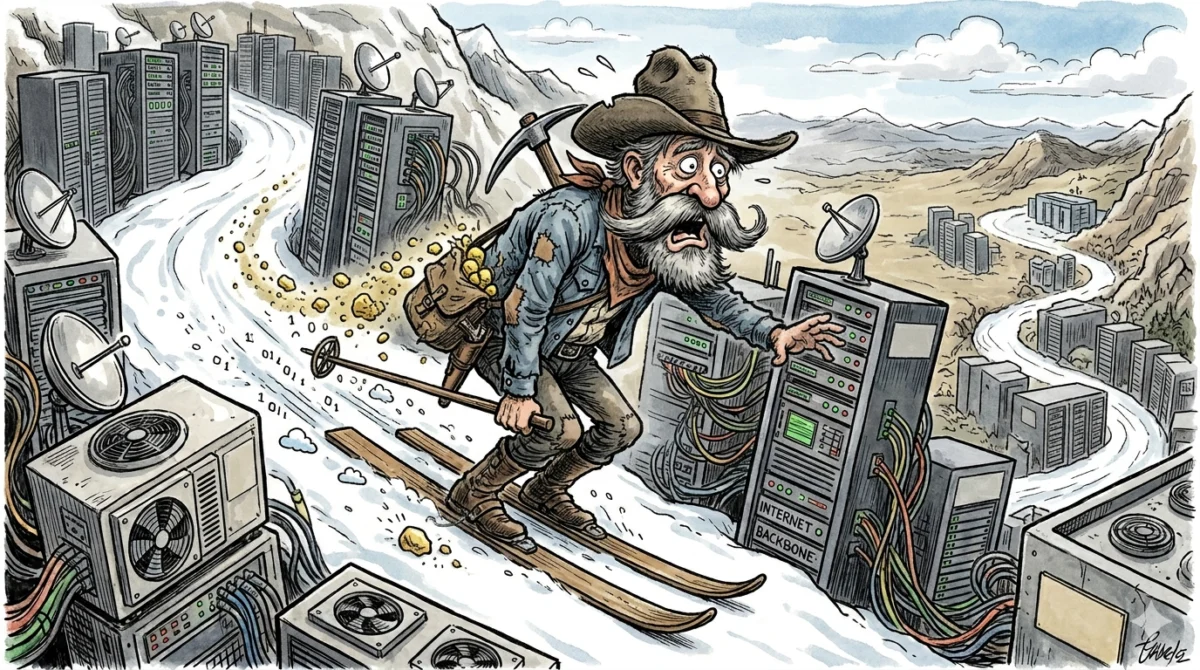
The rapid expansion of artificial intelligence and the massive data center infrastructure required to support it have encountered a significant reality check as supply chain constraints and grid limitations begin to stall the industry’s aggressive growth trajectory. While the prevailing narrative in the tech sector has long emphasized the "first-mover advantage," a new set of data suggests that being an early mover is no longer a guarantee of success if the physical infrastructure cannot keep pace with digital ambition. From critical shortages in electrical equipment to the financial volatility of major tech players, the intersection of energy and AI is currently defined by a "gold rush" mentality that is increasingly hitting structural barriers.
The Infrastructure Deficit: Equipment Shortages and Project Delays
According to recent data from Sightline Climate, a significant portion of the planned data center expansion in the United States is facing immediate headwinds. Nearly half of the data centers scheduled for construction this year are projected to be delayed or canceled entirely. The primary driver behind this trend is not a lack of capital or demand, but a persistent and worsening shortage of essential electrical components.
Critical hardware, including high-voltage transformers, switchgear, and industrial-scale batteries, remains in short supply. Lead times for large power transformers, which are essential for connecting data centers to the high-voltage grid, have ballooned from a historical average of 50 to 60 weeks to more than 150 weeks in some regions. This shortage has created a tiered market where only the largest developers with the deepest pockets and pre-existing supplier relationships can secure the necessary equipment, effectively pricing out smaller or newer entrants.
The reliance on international supply chains has further complicated the situation. A significant portion of U.S. AI data center expansion remains dependent on Chinese electrical equipment imports, a vulnerability that has drawn increased scrutiny from both market analysts and federal regulators. As geopolitical tensions fluctuate, the stability of these imports remains a variable that many developers failed to account for in their initial "sprint to build."

The Financial Fallout: Market Volatility and the AI Bubble
The physical constraints of the grid and supply chain are beginning to manifest in the financial performance of major technology and semiconductor firms. The tech sector, including the influential "Magnificent 7" stocks, experienced a turbulent first quarter, characterized by sharp corrections as investors began to question the immediate ROI of massive AI expenditures.
Oracle serves as a prominent case study in this volatility. The company recently saw its Wall Street valuation plummet by more than 50% as it undertook a massive restructuring effort. In an attempt to free up liquidity for data center construction, Oracle announced the layoff of approximately 30,000 employees. This pivot underscores the desperate need for physical capacity, even at the cost of human capital and short-term stock stability.
Simultaneously, the semiconductor industry is grappling with "RAMaggedon"—a critical shortage of random access memory (RAM) chips. Memory chip manufacturers recently witnessed nearly $100 billion in market value evaporate as the industry struggled to meet the specialized hardware demands of AI processing while maintaining supply for traditional consumer electronics. These market shifts suggest that the AI sector may be entering a cooling period, or at the very least, a phase where the "bubble" is being tested by the realities of manufacturing and power availability.
Grid Integrity and the Transmission Challenge
Beyond the immediate need for equipment, a broader systemic risk is emerging regarding the U.S. electrical grid. Industry leaders and investment firms have raised alarms that the frantic race to secure power for AI could lead to a misalignment of resources. The primary concern is that developers are focusing on securing "behind-the-meter" generation or localized power sources without the necessary investment in the broader transmission network.
If the AI boom were to plateau or "burst," the excess generation capacity built specifically for these centers could become a stranded asset. Furthermore, the costs associated with upgrading the grid to accommodate these high-density loads often fall to utility companies, which then pass those costs onto residential and commercial ratepayers. Major tech firms like Google have publicly committed to "doing data centers right" by ensuring their projects contribute to grid stability, but the rapid pace of development makes oversight and long-term planning difficult for state regulators and grid operators.

Robotics and Innovation: AES and the Maximo Milestone
While the data center sector faces delays, the renewable energy industry is turning to advanced technology to accelerate construction. Maximo, a solar robotics company incubated by the AES Corporation, recently announced a significant milestone in the automation of utility-scale solar installation. The company successfully installed more than 100 megawatts (MW) of solar capacity using AI-enabled robots at the Bellefield complex in Kern County, California.
The Bellefield project is an ambitious undertaking, designed to eventually reach 2,000 MW of capacity, split between 1,000 MW of solar and 1,000 MW of four-hour battery-based energy storage. The use of Maximo’s robotic fleet represents a shift from experimental validation to commercial-scale production.
Key Performance Metrics of Robotic Installation:
- Speed: Maximo 3.0 units consistently installed more than one solar module per minute.
- Efficiency: Robotic crews achieved an output of 24 modules per shift hour per person, nearly double the rate of traditional manual installation methods.
- Scalability: The project moved from a single robot to a fleet of four units operating in parallel, integrated into standard union labor workflows.
The development of Maximo was supported by AWS and NVIDIA, utilizing AI infrastructure and "Omniverse" simulation libraries to refine the robots’ movements in a virtual environment before field deployment. This technological leap is seen as a necessary solution to the labor shortages currently plaguing the large-scale construction industry.
Community Solar: Dimension Energy’s $650 Million Expansion
In the distributed generation sector, Dimension Energy has secured a $650 million financing package to support a 132 MW portfolio of 25 community solar projects. This financing represents one of the largest construction and term financing deals in the community solar space to date. The portfolio spans four key markets: Pennsylvania, New York, New Jersey, and Illinois.

Community solar is increasingly viewed as a vital component of the energy transition because it can be deployed much faster than utility-scale projects. While a major solar farm or data center may take five to seven years to navigate the interconnection queue, community solar projects are often brought online within 18 months. Dimension Energy’s CEO, Rafael Dobrzynski, noted that this financing reflects the growing institutional confidence in distributed energy infrastructure as a hedge against the delays seen in larger grid-connected projects.
The financing was provided by a consortium of major financial institutions, including First Citizens Bank, MUFG, ING Capital, and the National Bank of Canada, with tax equity provided by Franklin Park. This level of institutional backing indicates that even as the "AI bubble" faces scrutiny, the fundamental demand for clean energy remains a stable target for large-scale investment.
Utility-Scale Storage: Georgia Power’s Strategic Pivot
As intermittent renewable energy sources like solar continue to grow, the need for long-duration storage has become a priority for traditional utilities. Georgia Power recently broke ground on a 260 MW battery energy storage system (BESS) in Jefferson County, Georgia. Known as the Wadley BESS, the project is a company-owned asset designed to dispatch stored energy over a four-hour period to support grid reliability.
This project is part of a much larger strategic shift approved by the Georgia Public Service Commission (PSC). Georgia Power is currently in the process of adding nearly 3,000 MW of planned storage capacity across the state. This includes nine new BESS facilities and several solar-plus-storage hybrid sites.
The Wadley BESS, being built by EPC contractor Burns & McDonnell, is scheduled for completion in 2027. This timeline highlights the multi-year lead times required even for essential grid-stabilizing projects. For utilities, these storage assets are no longer optional; they are the primary mechanism for managing the "duck curve" and ensuring that the influx of renewable energy does not lead to localized grid failures.

Corporate Clean Energy Procurement: Zelestra and Meta
The final piece of the current energy landscape is the role of corporate power purchase agreements (PPAs). Zelestra, a global renewable energy firm, recently secured $600 million in green financing for two major solar projects in Texas: Echols Grove (252 MW) and Cedar Range (187 MW).
Both projects are backed by long-term PPAs with Meta (formerly Facebook). These agreements are critical for tech giants looking to offset the massive carbon footprint of their AI operations. Meta and Zelestra have collaborated on seven projects totaling 1.2 GW of capacity. For Zelestra, the ability to attract financing from Societe Generale and HSBC underscores the bankability of projects that have "Big Tech" as the guaranteed off-taker.
However, the concentration of these projects in Texas (ERCOT) also highlights the regional pressure on the grid. Texas has become a preferred destination for both data centers and solar developers due to its deregulated market and abundant land, but the state’s grid has also faced historic reliability challenges during extreme weather events.
Conclusion: A Period of Realignment
The current state of the U.S. power and tech sectors is one of profound realignment. The initial euphoria surrounding AI has met the hard reality of industrial manufacturing and grid physics. While the demand for data processing continues to skyrocket, the ability to power that processing is currently hamstrung by a lack of transformers, a shortage of specialized chips, and a grid that was never designed for the density of load that AI requires.
As 2024 progresses, the industry will likely see a widening gap between companies that can navigate these physical bottlenecks and those that cannot. The success of robotic installation milestones and the steady flow of capital into community solar and storage provide a roadmap for the future, but the immediate path is one defined by delays, high costs, and a necessary focus on infrastructure over hype. The "god-in-the-machine" aspirations of the AI era are, for now, tethered to the very human and material challenges of the 21st-century global economy.
