

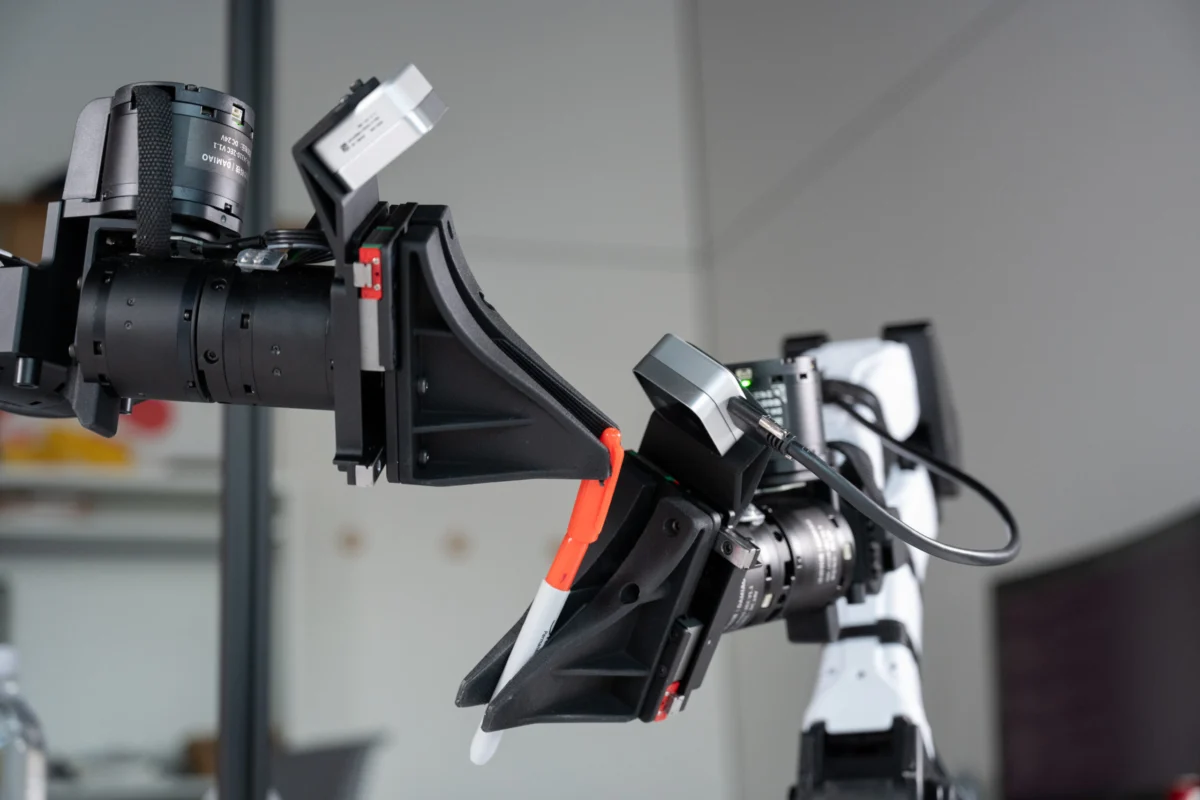
Less than three months after emerging from stealth, XDOF, a pioneering startup dedicated to collecting real-world teleoperation data for training general-purpose robots, is reportedly in advanced discussions to secure a Series B funding round at an estimated valuation of $1.2 billion. The significant investment is anticipated to be spearheaded by prominent venture capital firm 8VC, according to multiple sources with intimate knowledge of the ongoing negotiations. This rapid ascent to unicorn status underscores the intense investor interest in foundational infrastructure for the burgeoning field of advanced robotics and artificial intelligence.
A Rapid Ascent in the AI Landscape
Founded in 2024 by UC Berkeley researchers Philipp Wu (CEO) and Fred Shentu (CTO), XDOF has quickly established itself as a critical player in addressing one of the most significant bottlenecks facing the robotics industry: the scarcity of high-quality, large-scale training data. The company’s trajectory has been remarkably swift. Earlier this year, in June, TechCrunch reported on XDOF’s successful $70 million Series A round, which saw participation from leading investment firms including Thrive Capital, Andreessen Horowitz, Lux, and Spark Capital. At that time, the company had not anticipated seeking further capital so soon. However, XDOF’s explosive growth, characterized by annualized revenue reportedly approaching $50 million, compelled venture capitalists to proactively approach the startup for a new funding round.
Details regarding the total capital being raised in this Series B round and whether the stated valuation incorporates the new funding remain undisclosed. Furthermore, the terms of the deal are still in flux and could undergo revisions before finalization. Both XDOF and 8VC declined to comment on the ongoing discussions when contacted for this report, adhering to the typical protocol for unfinalized financial transactions.
Addressing the Data Chasm in Robotics
XDOF’s core mission is to construct the essential data pipelines, sophisticated collection tools, and robust annotation systems that frontier AI laboratories and advanced robotics companies often struggle to develop internally. In essence, XDOF functions as an outsourced, specialized data-supply chain, critical for the progression of the robotics industry. This strategic positioning has drawn comparisons to data-labeling titans like Scale AI and Mercor, which played instrumental roles in fueling the broader AI boom by providing the necessary data infrastructure for large language models (LLMs) and other AI applications.
The challenge XDOF addresses is fundamental. While LLMs benefited immensely from vast, readily available datasets harvested from the entirety of the internet, physical robots lack an equivalent real-world dataset to draw upon. The complexity of physical interaction, the diversity of environments, and the nuances of human-robot collaboration demand entirely new paradigms for data acquisition and processing. This data gap has long been identified as a critical impediment to the development of truly general-purpose machines capable of operating autonomously in unstructured, dynamic environments.
Philipp Wu’s journey to co-founding XDOF began during his PhD studies at UC Berkeley, where his research focused on how robots learn from extensive datasets. A primary obstacle he encountered was precisely this "lack of large-scale data to work with," as he articulated to TechCrunch in a previous interview. This academic insight spurred his collaboration with Fred Shentu, leading to the development of Project GELLO. GELLO was conceived as a low-cost teleoperation system, enabling a human operator to remotely control a robotic arm to generate valuable training data. Their groundbreaking work culminated in an influential paper within the robotics community, laying the intellectual groundwork for what would become XDOF.
Innovative Data Collection and the ABC Dataset
XDOF’s methodology for capturing this crucial data is multifaceted and innovative. It integrates sophisticated remote robot teleoperation with direct human involvement. This includes human collectors who wear an array of sensors to meticulously record everyday tasks, such as folding laundry, flattening cardboard boxes, or interacting with various objects in diverse settings. This dual approach ensures both the robotic perspective and the human intention and action are captured comprehensively.
The startup has ambitious plans for global expansion of its data collection efforts. This involves recruiting and rigorously training specialized teams worldwide. These teams will comprise teleoperators, who skillfully steer robots remotely to perform tasks and gather data, and egocentric operators, who wear body sensors to capture movement data from a first-person perspective. This egocentric data is particularly valuable for training robots to understand human actions and intentions, crucial for collaborative robotics and human-robot interaction.
A significant milestone for XDOF is its partnership with UC Berkeley’s AI Research lab to release what is anticipated to be the largest collection of high-quality robot training data ever assembled. Dubbed "ABC" (A Big Collection of Robot Data, or similar, though the full name isn’t specified), this dataset aims to become a foundational resource for the global robotics research community and industry. The meticulous curation and annotation of ABC are expected to set new standards for quality, diversity, and scale, directly addressing the data bottleneck that has plagued the field. This commitment to open-sourcing or making widely available such a critical dataset could significantly accelerate advancements across the entire robotics ecosystem.
The Broader Market Context and Competitive Landscape
The analogy of XDOF as the "Scale AI or Mercor for physical robotics" is highly pertinent. Scale AI, for instance, has achieved a multi-billion-dollar valuation by providing data labeling and annotation services that underpinned the development of numerous AI applications, from autonomous vehicles to natural language processing. XDOF aims to replicate this success by offering similar foundational services, but tailored specifically to the unique demands of physical robots interacting with the real world. This requires not just labeling images or text, but understanding complex sensor streams, motor commands, environmental physics, and the intricacies of manipulation and locomotion.
The burgeoning robotics data economy is attracting increasing attention and investment. The global robotics market, projected to exceed $200 billion by the end of the decade, is critically dependent on advancements in AI, which in turn relies on robust data. The demand for specialized AI training data is skyrocketing across various industries, including logistics, manufacturing, healthcare, and even consumer robotics. XDOF’s early traction, including its reported engagement with 20 customers—several of which are frontier AI labs—demonstrates the immediate and pressing need for its services.
While XDOF has established an early lead, it operates within an increasingly competitive landscape. Other startups, such as Mecka AI, are also attempting to collect real-world data specifically for robot training. Furthermore, established human-data platforms like Scale AI and Micro1, which traditionally focused on data for LLMs and other software-based AI, are beginning to expand their offerings to encompass the specialized requirements of physical robotics. This growing competition underscores the market’s immense potential but also highlights the need for continuous innovation and differentiation. XDOF’s deep academic roots from UC Berkeley, coupled with its rapid execution and specialized focus on physical teleoperation data, could provide a significant competitive advantage.
Implications of the Landmark Funding
The impending Series B funding round, particularly at such a substantial valuation, carries profound implications for XDOF, the broader robotics industry, and the investment community.
For XDOF: The infusion of capital will undoubtedly accelerate the company’s ambitious growth plans. This includes significantly expanding its global network of data collectors, investing further in advanced research and development for its data tooling and annotation platforms, and potentially exploring new service offerings or even vertical integration opportunities. The capital will also enable XDOF to scale its infrastructure to meet the surging demand from its rapidly growing customer base, solidifying its position as a market leader.
For the Robotics Industry: XDOF’s success validates the critical importance of solving the data bottleneck for general-purpose robotics. By providing readily accessible, high-quality training data, XDOF could significantly lower the barriers to entry for robotics companies and accelerate the development cycles for new robotic applications. This could pave the way for a new generation of intelligent robots capable of performing complex tasks in diverse environments, from automated warehouses and factories to elder care and domestic assistance. The availability of datasets like ABC could become as transformative for robotics as ImageNet was for computer vision or massive text corpora for natural language processing.
For Investors: 8VC’s leadership in this round signals a clear investment thesis: betting on foundational infrastructure for the next wave of AI innovation. The rapid appreciation of XDOF’s valuation—from a $70 million Series A to a potential $1.2 billion Series B in less than three months—underscores the intense investor appetite for companies that solve critical, high-value problems in emerging technological sectors. It also reflects a broader trend of venture capitalists increasingly backing firms that provide the essential building blocks for advanced AI, recognizing that data is the ultimate fuel for these intelligent systems.
Broader AI Impact: The successful maturation of the robotics data ecosystem, spearheaded by companies like XDOF, could unlock unprecedented capabilities in AI. Just as foundation models have revolutionized language understanding, similar large-scale, diverse datasets could enable the creation of "foundation models for robotics." These models, pre-trained on vast amounts of real-world interaction data, could then be fine-tuned for a multitude of specific tasks, dramatically reducing the time and cost associated with developing new robotic applications. This paradigm shift could accelerate the deployment of intelligent robots across nearly every sector of the global economy, driving productivity gains and transforming industries.
While XDOF and 8VC have maintained silence on the specifics of the deal, sources close to 8VC’s investment strategy, speaking on background given the unfinalized nature of the discussions, indicated that the firm views XDOF as a critical enabler for the burgeoning general-purpose robotics market. This perspective aligns with a broader industry sentiment that data infrastructure companies are pivotal for propelling the next frontier of AI, much like they did for the early AI boom. Industry analysts further suggest that XDOF’s rapid valuation increase underscores a growing recognition among venture capitalists that data, particularly for physical interaction, remains the "new oil" for advanced robotics, demanding specialized collection and processing capabilities.
The trajectory of XDOF, from a university research project to a potential unicorn in mere months, serves as a compelling narrative of innovation meeting market demand. As the world races towards a future populated by increasingly intelligent and versatile robots, XDOF’s role in supplying the vital data to train these machines positions it at the very heart of this technological revolution. The finalization of its Series B round will not only mark a significant financial milestone but also represent a critical validation of the company’s vision and its indispensable contribution to shaping the future of robotics.
