

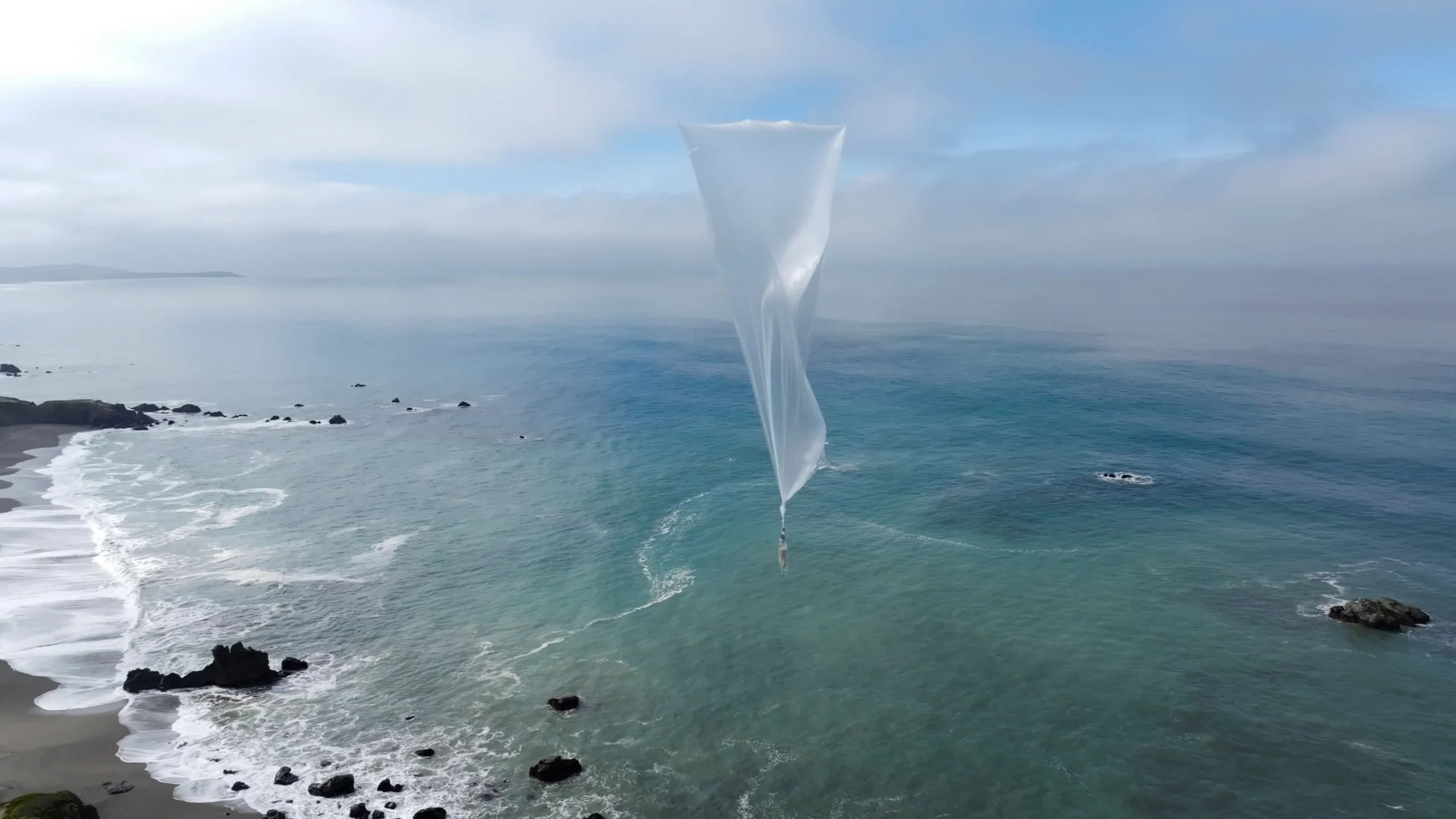
The United States Air Force has inked a significant deal with WindBorne Systems, a Redwood City, California-based startup, to acquire data from its expansive fleet of autonomous weather balloons. This groundbreaking contract, potentially worth up to $49 million, marks a pivotal moment in the integration of advanced artificial intelligence and empirical data collection into critical military and meteorological operations, promising to redefine global weather forecasting capabilities. The agreement underscores the increasing reliance of governmental agencies on agile private sector innovation to address complex environmental intelligence needs.
WindBorne Systems, established in 2015, has rapidly emerged as a frontrunner in a burgeoning field, distinguishing itself by directly feeding real-time atmospheric sensor readings into sophisticated deep-learning weather models. With approximately 700 weather balloons currently navigating the Earth’s atmosphere, the company maintains a dynamic, global constellation capable of providing unparalleled data granularity. This unique approach contrasts sharply with traditional meteorological methods, positioning WindBorne at the forefront of a technological paradigm shift in how weather is predicted and understood.
A Strategic Partnership for Enhanced Global Operations
The contract, which allows the Air Force to procure data on an as-needed basis for specific regions and times, has already seen initial orders totaling $1.7 million. This flexible procurement model highlights the Air Force’s strategic interest in obtaining highly targeted and dynamic weather intelligence, crucial for a wide array of missions ranging from flight planning and reconnaissance to disaster response and tactical operations across diverse global environments. Military operations, by their very nature, are profoundly impacted by weather conditions, making accurate and timely forecasts a non-negotiable requirement for operational success and personnel safety.
Andrey Sushko, co-founder and CTO of WindBorne, emphasized the multifaceted impact of the contract. "This is largely a vehicle through which continued growth of the constellation can be supported, as well as some work on research and development to continue to improve the hardware and performance of the balloons," Sushko explained. He also noted the non-competitive nature of the award, stating, "It’s a determination by the government that for this capability of collecting global data, we were the only company able to provide it in the way that met their needs for these operations." This assertion underscores WindBorne’s unique position in offering a scalable, autonomous, and globally distributed data collection system tailored for high-stakes governmental requirements.
The Dawn of AI-Driven Meteorology
The collaboration between WindBorne and the U.S. Air Force is emblematic of a broader revolution sweeping through the field of meteorology: the ascendancy of artificial intelligence. For decades, weather forecasting relied predominantly on Numerical Weather Prediction (NWP) models. These models, run on powerful supercomputers, simulate atmospheric behavior by solving complex equations derived from the laws of physics. While incredibly sophisticated, NWP models are computationally intensive, require vast amounts of processing power, and can be slow to produce forecasts, especially for localized, rapidly changing conditions.
The advent of deep learning, particularly transformer model architectures, coupled with the release of massive historical weather datasets by organizations like the European Centre for Medium-Range Weather Forecasts (ECMWF), has dramatically altered this landscape. AI-powered models can ingest decades of weather data, identifying intricate patterns and relationships that might elude traditional physics-based simulations. This enables them to issue predictions with unprecedented speed and, in many cases, superior accuracy. These "end-to-end learning" systems offer a compelling alternative to the prohibitively expensive and time-consuming supercomputer-driven simulations of the past.
WindBorne’s commitment to this paradigm is evident in its WeatherMesh 6 forecasting model, released earlier this summer. The company asserts that WeatherMesh 6 consistently outperforms the traditional models run by the ECMWF, widely regarded as one of the world’s leading meteorological centers. This claim, backed by internal benchmarks, highlights the disruptive potential of combining empirical, real-time data with advanced machine learning algorithms.
Chronology of Innovation: WindBorne’s Journey
Founded in 2015, WindBorne Systems set out to reimagine atmospheric data collection and weather prediction. Their journey has been marked by several key milestones:
- 2015: Establishment of WindBorne Systems, with a vision to leverage autonomous systems for superior weather intelligence.
- Early Development: Focus on refining autonomous balloon technology, sensor integration, and developing proprietary navigation algorithms.
- Ongoing Government Collaboration: Building relationships with key U.S. government agencies, including the National Weather Service, U.S. Air Force, and Navy, demonstrating the reliability and value of their data.
- Recent Funding: In August, WindBorne CEO John Dean announced a successful $37 million Series B funding round. This capital injection is crucial for scaling the company’s operations, expanding its balloon constellation, and accelerating research and development efforts.
- WeatherMesh 6 Release: Earlier this summer, the company unveiled the latest iteration of its AI weather forecasting model, WeatherMesh 6, showcasing significant improvements in predictive accuracy.
- Pioneering Typhoon Data Collection: In a remarkable demonstration of its capabilities in August, WindBorne became the first organization to successfully navigate an unpowered flight system – one of its autonomous weather balloons – directly into the eye of a typhoon. This mission, targeting Typhoon Dolphin, provided invaluable empirical data from a notoriously dangerous and difficult-to-access atmospheric phenomenon.
- Major Air Force Contract: The recent award of a contract potentially worth up to $49 million solidifies WindBorne’s position as a critical provider of advanced weather data to the U.S. government.
The typhoon mission, in particular, illustrates WindBorne’s technological prowess. Its balloons, devoid of engines, are maneuvered by adjusting their altitude, bleeding air, or dropping ballast (sand) to catch specific wind currents. "That’s a pretty novel step, and the two ingredients for that are one, having good wind and weather models, and knowing how to navigate them; and two, having a large enough constellation that you have balloons in the right places," Sushko elaborated. He added, "It’s one of the first times that a deep-learning model was used for actual operational decisions," highlighting the real-world application of their AI not just for forecasting, but for real-time autonomous navigation.
Broader Implications and the Future of Weather Intelligence
The partnership between the U.S. Air Force and WindBorne Systems carries profound implications across several sectors:
1. Military and National Security: For the Air Force, enhanced weather data translates directly into a significant strategic advantage. Precision forecasting improves flight safety, optimizes mission planning for reconnaissance and combat operations, and ensures more effective deployment of assets during humanitarian aid and disaster relief missions. Accurate, real-time atmospheric intelligence can be the deciding factor in operational success, particularly in complex or contested environments where traditional data sources might be limited or unreliable. The ability to place orders for data in specific regions at specific times provides an unparalleled level of operational flexibility and responsiveness.
2. Commercial Weather Industry: WindBorne’s success signals a potential disruption within the broader commercial weather industry. Traditional providers may face increasing pressure to integrate AI and real-time empirical data collection to remain competitive. The contract also validates the business model of private companies leveraging innovative technologies to address gaps in governmental capabilities. This could spur further investment and innovation in related fields, from atmospheric sensors to autonomous aerial platforms.
3. Advancements in AI and Scientific Modeling: The application of deep learning to weather prediction is a testament to AI’s growing utility in complex scientific domains. As models like WeatherMesh 6 continue to demonstrate superior accuracy, they push the boundaries of what’s possible in environmental modeling. This success could inspire similar AI-driven approaches in other scientific disciplines, from oceanography to climate science, accelerating discovery and improving predictive capabilities across the board. Google DeepMind’s recent weather models, which offer improved cyclone forecasting tools, are another example of this trend, becoming increasingly central to how the U.S. government prepares for and responds to hurricane seasons. This ongoing competition and collaboration between various AI developers, both public and private, suggest a dynamic and rapidly evolving field.
4. Environmental Monitoring and Climate Research: While the primary focus of this contract is operational weather forecasting, the data collected by WindBorne’s global constellation also holds immense potential for environmental monitoring and climate research. A continuous, high-resolution stream of atmospheric data can contribute to a deeper understanding of climate patterns, atmospheric chemistry, and the impacts of climate change, offering invaluable insights for scientists and policymakers.
The non-competitive award to WindBorne underscores a critical reality: for highly specialized capabilities that directly address national security needs, the government is willing to fast-track procurement from sole providers. This approach prioritizes immediate access to cutting-edge technology over a lengthy competitive bidding process when the technology is deemed uniquely capable of meeting urgent strategic requirements.
As WindBorne continues to scale its operations, supported by recent funding and this landmark Air Force contract, its fleet of autonomous weather balloons is poised to become an indispensable asset in the global effort to predict and understand the Earth’s atmosphere. The fusion of ubiquitous data collection with advanced artificial intelligence is not just improving weather forecasts; it is fundamentally transforming how humanity interacts with, prepares for, and responds to the forces of nature. The skies, once an enigma, are slowly yielding their secrets to the relentless innovation of companies like WindBorne Systems.
