

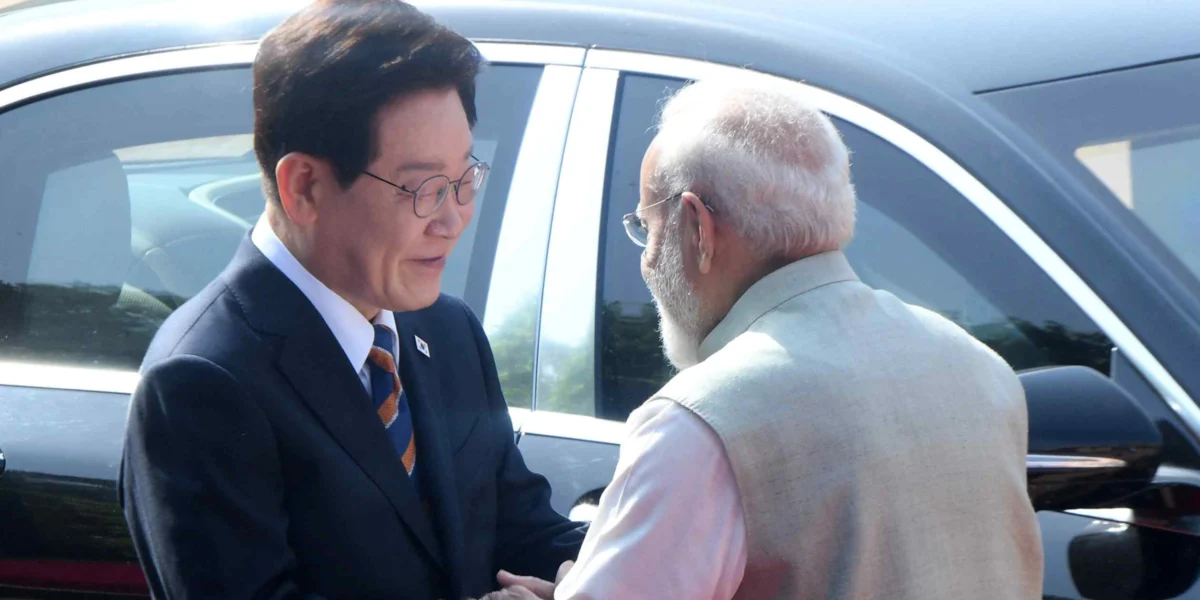
NEW DELHI – South Korean President Lee Jae Myung concluded a significant state visit to India on April 20, 2026, engaging in comprehensive discussions with Indian Prime Minister Narendra Modi that underscored a shared commitment to elevating bilateral cooperation across a spectrum of strategic sectors, with a pronounced emphasis on artificial intelligence, semiconductors, and information technology. This maiden visit by President Lee since assuming office marks a pivotal moment in the burgeoning India-South Korea strategic partnership, signaling a deliberate effort to leverage synergistic strengths for mutual economic and technological advancement.
The high-level summit, held against the backdrop of a rapidly evolving global geopolitical and economic landscape, saw leaders from both Asian powerhouses delve into a wide array of issues, from defense and security to clean energy and the burgeoning cultural exchange that has woven a unique tapestry of connection between their peoples. Prime Minister Modi, in his welcoming remarks, eloquently articulated the deep-seated affinity Indians hold for South Korean popular culture, affectionately known as K-pop and K-dramas, a sentiment that resonated with President Lee’s acknowledged appreciation for Indian cinema. This shared cultural appreciation, though seemingly informal, serves as a powerful undercurrent, fostering goodwill and a more receptive environment for deeper diplomatic and economic engagement.
Strategic Dialogue on Technological Advancement
At the core of the discussions was the imperative to bolster collaboration in advanced technology sectors. India, with its vast pool of skilled IT professionals and a rapidly growing digital economy, presents a fertile ground for South Korean technological prowess. Conversely, South Korea, a global leader in semiconductor manufacturing and innovation, offers cutting-edge solutions and manufacturing capabilities that India is keen to integrate into its own industrial ambitions.
The leaders reportedly explored mechanisms to enhance joint research and development initiatives in artificial intelligence, with a view to leveraging AI for societal benefit and economic growth in both nations. This includes exploring collaborative projects in areas such as smart cities, healthcare diagnostics, and agricultural productivity. Discussions also focused on strengthening the semiconductor supply chain, a critical area of global concern following recent disruptions. India’s ambition to become a significant player in the global semiconductor manufacturing ecosystem, as outlined in its national policies, found a receptive partner in South Korea, which possesses decades of experience and established leadership in this domain. Potential avenues for investment, technology transfer, and joint ventures were reportedly on the agenda, aiming to create a more resilient and diversified global semiconductor landscape.
Furthermore, the information technology sector, a traditional bedrock of Indo-Korean cooperation, was a key focus. Both nations recognized the potential to deepen partnerships in areas such as software development, cybersecurity, and digital infrastructure. The aim is to foster an environment conducive to innovation, attract greater investment, and create high-skilled employment opportunities in both countries.
Background and Chronology of Engagements
President Lee Jae Myung’s visit, spanning several days, was meticulously planned to maximize engagement with India’s leadership and key stakeholders. The initial arrival on April 20th was marked by a formal welcome ceremony outside the presidential palace in New Delhi, where Prime Minister Modi personally greeted the South Korean President. This personal touch underscored the importance India places on this high-level interaction.
Following the ceremonial reception, the two leaders commenced their substantive bilateral talks. These discussions were not confined to a single session but were structured to allow for in-depth exploration of various bilateral issues. Over the subsequent days, the itinerary likely included meetings with other senior Indian ministers, including those responsible for finance, commerce and industry, electronics and information technology, and external affairs. Such engagements are crucial for translating high-level political will into concrete policy initiatives and actionable economic partnerships.
The visit’s timing is also significant. It comes at a juncture when both India and South Korea are navigating complex global economic headwinds and seeking to diversify their international partnerships. For India, the visit reinforces its "Act East" policy and its broader strategy of forging robust ties with key Asian nations. For South Korea, it represents a strategic recalibration, seeking to deepen economic and technological alliances beyond its traditional partners.
Supporting Data and Economic Interdependence
The economic relationship between India and South Korea has witnessed a steady upward trajectory. As of recent data, bilateral trade has consistently grown, exceeding significant milestones. South Korea is a major investor in India, with its companies actively participating in sectors ranging from automotive and electronics to steel and chemicals. Major South Korean conglomerates like Samsung, Hyundai, and LG have established substantial manufacturing and operational footprints in India, contributing significantly to job creation and economic development.
India, in turn, sees South Korea as a vital partner in its ambition to become a global manufacturing hub. The "Make in India" initiative and the Production Linked Incentive (PLI) schemes are designed to attract foreign direct investment and foster domestic manufacturing capabilities, areas where South Korean expertise and capital can play a crucial role. For instance, in the electronics sector, South Korean companies have been instrumental in setting up advanced manufacturing facilities, aligning with India’s strategic goal of reducing reliance on imports and building domestic capacity.
The semiconductor sector, in particular, presents a compelling case for enhanced collaboration. The global semiconductor market is projected to reach over $600 billion by 2027, driven by increasing demand from various industries. India’s nascent but ambitious plans to enter this complex and capital-intensive market require significant technological know-how, access to advanced equipment, and substantial investment. South Korea’s leadership in memory chip manufacturing and its advanced foundry capabilities offer a potent combination that could accelerate India’s semiconductor ambitions. Joint ventures in wafer fabrication, assembly, testing, and design services could be mutually beneficial, creating new supply chains and fostering innovation.
Official Statements and Reactions
While the official joint statement following the summit would provide a detailed account of agreements reached, the initial remarks from Prime Minister Modi offered a glimpse into the spirit of the discussions. His acknowledgment of Indians’ affinity for K-pop and K-dramas, and the reciprocal pleasure in President Lee being a fan of Indian cinema, highlights the cultural bridge that facilitates deeper engagement. Such cultural diplomacy often paves the way for more robust economic and strategic partnerships by fostering mutual understanding and goodwill.
Inferred from the tenor of such high-level visits, one can anticipate that President Lee Jae Myung would have expressed South Korea’s strong interest in expanding its economic footprint in India, particularly in sectors aligned with India’s growth agenda. He would likely have reiterated South Korea’s commitment to being a reliable partner in India’s development journey, emphasizing the mutual benefits of shared technological advancement and enhanced trade relations.
Reactions from industry bodies in both countries are also anticipated to be positive. Indian industry chambers, such as FICCI and CII, would likely welcome the renewed focus on technology and investment, seeing it as an opportunity to attract further South Korean investment and facilitate technology transfer. Similarly, South Korean business associations would likely express optimism about the potential for increased market access and collaborative opportunities in India’s dynamic economy.
Broader Impact and Implications
The successful conclusion of President Lee Jae Myung’s visit carries significant implications for both nations and the broader regional landscape.
Economic Implications: The enhanced cooperation in AI, semiconductors, and IT is poised to drive substantial economic growth in both countries. For India, it offers a pathway to accelerate its digital transformation, enhance its manufacturing capabilities, and integrate more effectively into global technology value chains. For South Korea, it provides access to a large and rapidly growing market, diversifies its investment portfolio, and strengthens its position in critical global supply chains. The potential for joint ventures and technology transfer in the semiconductor industry, in particular, could be transformative for India’s industrial ambitions.
Geopolitical Implications: In a world increasingly characterized by geopolitical uncertainties and evolving alliances, the deepening of the India-South Korea partnership signifies a strategic alignment. Both nations share a commitment to a free, open, and inclusive Indo-Pacific region and are seeking to strengthen their strategic autonomy. Enhanced cooperation in defense and security, though not explicitly detailed in the initial report, is often a component of such high-level dialogues, potentially including joint exercises, technology sharing, and maritime security cooperation.
Cultural and Societal Implications: The acknowledgment of shared cultural appreciation is more than a diplomatic nicety. It reflects a growing people-to-people connection that can foster long-term goodwill and understanding. As more Indians embrace Korean culture and vice versa, it creates a fertile ground for further collaboration in creative industries, tourism, and educational exchanges, further solidifying the multifaceted nature of the bilateral relationship.
President Lee Jae Myung’s visit to India, therefore, represents not merely a diplomatic engagement but a strategic investment in the future, aiming to build a more robust, technologically advanced, and culturally connected partnership between two dynamic Asian economies. The concrete outcomes of this visit, as they unfold in the coming months and years, will be closely watched for their impact on regional and global economic and geopolitical dynamics.
