

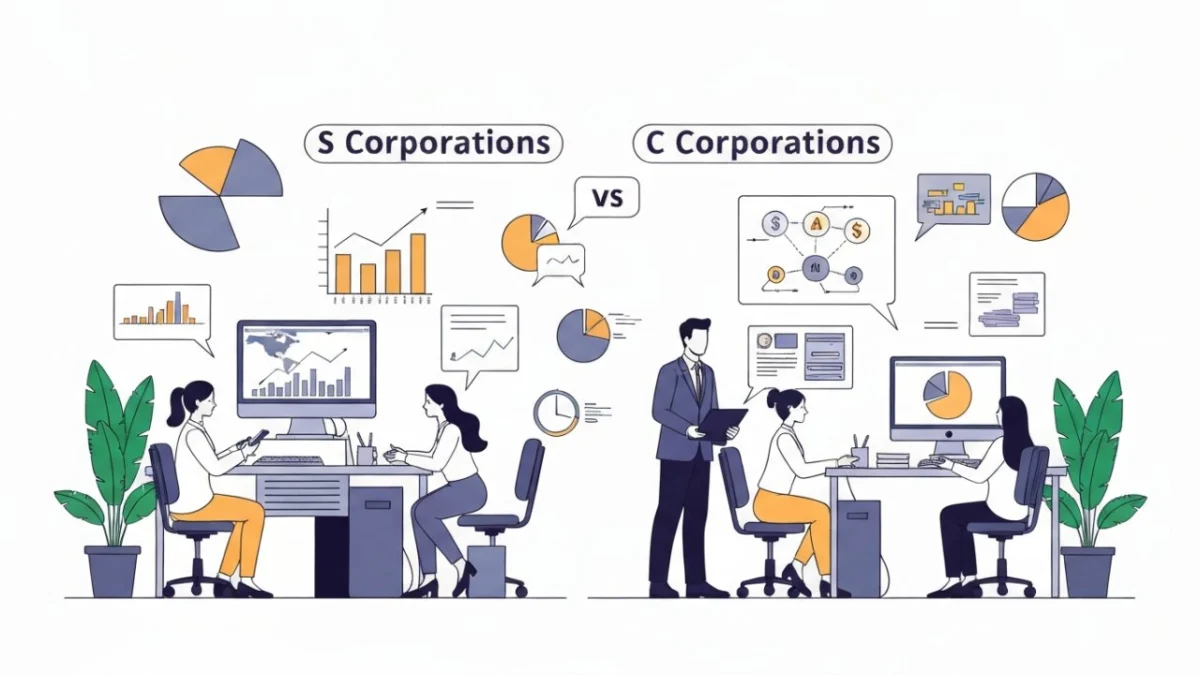
The S-Corporation, commonly referred to as an S-Corp, represents a specialized tax designation granted by the Internal Revenue Service (IRS) that allows businesses to pass corporate income, losses, deductions, and credits through to their shareholders for federal tax purposes. By electing this status under Subchapter S of the Internal Revenue Code, a business avoids the "double taxation" typically associated with standard C-Corporations, where profits are taxed at both the corporate level and again when distributed as dividends to shareholders. Instead, S-Corp shareholders report the pass-through of profits and losses on their individual income tax returns, where they are assessed at their ordinary income tax rates. This structure has become the most prevalent corporate form in the United States, providing a blend of the legal protections found in corporations and the tax flexibility of partnerships.

Historical Context and the Evolution of Subchapter S
The S-Corporation structure was established by Congress in 1958 to encourage the growth of small businesses. At the time, legislators recognized that many small enterprises were hesitant to incorporate due to the tax disadvantages of the C-Corporation model, yet they needed the limited liability protection that a corporate structure provided. By creating Subchapter S, the federal government allowed small and family-owned businesses to enjoy a "best of both worlds" scenario.
Over the decades, the popularity of the S-Corp has surged. According to IRS data, the number of S-Corporation returns has grown significantly since the mid-1980s, following the Tax Reform Act of 1986, which lowered individual tax rates relative to corporate rates. Today, S-Corps represent approximately 70% of all corporate filings in the U.S., serving as a cornerstone of the American small business economy. Financial analysts note that the structure remains a preferred choice for service-based industries, consulting firms, and specialized trade contractors.

The Chronology of Establishing an S-Corporation
Transitioning to or starting an S-Corporation involves a specific legal and administrative timeline that must be strictly followed to ensure compliance with federal law.
- Entity Formation: The process begins with the legal formation of a business entity at the state level. This typically involves filing Articles of Incorporation for a corporation or Articles of Organization for a Limited Liability Company (LLC).
- Obtaining an EIN: Once the state recognizes the entity, the business must apply for an Employer Identification Number (EIN) from the IRS, which serves as the business’s social security number for tax purposes.
- The Election Window: To be taxed as an S-Corp, the entity must file IRS Form 2553, "Election by a Small Business Corporation." This form must be signed by all shareholders.
- Critical Deadlines: For the S-Corp election to be effective for the current tax year, Form 2553 must be filed no later than two months and 15 days after the beginning of the tax year the election is to take effect, or at any time during the preceding tax year. Failure to meet this 75-day window often results in the business being taxed as a C-Corp or a partnership for that year, unless the IRS grants late-election relief.
- Ongoing Annual Compliance: Once established, the S-Corp must file Form 1120-S annually by March 15th (for calendar-year businesses). Each shareholder is then issued a Schedule K-1, detailing their specific share of the income or loss to be reported on their personal 1040 returns.
Core Requirements and Eligibility Constraints
The IRS maintains stringent requirements for businesses seeking S-Corp status. These limitations are designed to ensure the structure is utilized by small, domestic enterprises rather than large, multinational conglomerates.

- Shareholder Limits: An S-Corp cannot have more than 100 shareholders. However, certain family members can be treated as a single shareholder for the purpose of this limit.
- Shareholder Identity: All shareholders must be individuals, certain trusts, or estates. They must also be U.S. citizens or resident aliens. Partnerships, corporations, and non-resident alien shareholders are strictly prohibited from owning shares in an S-Corp.
- Domestic Status: The entity must be a domestic corporation or a domestic entity eligible to elect to be treated as a corporation.
- Single Class of Stock: An S-Corp is permitted only one class of stock. While there can be differences in voting rights among shares, all shares must carry identical rights to distribution and liquidation proceeds. This prevents complex equity structures that could be used to shift income in ways the IRS deems improper.
Tax Mechanics and the "Reasonable Compensation" Mandate
The primary financial draw of the S-Corp is the potential for significant savings on self-employment taxes (Social Security and Medicare). In a sole proprietorship or a standard LLC, the owner generally pays self-employment tax on the entire net income of the business. In an S-Corp, however, only the income paid as a salary to the owner-employee is subject to FICA (Federal Insurance Contributions Act) taxes. The remaining profit, distributed as a "dividend" or draw, is subject to income tax but not self-employment tax.
To prevent business owners from paying themselves a zero-dollar salary to avoid taxes entirely, the IRS requires that shareholder-employees receive "reasonable compensation."

The 60/40 Rule and Industry Benchmarks
While the IRS does not provide a hard-coded mathematical formula for "reasonable compensation," tax professionals often point to the "60/40 Rule" as a starting point for discussions. This guideline suggests allocating 60% of business income to salary and 40% to distributions. However, the IRS emphasizes that compensation must be based on what a similar business would pay for similar services. Factors include the individual’s experience, the complexity of the job, and the geographical cost of labor.
Data from recent tax court cases suggests that the IRS has increased scrutiny on S-Corps with high distributions and low salaries. Experts warn that if a salary is deemed unreasonably low, the IRS can reclassify distributions as wages, resulting in back taxes, interest, and substantial penalties.

Comparative Analysis: S-Corp vs. LLC and C-Corp
Choosing between an S-Corp and other structures requires a nuanced understanding of long-term goals and operational costs.
- S-Corp vs. LLC: While an LLC offers more flexibility—such as allowing an unlimited number of members and foreign ownership—it lacks the ability to split income between salary and distributions to save on self-employment taxes unless it specifically elects S-Corp tax status. LLCs are generally easier to maintain as they require fewer corporate formalities like annual meetings and formal minutes.
- S-Corp vs. C-Corp: C-Corps are preferred for businesses planning to "go public" or seek venture capital, as they can have multiple classes of stock and unlimited shareholders. However, C-Corps face double taxation. The current federal corporate tax rate is a flat 21%, but when combined with personal dividend taxes, the effective rate often exceeds the individual rate paid by S-Corp shareholders.
The Qualified Business Income (QBI) Deduction
A significant boost to the S-Corp structure arrived with the Tax Cuts and Jobs Act (TCJA) of 2017. Under Section 199A, many S-Corp shareholders are eligible for a Qualified Business Income (QBI) deduction, which allows them to deduct up to 20% of their pass-through business income from their federal income taxes.

This deduction is subject to various income thresholds and "Specified Service Trade or Business" (SSTB) restrictions, which apply to doctors, lawyers, accountants, and consultants. As the TCJA provisions are currently set to expire at the end of 2025, many tax policy experts are monitoring legislative developments to see if this deduction will be extended, as its removal would significantly alter the tax-saving calculus for millions of S-Corp owners.
Strategic Implications and Broader Impact
The S-Corporation remains a vital instrument for American entrepreneurship, but it is not without its burdens. The requirement for rigorous record-keeping, payroll processing, and strict adherence to shareholder rules means that the administrative costs of an S-Corp are typically higher than those of a sole proprietorship.

Financial analysts argue that the "break-even point" for an S-Corp election usually occurs when a business generates enough profit to pay the owner a fair market salary while still having at least $20,000 to $30,000 in remaining profit to distribute. Below this threshold, the costs of payroll taxes, accounting fees, and corporate filings may outweigh the tax benefits.
From a broader economic perspective, the S-Corp structure supports local economies by allowing small business owners to reinvest tax savings back into their operations, equipment, and workforce. However, as the IRS seeks to close the "tax gap," S-Corps are likely to remain a focal point for audits, particularly regarding the classification of income.

Conclusion
The S-Corporation serves as a sophisticated middle ground in the American business landscape, offering the legal robustness of a corporation with the fiscal efficiency of a pass-through entity. While the potential for tax savings is substantial, particularly through the strategic management of distributions and the QBI deduction, the structure demands a high level of regulatory discipline. Business owners must navigate complex IRS eligibility rules, maintain "reasonable" salary standards, and adhere to strict filing deadlines. As the tax landscape evolves toward 2025, the S-Corp will undoubtedly remain a central topic for entrepreneurs seeking to balance liability protection with optimized financial performance. Professional consultation with tax attorneys or Certified Public Accountants (CPAs) remains essential for any business owner considering this path, ensuring that the election aligns with both current profitability and long-term growth objectives.
