

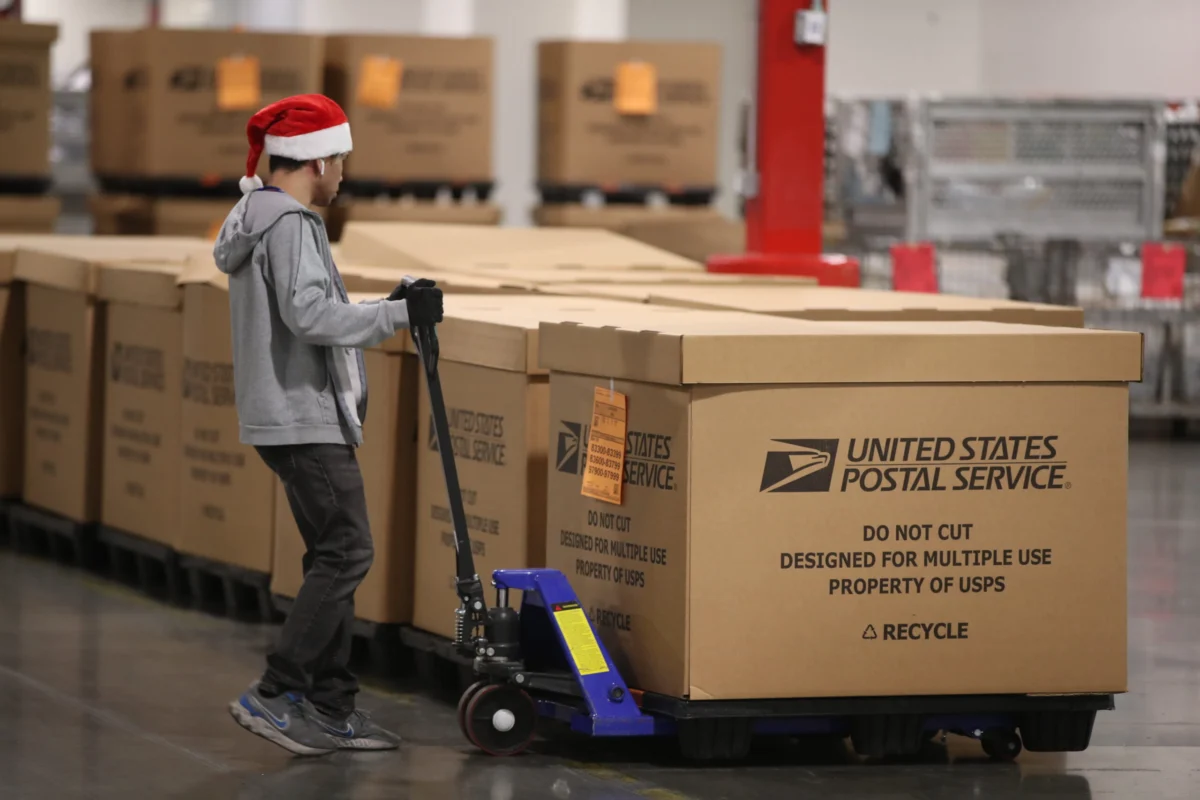
The festive bustle of the holiday season, traditionally a period of peak sales and robust growth for retailers, is overshadowed this year by an unrelenting surge in shipping costs, presenting an existential challenge for small- and medium-sized enterprises (SMEs) across the United States. While consumer demand remains surprisingly resilient, the rising expenses associated with package delivery are rapidly eroding profit margins, forcing many independent businesses to rethink long-standing practices and even question their long-term sustainability.
For Jenni Shields, owner of Evie Pearl Handmade, an eight-year-old Kansas City, Kansas-based business specializing in handcrafted hair accessories like bows and quilted headbands, the dramatic escalation in shipping expenses has been particularly acute. Just eight years ago, Shields paid approximately $2.93 to ship a single order. Adjusted for inflation, that figure would be close to $4 in today’s dollars. By last year, her average shipping label hovered around $4.50. However, a recent visit to her local U.S. Postal Service (USPS) office revealed a staggering increase, with the average cost per package now nearing $6. This represents an increase of over 33% in just one year, and nearly double the inflation-adjusted cost from her business’s inception.
Shields typically charges her customers a flat $6 shipping fee, a price point carefully calculated to cover the actual postage and an additional $1.50 for packaging supplies. With current average shipping costs now approaching or exceeding this threshold, she finds herself not merely breaking even, but actively losing money on each shipment. "I am losing money at this point, and I’ve really taken a huge hit this year," Shields articulated, her frustration palpable. "I feel like it’s just been this slow increase up [in shipping costs], and I feel horrible." This predicament is echoed by countless small business owners who lack the economies of scale and contractual leverage enjoyed by larger corporations, making them disproportionately vulnerable to market fluctuations.
The Economic Tide Turning Against Small Retailers
The current crisis stems from a confluence of factors, primarily the sustained upward trend in global fuel prices, persistent inflationary pressures across the supply chain, and an evolving consumer expectation for rapid, often free, shipping. Geopolitical tensions, particularly those impacting key oil-producing regions, have played a significant role in recent months. While the original article alluded to specific events, it’s more broadly understood that heightened tensions in the Middle East, coupled with the ongoing war in Ukraine and strategic decisions by OPEC+ regarding oil production quotas, have kept crude oil benchmarks elevated.
For instance, the price of Brent crude, a global benchmark, has seen significant volatility, often spiking in response to perceived supply risks. While individual daily fluctuations can be dramatic, the underlying trend since early 2022 has been one of elevated pricing compared to pre-pandemic levels. This directly translates to higher operational costs for every mode of transportation—sea, air, rail, and road—which carriers then pass on to their customers through increased rates and surcharges.
This widespread impact is evident across the logistics sector. Even giants like Amazon, with their sophisticated logistics networks and substantial bargaining power, reported an 11% increase in shipping expenses in the third quarter compared to the previous year. This translates to billions of dollars in added costs, illustrating the sheer magnitude of the challenge. For smaller businesses, whose profit margins are often razor-thin, such increases can be catastrophic.
A Deep Dive into the Drivers of Shipping Inflation
The global freight market offers a stark illustration of these rising costs. According to Freightos, a transportation marketplace, air cargo rates globally reached approximately $3.37 per kilogram, marking a substantial 43% increase from the same period a year ago. Judah Levine, Freightos’ head of research, noted that beyond fuel price hikes, the surging demand for expedited shipping of high-value hardware components crucial for data center construction is also contributing to the elevated air freight rates, even before the typical pre-holiday rush of consumer packages. This indicates a broader systemic pressure on global logistics infrastructure, not just a seasonal anomaly.
The impact of these rising costs is multifold:
- Fuel Surcharges: Major carriers like UPS, FedEx, and USPS all implement fuel surcharges, which are dynamic and adjust with market prices. These surcharges are layered on top of base shipping rates, significantly inflating the final cost.
- Inflationary Pressures: Beyond fuel, the cost of labor, packaging materials, and vehicle maintenance has also climbed due to broader inflation. The Consumer Price Index (CPI) has shown sustained elevated levels, translating into higher operational expenses for every component of the shipping process.
- Labor Shortages: While perhaps less prominent than fuel, ongoing labor shortages in the trucking and logistics industries have also contributed to upward pressure on wages and, consequently, shipping rates.
- Peak Season Surcharges: During the crucial holiday shopping period, carriers traditionally institute additional surcharges to manage the surge in volume. While these are customary, their magnitude has steadily increased over the past few years, adding another layer of expense for retailers during their busiest time.
Jason Seidl, managing director and transportation analyst at TD Cowen, succinctly summarized the immediate impact: this run-up in costs will "squeeze their margins in the near-term." He further elaborated on the competitive disparity, noting that "Larger companies tend not to be exposed to the spot market, and they’ll have what we call dedicated deals in place." These long-term contracts provide a degree of insulation from immediate price volatility, a luxury unavailable to most small businesses relying on standard retail rates.
The Erosion of "Free Shipping" and Shifting Consumer Expectations
For nearly a generation, "free shipping" has evolved from a promotional perk to a deeply ingrained consumer expectation, largely driven by the dominance of e-commerce behemoths like Amazon. This expectation now places smaller retailers in an unenviable position: absorb the escalating costs and risk profitability, or pass them on to customers and risk alienating a base accustomed to complimentary delivery.
Todd Shelton, founder of an eponymous 23-year-old New Jersey clothing company specializing in high-end men’s jeans, T-shirts, and button-up shirts, illustrates this dilemma. After years of absorbing rising expenses, including those for imported Japanese denim and Portuguese shirt fabric, his company recently began charging customers for return shipping – a significant departure from previous policy. The cost of return shipping is now deducted from customer refunds, a move he considered necessary to maintain profitability. Shelton admits he is also contemplating raising product prices or instituting shipping charges for outbound orders, highlighting the difficult choices businesses face.
Jenni Shields of Evie Pearl Handmade is similarly considering raising her shipping fees for the first time in six years, a decision fraught with anxiety given the potential impact on sales. She observes a direct correlation between shipping costs and customer hesitation. "I can’t compete with Amazon on the free shipping. I can’t do that. I can’t afford that," Shields stated, expressing a sentiment shared by countless micro-entrepreneurs. "I’m seeing so much of my percentage that’s supposed to come back to me and my family being put towards the shipping costs." The implication is clear: without intervention or a significant market shift, the competitive playing field becomes increasingly tilted against small businesses.
Holiday Season: A Double-Edged Sword
The National Retail Federation (NRF) projects a robust holiday shopping season, with retail sales expected to grow by 4.2% through the end of the year, reaching a total spending of $1.01 trillion. This follows last year’s holiday sales totaling $972 billion, which saw 3.1% growth. While these figures suggest strong consumer activity, a significant portion of this growth is attributed to inflation, meaning consumers are simply paying more for the same quantity of goods.
Aaron Cheris, the global retail practice head at Bain & Company, elaborated on this nuance: "Customers all expect to spend more this holiday, but part of why they expect to spend more is they expect things to cost more, not because they’d like to spend more or they were hoping to get more quantity of stuff." He anticipates that while non-discretionary categories like food will likely perform well, the amount of disposable income remaining for discretionary goods will be curtailed.
This scenario creates a precarious situation for small businesses, particularly those in the discretionary goods sector. They face strong demand but simultaneously battle record-high shipping costs, which Cheris asserts is "putting immense pressure on smaller retailers." He warns that many small businesses may find themselves in severe financial distress in the first quarter of next year, having struggled to navigate the holiday season without adequate profit margins.
Broader Implications and the Competitive Landscape
The current environment exacerbates the existing competitive disparities between large and small retailers. Large corporations benefit from several advantages:
- Contractual Agreements: They can negotiate long-term, favorable shipping rates with carriers due to their high volume and predictable demand. These contracts often shield them from the volatility of the spot market.
- Dedicated Fleets: Some retail giants operate their own delivery fleets, giving them greater control over logistics costs and efficiency, bypassing third-party carrier surcharges.
- Scale and Diversification: Larger entities often have diverse revenue streams and deeper pockets, allowing them to absorb temporary shocks or strategically subsidize shipping costs as a loss leader to drive overall sales.
"If anything, it benefits the scale players over the little players, but it’s kind of a little bit bad for everybody," Cheris observed, encapsulating the pervasive nature of the challenge while acknowledging the differential impact. "I think that is the challenge."
Looking Ahead: Strategies and Uncertainties
With no immediate sign of a significant decline in fuel prices or a reversal of inflationary trends, the outlook for small businesses remains uncertain. Many are exploring various strategies to adapt:
- Price Adjustments: Raising product prices or shipping fees, though risky, may become unavoidable for many.
- Carrier Diversification: Seeking out alternative, potentially more affordable, regional carriers or exploring hybrid shipping solutions.
- Optimizing Packaging: Reducing package weight and dimensions to minimize shipping costs, where feasible.
- Local Focus: Emphasizing local sales, in-store pickup, and regional delivery options to reduce reliance on long-distance shipping.
- Bundling Orders: Encouraging customers to purchase multiple items to consolidate shipping costs.
- Subscription Models: For certain products, exploring subscription boxes where shipping costs can be factored into a recurring fee.
However, these adaptations come with their own set of challenges, requiring careful calculation and potentially impacting customer experience. For Jenni Shields, operating her business out of a spare bedroom, the stakes are profoundly personal. She questions whether small businesses like hers will be able to emerge intact on the other side of the holiday season, a sentiment that underscores the fragility of the current economic landscape for independent entrepreneurs.
The confluence of elevated fuel costs, persistent inflation, and entrenched consumer expectations for "free" and fast delivery has created a perfect storm for small- and medium-sized retailers. While large corporations possess the resilience and strategic flexibility to navigate these turbulent waters, the path forward for smaller businesses is fraught with peril, threatening to reshape the very fabric of the e-commerce and retail landscape in the coming year. The holiday season, traditionally a period of celebration, has become a high-stakes battle for survival for countless independent ventures across the nation.
