

When Silicon Valley entrepreneur Chad Steelberg initially sought to contribute to the war in Ukraine, he found himself at a loss for how to begin. As the then-CEO of enterprise AI company Veritone, Steelberg’s instinct was to leverage his core expertise: building an artificial intelligence model to navigate the complex landscape of international conflict. Today, this AI-driven approach has propelled Steelberg and his co-founder, former Google and Apple executive Andy Baynes, to develop proprietary munition and missile designs, forge several government partnerships, and establish a defense-as-a-service business now valued at over $1 billion.
The venture, christened Tiberius Aerospace, is not merely a philanthropic endeavor but a calculated disruption of the traditional defense industry, aiming to break the perceived stalemate in the Russia-Ukraine war through rapid, Silicon Valley-style innovation. Steelberg and Baynes believe their collective experience in rapidly developing and iterating technology can bridge the gap between Western weapon manufacturing capabilities and the high-speed innovation cycles observed on the battlefield. They aim to overcome what Baynes describes as the "attritional cat-and-mouse technology game" that has defined the conflict.
The Genesis of Tiberius Aerospace
Steelberg, originally from Newport Beach, California, felt a profound urge to "make a difference" on the front lines following a deeply personal experience in early 2022. He and his wife hosted several hundred Ukrainian refugees at their French château. Witnessing firsthand the pervasive grief and despair that accompanied news of casualties back home, Steelberg was moved to act. "I believe I could really change the outcome of this and every war," Steelberg told WIRED. He acknowledges the business imperative, adding, "I’m not saying this is purely altruistic. Of course, we’re going to be making money doing it."
This week, Tiberius Aerospace announced it had successfully secured $85 million in Series A financing. The round was led by European technology investment firm Lakestar and Rochefort Asset Management, an investment firm specializing in national security and licensed under the U.S. Department of Defense. Ukrainian venture capital firm UA1 also participated in the funding, signaling strong support from both Western and Ukrainian investment communities.
Tiberius Aerospace’s origins trace back to 2021 as Steelberg’s private research laboratory. Initially, the lab employed a global team of engineers across France, the UK, and the U.S., exploring a broad spectrum of advanced technologies, including drones, electric vertical takeoff and landing (eVTOL) aircraft, and quantum computing. Following the full-scale Russian invasion of Ukraine in February 2022, Steelberg redirected the lab’s AI and aerospace engineers. Their mandate shifted to developing analytical tools to objectively assess the multifaceted dynamics of the war and identify potential leverage points. The AI model they subsequently created quickly concluded that focusing solely on defensive technologies would inadvertently entrench the existing stalemate.
AI-Driven Offensive Capabilities
With the strategic objective narrowed to the development of offensive weaponry, Steelberg’s team employed a rigorous, data-driven methodology. They established key metrics to numerically evaluate the effectiveness of various weapon systems, with a strong emphasis on cost-efficiency. The AI engine was then utilized to simulate weapon performance under diverse operational conditions, identifying concepts that could significantly disrupt the market. The AI’s recommendation was clear: instead of developing another drone, the focus should be on creating longer-range artillery munitions.
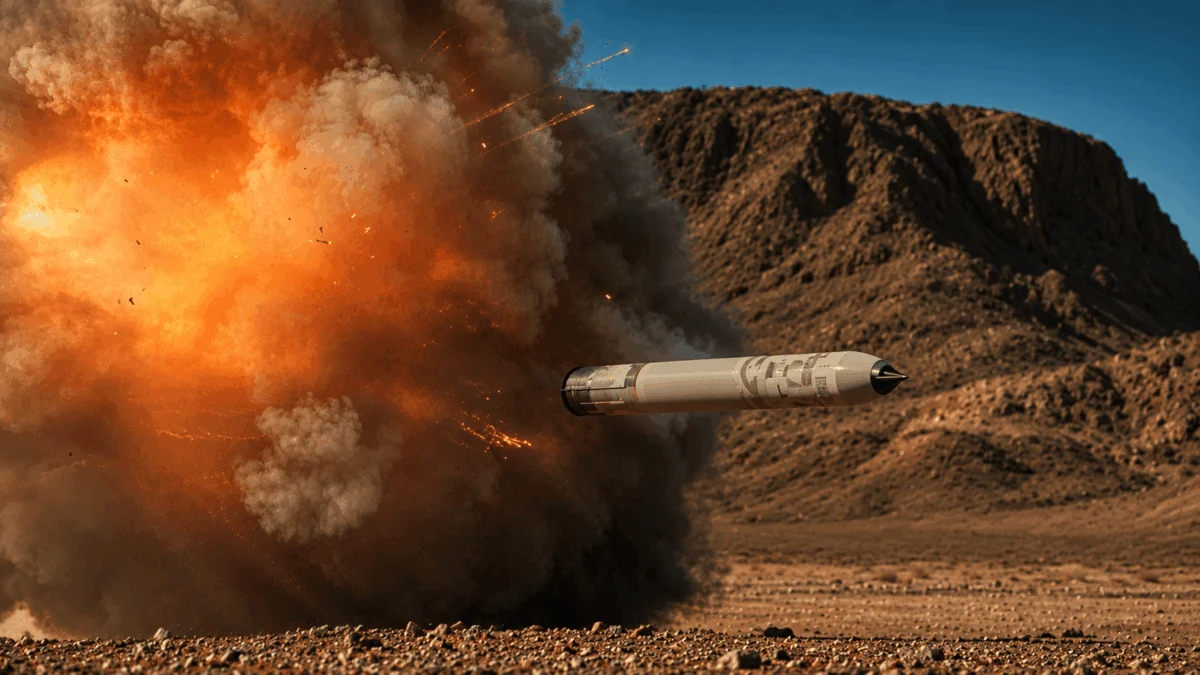
This led to the development of the Sceptre system, designed to be fired from a 155-millimeter howitzer. The 155-millimeter caliber is significant as it represents the most common artillery weapon donated to Ukraine by Western allies. Tiberius Aerospace claims that the Sceptre projectile not only possesses a longer range than currently available rounds but can also achieve supersonic speeds and operate at altitudes that place it beyond the effective jamming capabilities of adversary electronic warfare systems.
Strategic Implications of Extended Range
The strategic importance of extending the range of Ukraine’s artillery capabilities has been underscored by defense analysts. Sam Cranny-Evans, an associate fellow at the UK’s Royal United Services Institute, explained to WIRED that enabling Ukrainian gunners to operate beyond the reach of Russian drone attacks is crucial. "155-mm shells can cause massive damage to a group of vehicles or infantry," he stated. "Any technology that can help Ukraine extend the reach of its howitzers and return them to combat would be valuable." This sentiment highlights how advancements in munition technology can directly impact battlefield survivability and operational effectiveness.
The Partnership of Steelberg and Baynes
Steelberg began expanding the Tiberius team, including recruiting Andy Baynes as Chief Strategy Officer in 2023. Baynes’s initial engagement with Ukraine dates back nearly a decade, when he visited to investigate how the local startup Ring, now owned by Amazon, had surpassed Nest, a product he had worked on and subsequently sold to Google. He was captivated by Kyiv’s vibrant tech scene and its ambitious software engineers, who were responsible for globally successful innovations like Grammarly and Snapchat’s face filters. In 2016, Baynes acquired a local life-science technology company with the aim of accelerating the development of next-generation medicines through automation of clinical trials and enhancement of protein modeling. "What drew me into Kyiv was the hunger and ambition in the engineering community," Baynes told WIRED. "It was difficult to not be enormously attracted to that and to see if it’s something that could be put into really critical-mission problem sets like cancer drugs or speeding up clinical trials for life-science companies."
Following the full-scale Russian invasion, Baynes spent approximately six months in Budapest, coordinating logistics for the evacuation of women and children and facilitating the movement of essential equipment into Ukraine. His extensive global network was instrumental in sourcing medical supplies, vehicles, and accommodations for refugees, a process that re-established his connection with Steelberg. Baynes views the Western response to the invasion as "inadequate" and believes Ukraine requires enhanced offensive capabilities to push back Russian forces.
Tiberius Aerospace’s Progress and Future Vision
In April, Tiberius Aerospace announced a significant milestone: the successful test firing of a Sceptre projectile from a NATO-standard 155-millimeter howitzer. The company is currently collaborating with the U.S. Army to further mature the Sceptre system. Additionally, Tiberius has entered into a $500 million technology collaboration agreement with UK partners for the manufacturing, licensing, and distribution of the munition. The company is also actively developing a missile system, with revenue generation anticipated to begin next year.
Central to Tiberius Aerospace’s strategy is the evolution of its AI system into a product known as GRAIL (Generative Real-Time Artificial Intelligence for Lethality). Steelberg expresses particular enthusiasm for GRAIL, envisioning it as a platform that will enable continuous upgrades to Tiberius’s weapon designs through decentralized manufacturing. GRAIL aims to automate supply chain management and compliance processes while simulating weapon performance against diverse targets in various environmental conditions, such as an Arctic peninsula. Beyond utilizing open-source data, the Tiberius team is actively seeking access to highly sought-after active combat data from global conflict zones, including Ukraine. The underlying objective is to empower users to test, iterate, and design weapons for specific applications with unprecedented speed.
Baynes articulates a core question driving Tiberius’s approach: "In the world of AI and design and development getting faster and faster, what is it that the West or the group of allied nations have an undeniable advantage on?" He proposes that by "weaponizing all of the spare capacity and precision manufacturing across the UK, France, Germany, the Nordic countries, the U.S.," a formidable industrial advantage can be created that adversaries cannot match. Baynes draws a parallel to the "Apple model," under which he reported to Steve Jobs for four years. He suggests that outsourcing manufacturing to a multitude of third-party subcontractors can dramatically accelerate development and deployment, while also keeping substantial production costs off Tiberius’s balance sheet during peacetime.
Steelberg summarizes Tiberius’s philosophy as a Silicon Valley approach to problem-solving: "When you run into a big, hard, hairy problem, you not only cross that, but you turn around, you build a bridge—it’s a toll bridge, obviously—so the entire industry can cross that hurdle faster, better, stronger. They might pay a small fee, but it’s better than dying in the ditch and not making it across it." This perspective highlights Tiberius Aerospace’s ambition not just to develop advanced weaponry but to fundamentally transform the defense industrial base, making it more agile, responsive, and technologically advanced in an era of rapid geopolitical change. The company’s trajectory suggests a significant potential to reshape the landscape of modern warfare, leveraging cutting-edge technology and innovative business models to address critical defense challenges.
