

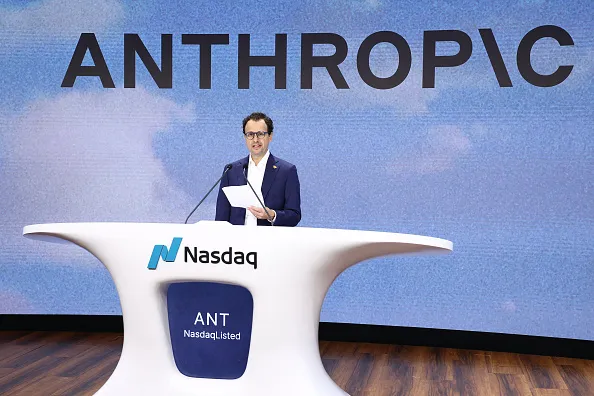
Anthropic, the artificial intelligence research company, marked a historic milestone on Thursday with its Wall Street debut, commencing trading on the Nasdaq in what has been heralded as the largest initial public offering (IPO) in history. Amidst the fanfare and significant capital infusion, CEO Dario Amodei delivered a powerful address ahead of the Nasdaq opening bell, unequivocally reaffirming the company’s core commitment to developing AI responsibly, vowing that Anthropic would not succumb to either business or political pressures and would ensure its advanced AI systems “remain under human control.”
A Vision Rooted in Human Progress and Personal Experience
Reading from a prepared statement, Amodei began by articulating Anthropic’s foundational philosophy: to harness the immense power of artificial intelligence for the betterment of humankind. His deeply personal motivation for this mission was immediately evident as he recounted the profound impact of losing his father to a disease that, tragically, became curable just a few years later. This poignant experience, he explained, fueled his early career in biology and ignited a lifelong quest to accelerate scientific breakthroughs.
Amodei emphasized the historical triumphs of human intelligence in eradicating scourges like the plague, smallpox, and polio, rendering them mere footnotes in medical history for much of the globe. However, he lamented the persistent challenges in other critical areas of disease research, where progress remains agonizingly slow due to the scarcity of scientists and the prohibitive timelines of traditional research. He passionately asserted that AI holds the transformative potential to bridge this gap, working in concert with human experts to dramatically accelerate medical advancements. He envisioned a future where powerful AI systems could compress "a century of scientific and medical progress into a decade," revolutionizing fields from protein folding and drug design to cancer genetics and clinical trial administration.
Anthropic’s Genesis and the AI Safety Imperative
Anthropic’s journey to this monumental IPO has been inextricably linked with its steadfast dedication to AI safety. Founded in 2021 by former members of OpenAI, including Dario and Daniela Amodei, the company was born out of a conviction that the burgeoning field of AI required a more deliberate and safety-conscious approach. This commitment quickly distinguished Anthropic in a rapidly accelerating and fiercely competitive industry. The company’s flagship product, Claude, has been developed with "Constitutional AI" principles, a method designed to align AI systems with human values through a set of guiding principles, rather than solely relying on extensive human feedback. This philosophical underpinning is a direct response to the "alignment problem" – the challenge of ensuring advanced AI systems act in accordance with human intentions and well-being.
Amodei’s consistent warnings about the potential risks of unchecked AI development have been a hallmark of his public discourse. As early as September 2026 (referencing the article’s timeline), he garnered significant attention for outlining a comprehensive plan to "pace AI development." This forward-thinking proposal included critical measures such as coordinating safety standards with other leading AI companies and integrating independent evaluators from third-party organizations to verify adherence to safety commitments. This proactive stance contrasts with some industry approaches that prioritize rapid deployment, positioning Anthropic as a leader in the nascent but crucial field of AI governance.
Industry Consensus and the "Race to the Top"
The gravity of Amodei’s safety concerns has resonated across the AI ecosystem. Prominent figures such as OpenAI CEO Sam Altman, Google DeepMind chief Demis Hassabis, and xAI owner Elon Musk have publicly voiced agreement with Amodei’s position on the necessity of pacing AI development for safety. This rare consensus among fierce competitors underscores the widespread acknowledgment of the potential risks associated with frontier AI models. While concrete, universally binding commitments across the industry remain an ongoing challenge, this alignment in principle marks a significant step towards fostering a more collaborative approach to AI safety.
In his Nasdaq speech, Amodei reiterated the "very real risks" posed by AI, categorizing them into several critical domains: misuse by malicious actors, whether individuals or nation-states, leading to unforeseen societal harms; widespread economic disruption due to automation and shifts in labor markets; and, perhaps most critically, the potential for "losing control of AI systems" that surpass human comprehension and oversight.
However, Amodei was careful to frame these risks not as inevitable outcomes but as avoidable challenges, provided that robust safeguards are meticulously implemented. He affirmed Anthropic’s unwavering investment in AI alignment research, advanced testing methodologies, and the development of novel techniques to understand and steer AI behavior, thereby ensuring these powerful systems remain firmly under human control. He acknowledged that "much work still needs to be done, and the most difficult safety work lies ahead of us," emphasizing that the same extraordinary talent responsible for building Anthropic’s capable AI systems must now be even more rigorously directed towards "double and triple checking that those AI systems are safe and remain under human control."
Financial Strength to Uphold Ethical Imperatives
The IPO, representing a significant capital injection, places Anthropic in a uniquely fortified financial position. Amodei explicitly stated that this newfound financial strength would only "strengthen our resolve to do the right thing." He articulated a vision of a "race to the top," where Anthropic’s success in building a highly capable and safe AI company would inspire others in the industry to adopt similar rigorous safety standards. This competitive dynamic, he argued, would ultimately benefit everyone by fostering a safer overall AI landscape, regardless of which company might hold a temporary lead in model capabilities.
His sister and Anthropic co-founder, Daniela Amodei, echoed these sentiments in a CNBC interview on Thursday, acknowledging the "incredible" promise of AI while underscoring the reality of its risks. She highlighted Anthropic’s founding ethos: "We were really founded on this idea that it is our job to mitigate those risks, and I think we have to date done an incredible job doing that. We obviously have more work ahead of us, but we are deeply committed to safety."
Broader Implications and the Future Trajectory of AI
Anthropic’s record-breaking IPO and its CEO’s steadfast commitment to safety have profound implications for the trajectory of artificial intelligence development globally. The event signals a maturing market where investors are increasingly willing to back companies that integrate ethical considerations and safety protocols into their core business model, rather than viewing them as secondary concerns. This could catalyze a broader shift in industry norms, pushing competitors to more actively address safety to attract investment and talent.
The IPO’s success also provides Anthropic with the resources to accelerate its research into advanced AI safety techniques, including interpretability, robust alignment, and adversarial training. These technical safeguards are crucial in mitigating risks as AI models become exponentially more powerful and complex. The company’s stated intention to "pace the training and deployment of AI systems, taking as long as is necessary to have confidence that they are safe," represents a bold challenge to the conventional Silicon Valley mantra of "move fast and break things."
From a regulatory perspective, Anthropic’s public stance could influence ongoing discussions in legislative bodies worldwide. Governments and international organizations are grappling with how to regulate AI effectively without stifling innovation. A prominent industry player demonstrating a viable path to responsible development offers a practical model that policymakers might consider. The European Union’s AI Act, for instance, emphasizes risk-based regulation, aligning conceptually with Anthropic’s approach. In the United States, ongoing dialogues in Congress about AI oversight could draw lessons from companies actively championing safety.
The "race to the top" concept, if successfully implemented, could transform the competitive landscape. Instead of a purely capability-driven arms race, it could foster a dynamic where companies vie to demonstrate superior safety records, transparency, and ethical governance. This shift could lead to a more resilient and trustworthy AI ecosystem, crucial for widespread public adoption and integration into critical sectors like healthcare, finance, and infrastructure.
In conclusion, Anthropic’s momentous entry into the public market is more than just a financial success story. It represents a potent declaration that profound technological advancement can, and must, be coupled with an unyielding commitment to safety and human control. As Amodei eloquently put it, "The advent of machine intelligence is one of the seminal moments in human history, and we have a rare opportunity to shape it for the better." The world will be watching to see if Anthropic can indeed lead the industry in this crucial "race to the top," ensuring that the incredible promise of AI is realized without compromising humanity’s future.
