

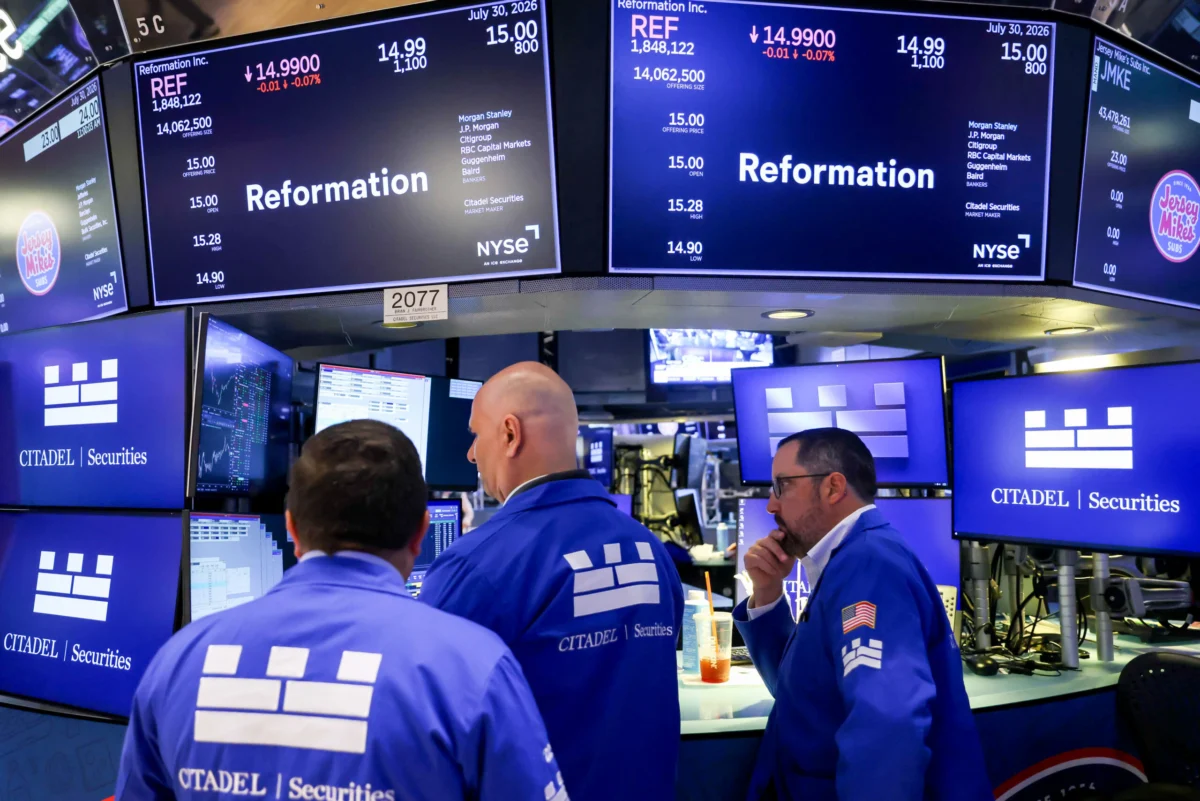
Sustainable women’s clothing retailer Reformation Inc. commenced public trading on the New York Stock Exchange (NYSE) on Thursday, July 30, 2026, under the ticker symbol "REF." The much-anticipated initial public offering (IPO) saw the company’s shares price at $15, concluding the trading day essentially unchanged. This stable debut in a generally cautious market reflects investor confidence in Reformation’s unique business model, which marries contemporary fashion with a strong commitment to sustainability. The offering of 14,062,500 shares successfully raised $210.9 million, providing the capital infusion necessary for the company’s ambitious growth plans.
The IPO marked a significant milestone for Reformation, positioning it as one of a select few consumer and retail companies to brave the public markets this year. Its listing occurred on the same day as sandwich chain Jersey Mike’s, which also made its debut on the NYSE, highlighting a nascent, albeit selective, re-opening of the IPO window after a prolonged slump that followed the boom of 2021. Hali Borenstein, CEO of Reformation, articulated the company’s readiness and strategic vision on CNBC on the day of the listing. "Reformation is ready, and that is really the driving reason we’ve spent a lot of time working to build a business that redefines retail, really innovates on what the role of a brand is in the fashion space, and we’ve done a great job at that," Borenstein stated, emphasizing the robust foundation now in place for significant scaling.
A Journey to Public Markets: Reformation’s Growth Trajectory
Reformation’s path to becoming a publicly traded entity is rooted in over a decade of consistent growth and a steadfast adherence to its founding principles. Established in 2009, the brand quickly carved a niche for itself by offering stylish, trend-conscious clothing made from sustainable materials and employing eco-friendly manufacturing processes. This commitment to "sustainable cool" resonated deeply with a growing segment of consumers who sought fashion that aligned with their environmental values without compromising on aesthetic appeal. The company pioneered a direct-to-consumer model, initially through e-commerce, before strategically expanding its physical footprint.
According to its S-1 fact sheet filed with the U.S. Securities and Exchange Commission, Reformation has demonstrated remarkable financial resilience and growth, achieving 20 consecutive quarters of double-digit net revenue growth through the first quarter of 2026. For the full fiscal year 2025, the company reported net revenue of $507.1 million and a net income of $12.6 million. This profitability was achieved despite various macroeconomic headwinds, including the impact of tariffs imposed by the Donald Trump administration, which posed significant cost challenges for many import-reliant retailers. Reformation’s ability to navigate these pressures underscored its operational efficiency and strategic sourcing.
The company’s retail presence has expanded significantly, now encompassing 70 stores across key markets including the United States, the United Kingdom, Canada, and France. This multi-channel approach, integrating a strong online presence with a curated physical retail experience, has been central to its customer acquisition and retention strategy. The S-1 filing explicitly highlighted the company’s optimistic outlook: "We believe we will continue to benefit from operating within the highly fragmented fashion industry, and that we are well positioned to capitalize on growing global demand for sustainable fashion." This statement encapsulates the core thesis underpinning Reformation’s appeal to investors and its strategic direction post-IPO.
The Sustainable Fashion Imperative: A Market Differentiator
Reformation’s public debut arrives at a pivotal moment for the global fashion industry, where sustainability has transitioned from a niche concern to a mainstream imperative. Consumers are increasingly scrutinizing brands’ environmental and ethical practices, driving significant shifts in purchasing behavior. Industry reports suggest that the global sustainable fashion market, valued at approximately $8 billion in 2025, is projected to grow at a compound annual growth rate (CAGR) exceeding 15% through 2030, potentially reaching over $17 billion. This burgeoning market provides a fertile ground for companies like Reformation that have sustainability embedded in their DNA.
The company’s commitment extends beyond material choices to its entire supply chain and operational ethos. Reformation emphasizes transparency, providing detailed "RefScale" metrics for each product, indicating its environmental footprint in terms of water, carbon dioxide, and waste saved compared to conventional methods. This level of transparency builds trust and reinforces its brand narrative. While numerous traditional fashion brands are now attempting to integrate sustainability initiatives, often through capsule collections or corporate social responsibility programs, Reformation’s long-standing, holistic approach provides it with a significant competitive advantage and authenticity that resonates with its target demographic.
CEO Hali Borenstein reiterated the company’s focus on its core strengths. "We are really focused on two things: our brand and our product. We think those are the winning recipes for consumers, so Reformation has a brand that cuts through," she explained. This emphasis on brand identity and product integrity, coupled with its sustainable mission, is designed to cultivate a loyal customer base. The company’s resilience in the face of tariff and trade uncertainty, with 34% of its units last year sourced from North America, further demonstrates its ability to mitigate external risks and maintain supply chain stability, a crucial factor for investors in a volatile global economy.

Strategic Vision and Customer Engagement
Looking ahead, Reformation’s post-IPO growth strategy is multifaceted, aiming to solidify its market leadership and expand its global footprint. Borenstein outlined several key pillars for the company’s next phase of development: increasing distribution with more physical stores, accelerating its e-commerce business, investing in category diversification, and expanding overseas. The synergy between its robust online platform and its thoughtfully designed brick-and-mortar stores is expected to drive enhanced customer engagement and brand visibility.
The retailer’s current market penetration in the U.S. demonstrates significant potential for further expansion, with Borenstein noting "really strong double-digit growth" across the country, and 70% of its revenue originating from outside the traditional fashion hubs of New York and California. This indicates a broad appeal that transcends specific urban markets, suggesting a robust national brand presence.
Reformation’s customer base is both substantial and strategically valuable. In 2025, the company reported over 1 million active customers across its direct-to-consumer channels. The majority of these customers, approximately 70%, fall within the 25 to 50 age bracket, a demographic known for its disposable income and growing awareness of sustainable consumption. Importantly, Borenstein highlighted the diversity within its customer base during an interview on CNBC’s "Morning Call," noting that 20% of new customers last year were under the age of 25, and another 20% were over 50. This broad appeal across generations underscores the universality of its brand message and product offering.
Furthermore, the company’s average consumer boasts an annual income exceeding $100,000. This demographic profile provides Reformation with a degree of insulation from the broader macroeconomic pressures that often impact other retailers, as higher-income consumers tend to be less affected by economic downturns and inflationary pressures. This financial stability of its customer base is a significant asset in a volatile retail landscape.
The Broader IPO Landscape and Market Implications
Reformation’s IPO takes place against a backdrop of a largely subdued global IPO market, particularly since the frothy conditions of 2021. High interest rates, persistent inflation, geopolitical uncertainties, and a general recalibration of investor expectations have led many companies to postpone or reconsider their public offerings. The selective nature of recent IPOs suggests that only companies with compelling growth stories, strong fundamentals, and clear paths to profitability are able to successfully navigate this challenging environment.
The stable debut of Reformation, concluding its first day of trading at its IPO price, is interpreted by market observers as a sign of cautious optimism. While not a dramatic "pop" often seen in more speculative markets, the absence of a significant decline indicates investor confidence in the company’s valuation and long-term prospects. This measured performance could serve as a bellwether for other growth-oriented, niche retailers with strong environmental, social, and governance (ESG) credentials contemplating public listings. It suggests that while the market remains discerning, quality companies with a clear value proposition can still attract significant capital.
The IPO was strongly backed by a syndicate of prominent investment banks, including J.P. Morgan, Morgan Stanley, Citigroup, and RBC Capital Markets. Their involvement underscores the perceived strength of Reformation’s business model and its potential for sustained growth. These underwriters play a critical role in validating a company’s financial health and strategic vision to institutional investors, and their commitment to Reformation’s offering speaks volumes about the company’s perceived stability and future potential.
As Reformation embarks on its journey as a public company, the scrutiny will intensify. The pressure to consistently deliver on growth targets, maintain profitability, and uphold its sustainability mission will be paramount. However, CEO Hali Borenstein frames success not merely in financial terms, but in its impact on customers. "Today is the first day," she concluded. "It’s a long journey ahead, and at Reformation, we have very big goals. We’re ambitious, and so where we are really focused is on building a once-in-a-generation type brand." This aspirational outlook, coupled with a proven track record and a clear strategic roadmap, positions Reformation as a compelling case study for conscious capitalism in the modern retail era. Its performance in the coming quarters will be closely watched by investors, industry peers, and the growing cohort of consumers who demand both style and substance from their brands.
