

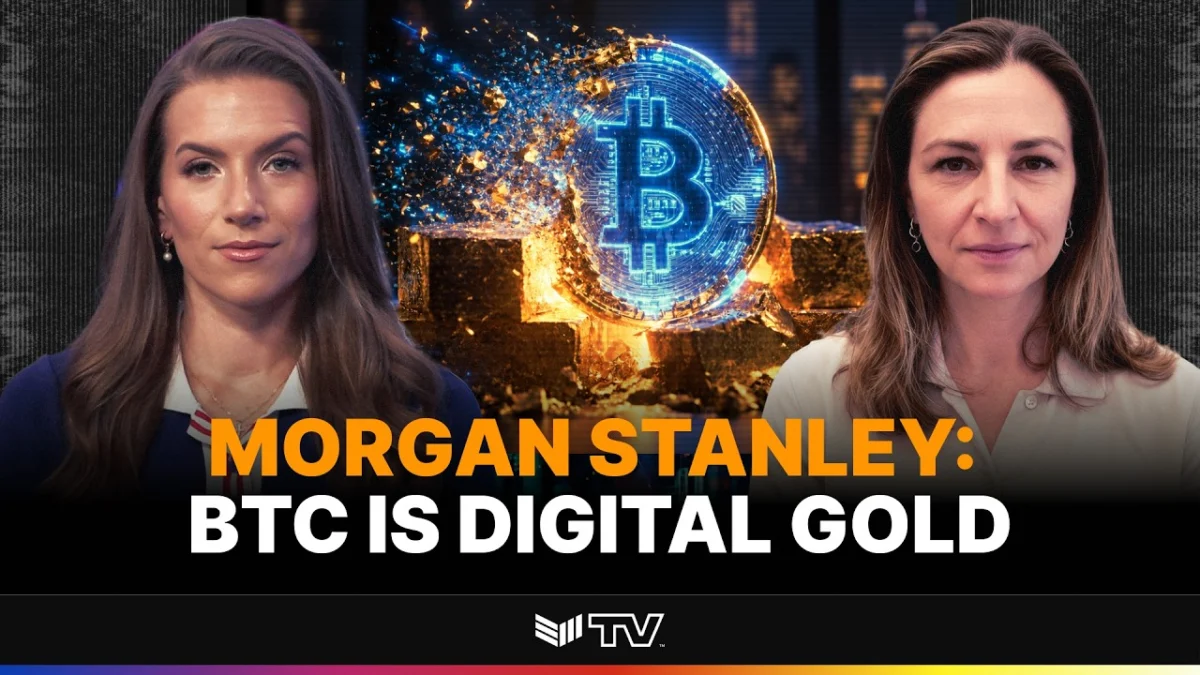
Amy Oldenburg, a prominent figure at Morgan Stanley, has articulated a nuanced perspective on Bitcoin’s potential as "digital gold." While acknowledging the compelling rationale behind this narrative, Oldenburg emphasizes the need for the cryptocurrency to demonstrate trading behaviors more akin to traditional safe-haven assets like gold, rather than continuing its correlation with riskier tech stocks. This assertion comes at a time when institutional interest in digital assets is growing, yet questions about Bitcoin’s volatility and its perceived role in diversified investment portfolios persist.
Oldenburg’s remarks, made in the context of a discussion encompassing the evolving digital asset landscape, highlight key areas of concern and opportunity for Bitcoin. Her desire for a reduced correlation with tech stocks suggests a wish for Bitcoin to decouple from the speculative whims often associated with the technology sector. Instead, she advocates for a more stable, less reactive trading pattern that aligns with the historical performance of gold as a hedge against inflation and economic uncertainty.
The ongoing debate surrounding Bitcoin’s "digital gold" status is central to its long-term adoption by institutional investors. Proponents often point to Bitcoin’s fixed supply, its decentralized nature, and its potential as a store of value, mirroring characteristics of physical gold. However, its relatively short history and its pronounced price swings have led many to classify it as a high-risk, speculative asset. Oldenburg’s statement directly addresses this dichotomy, indicating that for Bitcoin to truly fulfill its digital gold promise, it must exhibit greater resilience and predictability in its market movements.
The "Digital Gold" Narrative: A Persistent Argument
The concept of Bitcoin as "digital gold" has been a recurring theme since its inception. Advocates highlight several key parallels:
- Scarcity: Bitcoin has a capped supply of 21 million coins, a feature analogous to the finite nature of gold reserves. This scarcity is often cited as a primary driver of its potential as a store of value.
- Decentralization: Unlike fiat currencies, which are controlled by central banks, Bitcoin operates on a distributed ledger technology (blockchain), making it resistant to censorship and manipulation by any single entity.
- Divisibility and Portability: Bitcoin can be easily divided into smaller units (satoshis) and transferred globally with relative ease, offering a significant advantage over the physical logistics of storing and transporting gold.
- Durability: Digital assets, in theory, do not degrade over time, unlike physical commodities.
However, the primary challenge to this narrative has been Bitcoin’s volatility. Historically, Bitcoin has experienced dramatic price surges and equally sharp declines, a characteristic that starkly contrasts with gold’s typically more stable, albeit sometimes sluggish, appreciation. This volatility has made it difficult for many investors, particularly those with a fiduciary duty, to allocate significant portions of their portfolios to Bitcoin, especially when considering it as a primary hedge or store of value.
Factors Influencing Bitcoin’s Demand and Market Behavior
Oldenburg’s analysis delves into several specific factors that she believes are currently impacting Bitcoin’s demand and its correlation with other asset classes.
Stablecoins and Their Role
The conversation touches upon the role of stablecoins, particularly Tether (USDT), in the Bitcoin ecosystem. Stablecoins are cryptocurrencies designed to maintain a stable value, typically pegged to a fiat currency like the US dollar. They play a crucial role in facilitating trading on cryptocurrency exchanges by providing a liquid medium for transactions.
While stablecoins offer convenience, concerns about their backing and regulatory oversight can introduce a layer of systemic risk into the broader digital asset market. Any instability or lack of confidence in major stablecoins could indirectly affect Bitcoin’s demand and trading dynamics. The presence of stablecoins as a gateway to Bitcoin trading means that any shifts in their perceived stability or regulatory status can influence investor sentiment and, consequently, Bitcoin’s price action.
The Impact of Macroeconomic Forces
Oldenburg identifies several macroeconomic forces that are currently weighing on demand for Bitcoin:
- Quantum Fears: The theoretical threat posed by quantum computing to current encryption methods, including those securing Bitcoin, is a persistent concern. While the timeline for sufficiently powerful quantum computers is uncertain, the mere possibility can influence investor sentiment and prompt cautious approaches from institutions. Morgan Stanley, like many financial institutions, is actively assessing quantum risk and its potential implications for digital assets.
- Artificial Intelligence (AI): The rapid advancements in Artificial Intelligence and the burgeoning "agentic economy" also present a complex backdrop. While AI could potentially drive innovation and new use cases for blockchain technology, its immediate impact on Bitcoin’s demand is less clear. The focus on AI might be diverting investor attention and capital from other emerging technologies.
- Inflation: While inflation is often cited as a reason for Bitcoin’s "digital gold" appeal, the current inflation prints and their management by central banks can have a complex effect. If central banks are seen to be effectively controlling inflation, the urgency for alternative inflation hedges like Bitcoin might diminish. Conversely, persistent or rising inflation could bolster the argument for Bitcoin as a store of value.
Correlation with Gold: The Key Metric
The core of Oldenburg’s critique lies in Bitcoin’s correlation with gold. For Bitcoin to be a true "digital gold," its price movements should ideally be inversely correlated with traditional risk assets and exhibit a stable, upward trend over the long term, much like gold. However, in recent years, Bitcoin has often traded in lockstep with tech stocks and other risk-on assets, reacting more to market sentiment and liquidity conditions than to its fundamental value proposition as a scarcity-driven asset.
This correlation is a critical indicator for institutional investors. They seek assets that can provide diversification and stability, especially during periods of market turmoil. If Bitcoin behaves like a high-growth tech stock, it fails to fulfill this role, making it a less attractive addition to a conservative portfolio aiming for capital preservation and inflation hedging.
Morgan Stanley’s Engagement with Digital Assets
Morgan Stanley’s active participation in the digital asset space, including the introduction of a spot Bitcoin ETF for its clients, underscores the bank’s recognition of growing investor interest. However, this engagement is also accompanied by a rigorous due diligence process and a focus on understanding the underlying risks and potential benefits.
The discussion around who is buying Morgan Stanley’s spot Bitcoin ETF provides insight into the current adoption curve. The bank’s approach is likely to be measured, catering to clients who are already sophisticated in their understanding of digital assets or who have a clear mandate for such investments. The ability for clients to move self-custodied Bitcoin into ETF shares, or to borrow against Bitcoin ETFs and spot Bitcoin, are services that cater to existing holders and those looking to leverage their digital asset holdings within a regulated framework.
The establishment of Morgan Stanley’s Digital Asset Lab further highlights the institution’s commitment to exploring the potential of blockchain technology and tokenization across various asset classes. Tokenization, the process of representing ownership of an asset on a blockchain, has the potential to transform traditional finance by improving liquidity, transparency, and efficiency. This broader exploration of digital assets suggests that Morgan Stanley views the underlying technology as transformative, even as it maintains a cautious stance on specific cryptocurrencies like Bitcoin until they exhibit more mature market characteristics.
Broader Implications and Future Outlook
Oldenburg’s comments serve as a crucial signal to the market. They indicate that while the "digital gold" thesis for Bitcoin remains valid in principle, its practical realization is contingent on its market behavior evolving. For Bitcoin to transition from a speculative asset to a true safe haven, it needs to demonstrate:
- Decoupling from Tech Stocks: A sustained period where Bitcoin’s price movements diverge significantly from the NASDAQ and other technology indices would be a strong indicator of its growing independence as an asset class.
- Resilience During Downturns: Its ability to hold its value or even appreciate during broader market sell-offs, mirroring gold’s performance, would be a critical test.
- Reduced Volatility: A gradual decrease in its historical price volatility would enhance its appeal as a store of value and a reliable hedge.
The integration of Bitcoin into traditional financial products like ETFs, coupled with the ongoing development of regulatory frameworks, is likely to contribute to its market maturation. As more institutional capital flows into regulated products, and as market participants gain more experience with Bitcoin’s behavior, a clearer picture of its long-term role in investment portfolios will emerge.
However, the challenges posed by quantum computing and the evolving landscape of AI and digital economies remain significant considerations. These factors, alongside the persistent need for robust regulatory clarity, will continue to shape the narrative and adoption trajectory of Bitcoin.
Ultimately, Amy Oldenburg’s perspective from Morgan Stanley offers a valuable benchmark. It suggests that the journey for Bitcoin to be widely accepted as "digital gold" is ongoing and requires the asset to prove its mettle not just through its inherent properties, but through its consistent and predictable performance in the complex global financial markets. The coming years will be critical in determining whether Bitcoin can indeed shed its "risk-on" persona and embrace the stable, reliable characteristics of a true digital safe haven.
