

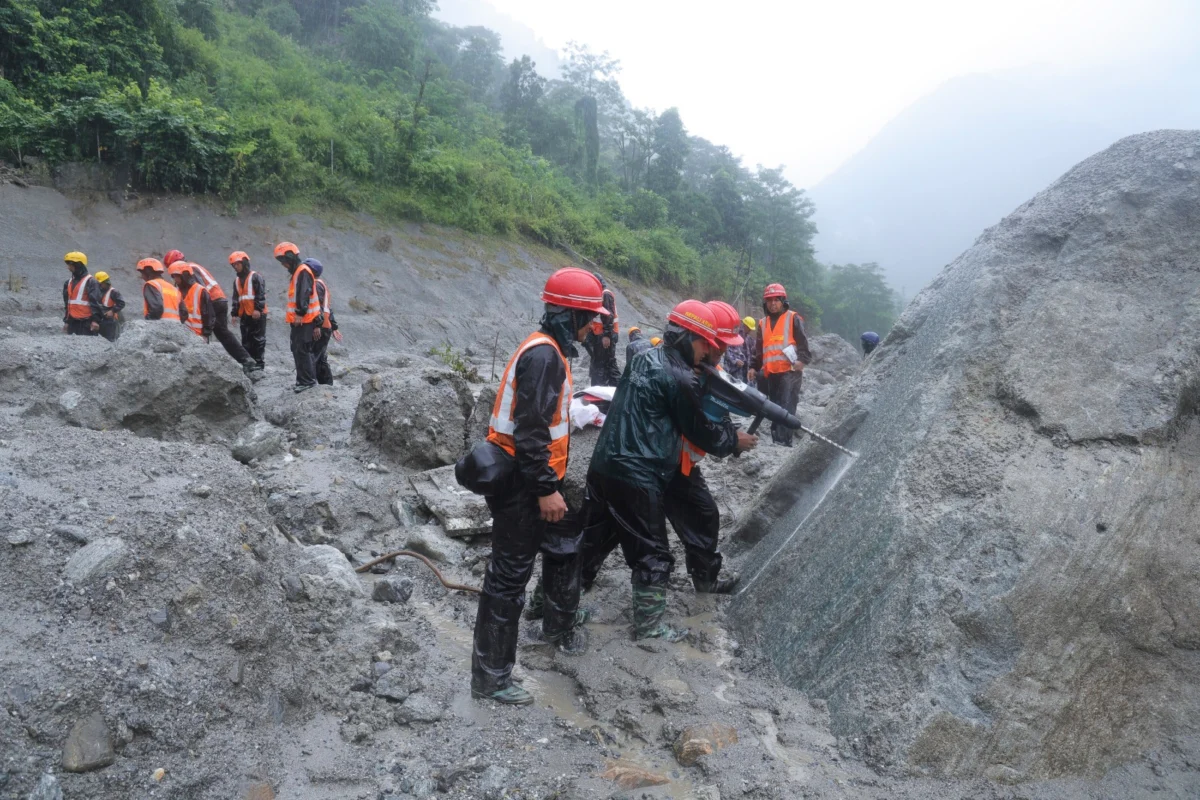
Rescue operations in the rugged Himalayan border region between Nepal and China reached a critical stage on Monday as emergency crews fought through thick mud and debris to reach hundreds of workers trapped inside hydropower tunnels. The catastrophic flash floods, which began late last week, have triggered a humanitarian and infrastructure crisis of unprecedented proportions in the region. With the combined death toll in Nepal and China now exceeding 950 and more than 4,400 individuals still listed as missing, the window for finding survivors is rapidly closing.
The focus of the rescue mission has centered on the Rasuwa and Nuwakot districts of Nepal, where at least 12 hydropower projects sustained severe damage. According to the Independent Power Producers’ Association, Nepal (IPPAN), approximately 900 workers remain unaccounted for across these sites. Of that number, an estimated 500 laborers are believed to be entombed within the massive diversion and access tunnels that characterize modern Himalayan hydroelectric infrastructure. While some workers have managed to communicate with the surface via emergency lines or mobile signals, the physical barriers to their extraction remain immense.
The Scale of the Underground Crisis
The geography of the disaster is defined by the "gigantic tunnels" designed to divert the flow of powerful glacial rivers. These structures, often large enough to accommodate heavy construction trucks, became de facto bunkers when the floodwaters and landslides struck. Jakob Steiner, a geoscientist at the University of Graz and a researcher based in the region, noted that while the size of the tunnels offers some initial protection, they also present a nightmare for rescuers.
"These tunnels are vital infrastructure for controlling water flow, but once they are sealed by mud and debris, they become traps," Steiner said. He confirmed that in some instances, rescue teams have successfully pumped oxygen into the shafts, but he warned that the lack of food and clean water would soon turn the situation fatal. "It is a race against time in the most literal sense," he added.
At the Upper Trishuli-1 Hydropower Project, one of the most significant energy undertakings in the Rasuwa district, the situation is particularly dire. IPPAN President Mohan Kumar Dangi reported that 576 people are currently missing from this site alone, with roughly 300 believed to be inside the project’s main tunnel. Meanwhile, at the Trishuli-3 project, the Nepal Army is attempting a high-risk operation to descend 15 meters (50 feet) through vertical shafts to reach workers blocked by a massive plug of river silt and boulders.
Chronology of the Disaster
The disaster began last Wednesday when a combination of intense, climate-driven rainfall and potential glacial lake outbursts caused rivers along the Nepal-China border to swell beyond recorded historical levels.
- Wednesday: Initial reports of flash flooding emerged from the Tibet-Nepal border. Several upstream gauging stations were swept away, resulting in a loss of real-time data for downstream communities. As the water surged, workers at various hydropower sites attempted to seek higher ground or retreated into the reinforced tunnels for safety.
- Thursday-Friday: The flood wave moved downstream, destroying bridges and sections of the Friendship Highway. Communication with the Rasuwa and Nuwakot districts was largely severed. Early reports indicated dozens missing, but the scale of the "tunnel entrapment" only began to surface as survivors reached administrative centers.
- Saturday: The Nepal Army and specialized police units were deployed with heavy drilling machinery and earth-moving equipment. The death toll began its sharp ascent as bodies were recovered from the periphery of the flood zones.
- Sunday-Monday: Rescue teams reached the primary hydropower sites. Four bodies were recovered from three mud-filled tunnels, confirming fears that many inside may have been overwhelmed by the initial influx of slurry. Drilling operations intensified as air began to fail in deeper sections of the Trishuli projects.
Impact on the National Power Grid
The destruction of these facilities has dealt a staggering blow to Nepal’s energy sector. Preliminary assessments indicate that approximately 10% of the country’s total power generation capacity has been knocked offline. This loss is not merely a domestic inconvenience; Nepal has increasingly relied on hydropower exports to India and Bangladesh as a pillar of its economic growth strategy.
In Dhading, another hard-hit district, workers at a ravaged power station told reporters that the facility was the sole source of electricity for over 20,000 residents. With the station now buried under several meters of silt, the region faces a prolonged blackout that will hamper recovery efforts and the operation of local health clinics and schools.
The Independent Power Producers’ Association has highlighted that the damage extends beyond operational plants. At least 15 projects currently under construction have seen years of progress erased in a matter of hours. The financial implications are massive, with early estimates of direct infrastructure damage reaching into the hundreds of millions of dollars.
Vulnerability of the "Third Pole"
The disaster has reignited an urgent debate among climate scientists and infrastructure experts regarding the feasibility of large-scale hydropower in the Hindu Kush Himalaya—a region often referred to as the "Third Pole" due to its massive ice reserves.
The International Center for Integrated Mountain Development (ICIMOD) has frequently warned that the Himalayas are warming at a rate significantly higher than the global average. This warming leads to permafrost degradation and the expansion of glacial lakes, which are prone to "Glacial Lake Outburst Floods" (GLOFS). When these outbursts occur, they carry not just water, but a "debris flow" of rocks and sediment that can act like liquid concrete, crushing any structure in its path.

Himanshu Thakkar, coordinator of the South Asia Network on Dams, Rivers and People, argued that hydropower projects in these valleys act as "force multipliers" during disasters. "When you alter the river channel and build massive concrete structures in narrow gorges, you change the way the river behaves during an extreme event. The debris from a construction site can become a battering ram for the communities downstream," Thakkar explained. He suggested that Nepal must diversify its energy portfolio, potentially shifting toward decentralized solar power, which is less vulnerable to the catastrophic geological shifts of the high Himalayas.
Economic Resilience and Future Planning
The financial stakes for Nepal are immense. A report from the Coalition for Disaster Resilient Infrastructure (CDRI) suggests that $124 billion worth of Nepal’s infrastructure is currently exposed to climate-driven disasters. On average, the country suffers $760 million in annual losses from natural hazards, a figure that dwarfs the national disaster relief budget.
Ramraj Narasimhan, a senior director with CDRI, emphasized that the focus of rebuilding must shift from "indestructibility" to "redundancy and resilience."
"We have to accept that in this landscape, damage will happen," Narasimhan said. "The question is: Can we build systems where a single failure doesn’t cut off entire regions? This means better early warning systems that provide hours rather than minutes of notice, and financial tools like insurance that allow for rapid recovery rather than years of stagnation."
Narasimhan’s analysis points to a critical failure in the current disaster: the lack of downstream communication. While the flood was detected at the China-Nepal border, the speed at which it traveled left workers at the hydropower sites with almost no time to evacuate. Experts are now questioning why automated warning sirens and satellite-linked alerts were not integrated into the project safety protocols.
Echoes of the 2024 Catastrophe
This month’s tragedy bears a haunting resemblance to the floods of October 2024. During that event, heavy monsoon rains caused landslides that impacted over 30 hydropower facilities, reducing Nepal’s electricity production by 1,100 MW—nearly one-third of its total capacity at the time.
The 2024 disaster resulted in roughly $32.6 million in losses for the energy sector alone. However, the current 2026 event appears far more lethal and structurally damaging. The recurring nature of these "once-in-a-generation" floods suggests that the historical data used to design these dams and tunnels may no longer be applicable in a rapidly changing climate.
The Human Toll and Official Response
As the Nepal Army continues its rescue efforts, the families of the missing have gathered at the edges of the exclusion zones in Rasuwa and Nuwakot. Desperate for news, many have criticized the speed of the government response, though officials maintain that the terrain and the sheer volume of mud make faster progress impossible.
Brig. Gen. Raja Ram Basnet, spokesperson for the Nepal Army, stated that every available resource is being directed toward the tunnels. "Our soldiers are working around the clock in extremely unstable conditions," Basnet said. "The risk of secondary landslides is high, but we are committed to reaching every trapped individual."
The disaster has also prompted a diplomatic response, with China and Nepal coordinating on search-and-rescue efforts along the border. However, with thousands still missing and the death toll climbing, the focus remains on the immediate tactical challenge: piercing the mud-choked tunnels before the air—and hope—runs out for those inside.
The coming days will determine the final scale of the tragedy, but the long-term impact on Nepal’s development path is already clear. The nation must now grapple with the reality that its greatest resource—its mountain rivers—is also its most volatile threat. As Himanshu Thakkar noted, the ultimate question is not just how fast the country can rebuild, but whether it will continue to "put the same infrastructure back in the path of the next inevitable flood."
