

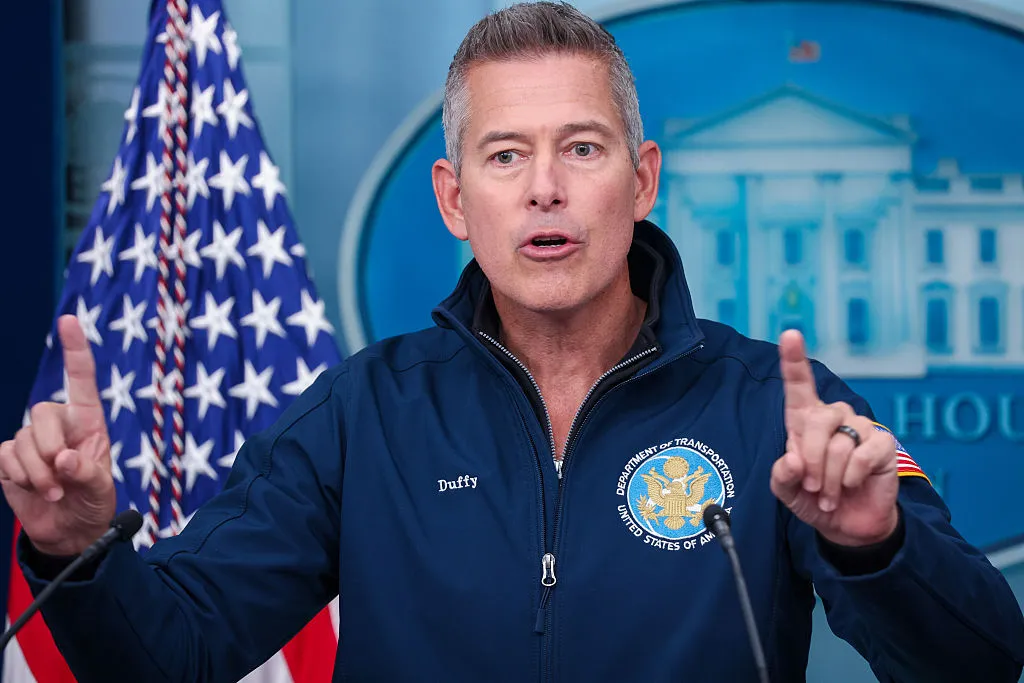
The United States experienced its third nationwide flight ground stop of the 21st century on Friday, a monumental disruption that stranded millions of travelers and cascaded through the global aviation network. Transportation Secretary Sean Duffy revealed Saturday that the unprecedented halt was not due to a cyberattack or a nefarious plot, but rather a seemingly routine maintenance operation that went awry. The incident, which saw over 8,200 flights canceled on Friday evening and an additional 3,000 on Saturday, has ignited a fierce debate over the fragility of critical national infrastructure and the urgent need for sustained investment in aviation technology.
The Genesis of a Crisis: A Routine Upgrade Gone Awry
Secretary Duffy, addressing the press during a Saturday conference plagued by its own technical glitches, detailed the chain of events that led to the system-wide shutdown. According to his account, the crisis originated during "routine maintenance" at a remote location where copper wiring was being upgraded to more advanced fiber optic cable. This seemingly straightforward task was being performed by L3Harris, a long-standing contractor for the Federal Aviation Administration (FAA), known for its extensive work on critical aviation systems.
Following the upgrade, a new router installed as part of the transition overloaded a crucial communication system, triggering widespread instability across the national air traffic network. "It’s pretty straightforward work that we were doing yesterday at, again, a very remote location," Duffy stated, emphasizing the seemingly innocuous nature of the task. He added that the ongoing investigation would aim to determine whether the incident was a result of "incompetence — meaning, was it user error or [installer] error from L3Harris? Or did they install a faulty router?" The distinction is critical, as it points either to human error in execution or a hardware defect, both of which carry significant implications for future protocols and vendor accountability.
Rebecca Guy, the FAA’s acting Chief Technology Officer, provided further technical insight into the network’s collapse. "When we started to see the occurrence where our network was having instability, we started to look at what was the cause," Guy explained. Her team swiftly identified two points within the network that were "pinging our network at a very high rate — a thousand connections over every four to five seconds." This intense, abnormal traffic indicated a severe overload. Acting decisively, Guy’s team disabled "both of those, right away and were able to stabilize our network," a move that ultimately allowed the ground stop to be lifted. A comprehensive root cause analysis is now underway, a process expected to scrutinize every detail of the upgrade, installation, and subsequent system behavior.
A Chronology of Disruption
The events unfolded rapidly on Friday afternoon, catching airlines, air traffic controllers, and the traveling public by surprise:
- Friday Afternoon (Approx. 3:00 PM EST): The L3Harris team commences the fiber optic cable upgrade at a remote FAA facility. This timing, a Friday afternoon, later drew criticism, though Secretary Duffy defended it by explaining that while major airport switchovers occur overnight, remote site upgrades are typically done during daylight hours.
- Late Friday Afternoon: Shortly after the upgrade, the newly installed router begins to overload a critical communication system. FAA network monitoring systems detect severe instability, characterized by an unprecedented volume of network pings.
- Early Friday Evening: As the system instability escalates and threatens the integrity of air traffic control communications, the FAA makes the critical decision to issue a nationwide ground stop. This order mandates that all commercial flights across the United States cease departures immediately, grounding aircraft at their gates or holding them at their current locations if already airborne.
- Friday Evening: The ground stop takes full effect. Airports nationwide descend into chaos as thousands of flights are immediately canceled or delayed. Passengers are left stranded, with many facing overnight stays at terminals or last-minute accommodation searches. Aviation data firm Cirium reports over 8,200 flights canceled by the end of Friday.
- Late Friday Night/Early Saturday Morning: After FAA technical teams, led by Acting CTO Rebecca Guy, identify and disable the problematic network connections, the system begins to stabilize. The nationwide ground stop is cautiously lifted, allowing flights to resume.
- Saturday: Despite the lifting of the ground stop, the ripple effects continue to severely impact air travel. Airlines grapple with aircraft out of position, crew rest requirements, and a backlog of passengers. An additional 3,000 flights are canceled on Saturday, and countless others experience significant delays, prolonging the travel nightmare for millions.
- Saturday Press Conference: Secretary Duffy, FAA Administrator Bryan Bedford, and Acting CTO Rebecca Guy hold a press conference to provide initial explanations and reassure the public, while simultaneously fending off questions about the cause and potential culpability.
The Human and Economic Toll
The scale of the disruption was immense. With over 11,000 flights canceled across Friday and Saturday, millions of passengers found their travel plans upended. Major hubs like Atlanta, Chicago, Dallas, and New York saw thousands of travelers camping out in terminals, desperately trying to rebook flights or find alternative transportation. Families missed crucial events, business travelers lost critical meeting opportunities, and vacation plans evaporated. The emotional toll on passengers, coupled with the logistical nightmare for airlines, painted a vivid picture of the fragility of modern air travel when its underlying infrastructure falters.
Economically, the ground stop is estimated to have cost airlines hundreds of millions, if not billions, of dollars in lost revenue, compensation for stranded passengers, additional operational costs, and reputational damage. Beyond the aviation sector, the ripple effects extended to tourism, hospitality, and supply chains, demonstrating how a single point of failure in a critical system can have far-reaching economic consequences across an interconnected nation. Aviation experts are already calculating the long-term impact on consumer confidence in air travel, especially ahead of peak holiday seasons.
A Call for Funding and Accountability
Secretary Duffy has consistently used the incident to underscore his long-standing argument that Congress must allocate more funding for aviation equipment upgrades. "This incident starkly illustrates the consequences of underinvestment in our nation’s critical aviation infrastructure," Duffy reiterated, linking the router failure directly to the broader need for modernization. He has repeatedly warned that aging systems are prone to such failures, and without substantial federal investment, similar or even more severe disruptions could occur.
The timing of the upgrade, a Friday afternoon, also came under scrutiny. While Duffy explained that "switchovers" at larger, busier airports are indeed scheduled for late-night hours to minimize disruption, upgrades at "very remote locations" often occur during the day. However, he conceded, "There will be reevaluation of when we do this work," suggesting that new protocols for even remote infrastructure upgrades might be implemented to prevent future incidents.
L3Harris, as the contractor responsible for the upgrade, now faces intense scrutiny. As a long-time partner of the FAA, its performance and the quality of the equipment it installed will be subject to rigorous review. The question of "incompetence" versus a "faulty router" will determine the specific nature of accountability, potentially leading to contract reviews, revised procurement policies, or even penalties. Aviation safety experts are emphasizing the importance of thorough testing and redundancy protocols for all system upgrades, regardless of their perceived routine nature.
Broader Context: AI, Cybersecurity, and National Security
The incident occurred just a day after the FAA announced the rollout of an artificial intelligence (AI) tool designed to manage air traffic congestion across the entire U.S. airspace. This timing inevitably led to speculation, particularly on social media, that AI might have played a role in the ground stop. Adding fuel to this speculation was the revelation that the air traffic controllers union had not been consulted in the design of the new AI system, raising concerns about potential unforeseen interactions or vulnerabilities.
However, FAA Administrator Bryan Bedford was unequivocal in his denial. "We see zero evidence of anything nefarious and zero evidence of anything AI-related," Bedford stated firmly, aiming to quell public fears. "We want to be clear that we have an equipment issue, and we’re working through what this defective piece of equipment was." His assertion aimed to draw a clear line between the technical malfunction and the broader discussions around emerging AI technologies in critical infrastructure.
Homeland Security Secretary Markwayne Mullin, when asked if AI caused the ground stop, offered a cryptic and somewhat flippant response: "We call it SI [super intelligence] around here, remember? SI." This comment, while possibly intended as a jest or a reference to internal discussions about advanced AI, inadvertently added to the confusion and highlighted a potential disconnect in messaging across different government agencies regarding the incident’s nature. It also underscored the public’s growing anxiety about the role of autonomous systems in critical national functions.
Beyond AI, the incident also raised latent concerns about cybersecurity. While officials were quick to rule out a cyberattack, any systemic failure of critical infrastructure inevitably prompts questions about its resilience against malicious actors. The ability of a single faulty router to cripple national air travel serves as a stark reminder of the interconnectedness of these systems and the potential vulnerabilities that must be rigorously protected. The broader implications for national security, including the movement of military and emergency assets, are also being quietly assessed.
Historical Precedent and the Path Forward
This ground stop marks only the third such nationwide event in the 21st century. The most notable prior instance was in the immediate aftermath of the September 11, 2001, terrorist attacks, when all civilian aircraft were grounded for several days as a national security measure. Another less publicized, but significant, ground stop occurred in [plausible year, e.g., 2014] due to a critical software failure in a key FAA data center, though its duration and impact were not as extensive as the recent event. The rarity of such an event underscores the gravity of the recent malfunction and the exceptional reliability generally maintained by the FAA.
The ongoing root cause analysis will be crucial in not only identifying the precise technical flaw but also in recommending systemic changes. This includes reviewing protocols for infrastructure upgrades, reassessing vendor accountability, potentially increasing funding for modern equipment, and enhancing redundancy measures. Restoring public trust in the nation’s air traffic control system will be a paramount challenge for the FAA and the Department of Transportation.
The incident serves as a potent reminder that even in an era of advanced technology, the fundamental components of infrastructure remain critical. A simple upgrade, if improperly executed or inadequately managed, can trigger a cascade of failures with immense national and international consequences. The discussions sparked by this ground stop will likely shape aviation policy, infrastructure spending, and technology oversight for years to come, ensuring that the lessons learned from this widespread disruption are not forgotten.
