

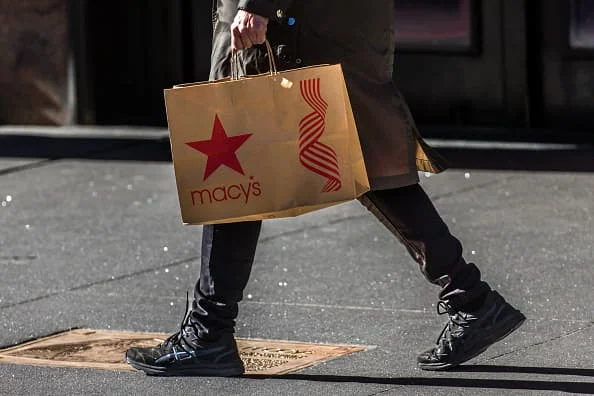
Macy’s, the iconic American department store chain, reported a robust performance for its fiscal fourth quarter on Wednesday, surpassing Wall Street’s expectations for both sales and profit. The positive results were largely attributed to encouraging signs of progress within its namesake brand, alongside continued strength from its luxury subsidiaries, Bloomingdale’s and Bluemercury. Despite this quarterly win, the company presented a notably cautious outlook for the fiscal year ahead, underscoring the persistent uncertainties in the broader economic and geopolitical landscape. Shares of Macy’s responded positively to the news, rising approximately 6% in premarket trading, reflecting investor confidence in the immediate past performance while digesting the forward-looking guidance.
Fiscal Year Projections and Market Response
For the upcoming fiscal year, Macy’s, which encompasses its flagship department stores, the upscale Bloomingdale’s, and the beauty retailer Bluemercury, projected consolidated net sales to fall within the range of $21.4 billion to $21.65 billion. The company also forecast adjusted earnings per share (EPS) to be between $1.90 and $2.10. These projections represent a anticipated decline from the previous fiscal year, where the company recorded total revenue of $21.8 billion and adjusted earnings per share of $2.15.
While Macy’s sales outlook broadly aligned with, or even slightly exceeded, analysts’ consensus expectation of $21.42 billion, its adjusted earnings guidance fell short of Wall Street’s more optimistic forecast of $2.17 per share for the year, according to data compiled by LSEG. This discrepancy highlights a nuanced investor sentiment: a recognition of strategic progress on the top line, tempered by concerns over profitability margins in an unpredictable environment.
Furthermore, the company anticipates comparable sales – a critical industry metric that normalizes for factors like new store openings or closures – to range from a modest 0.5% decline to a 0.5% increase for the full fiscal year. This forecast, while conservative, signals a continued focus on stabilizing and incrementally growing its core business amidst significant restructuring.
Strategic Turnaround in Motion: A "Bold New Chapter"
The strong fourth-quarter performance, particularly the positive comparable sales growth across all three brands for the full fiscal year (a significant 1.5% increase, marking the first time in three years), is seen by leadership as a clear validation of its ongoing multi-year turnaround strategy. CEO Tony Spring, who assumed the company’s top role approximately two years ago, has been at the helm of this ambitious initiative. The strategy aims to reinvigorate the struggling Macy’s namesake brand, capitalize on the robust performance of its higher-end chains, and modernize the company’s operational backbone, including its supply chain and technology infrastructure.
"Our results show that our strategy is working," Spring affirmed in an interview with CNBC, emphasizing the company’s achievement of beating Wall Street’s sales guidance for the fourth consecutive quarter. This consistent outperformance suggests a foundational shift in how the company is managing its inventory, engaging customers, and optimizing its store portfolio.
Reimagining the Macy’s Brand: Store Investments and Closures
A cornerstone of Macy’s strategic overhaul involves a significant rationalization of its physical footprint alongside substantial investments in its remaining, higher-potential stores. The company announced plans to close approximately 150, or more than a quarter, of its namesake Macy’s department stores by early 2027. So far, over 80 of these closures have already been executed, demonstrating a commitment to streamlining operations and focusing resources.
Concurrently, Macy’s is channeling significant capital into enhancing the customer experience at the approximately 350 Macy’s stores slated to remain open. These investments are multifaceted, focusing on improving visual merchandising, increasing staffing levels, and introducing a more curated assortment of brands. The company initiated this "reimagined store" concept with a pilot program in 50 locations. The success of this initial phase, which saw these stores outperform the rest of the chain with a comparable sales growth of 0.9%, prompted an aggressive expansion. Spring reported that Macy’s has now scaled this initiative to 200 locations, representing about 60% of its planned long-term namesake store base.
Key improvements in these revitalized stores include more attentive customer service, empowered local leadership with flexibility in staff deployment, and a refreshed product offering. "It always comes down to the quality of the assortment and the quality of the people and the quality of the experience," Spring explained. "We’ve added brands. We’ve edited brands. We’ve made sure the shopping environment is more pleasant, less dense, [with] better storytelling, and we’ve added people to the stores." This holistic approach aims to address long-standing criticisms regarding stale merchandise, inadequate staffing, and disorganized displays that had previously driven shoppers to competitors. The positive impact of these physical store enhancements is also extending to the digital realm, with Spring noting that a stronger in-store business has contributed to lifting online sales, which now account for a significant one-third of the brand’s overall revenue.
The renewed assortment in these reimagined Macy’s stores features newer, trendier, and often more premium brands such as Theory, Reiss, Good American, and Rodd & Gunn. These additions have been well-received by customers, and Macy’s plans to expand their availability to even more locations, signaling a strategic shift towards attracting a more fashion-forward and affluent customer segment within its traditional mid-tier offering.
Luxury and Beauty Powerhouses: Bloomingdale’s and Bluemercury
While the Macy’s brand undergoes its significant transformation, the company’s luxury and beauty segments have continued to be strong performers. Bloomingdale’s, the upscale department store, recorded an exceptional holiday season, contributing significantly to the company’s overall Q4 success. Its comparable sales surged by an impressive 9.9% in the fourth quarter. Spring attributed this outstanding performance to Bloomingdale’s meticulously curated assortment, a seamless blend of strong in-store and digital experiences, and its demonstrated ability to attract and retain shoppers across multiple generations.
Bluemercury, Macy’s beauty retail chain, also contributed positively with comparable sales growth of 1.3% in the fourth quarter. These figures underscore the continued resilience of the luxury and beauty markets, even as discretionary spending patterns become more polarized. The company’s strategy to lean into these higher-performing chains by potentially opening new Bloomingdale’s and Bluemercury stores (though specific numbers and locations were not disclosed by Spring) reflects a savvy allocation of resources towards segments with proven growth potential and higher margins.
A Deeper Look at Q4 Performance: Financials Snapshot
Macy’s reported a substantial increase in net income for the three-month period ending January 31, reaching $507 million, or $1.84 per share. This marks a significant improvement from $342 million, or $1.21 per share, in the corresponding year-ago period. Adjusting for one-time items, including impairment and restructuring costs, the retailer posted adjusted earnings per share of $1.67, comfortably exceeding analyst expectations.
Despite beating quarterly sales expectations, the company’s consolidated sales for the fourth quarter did experience a decline from $7.77 billion in the year-ago period. This nuance is crucial: while sales were lower year-over-year, they surpassed the more pessimistic forecasts from Wall Street analysts, indicating that the market had anticipated an even steeper decline. This context explains the positive market reaction to the "beat" despite the absolute sales figure being lower than the previous year.
Across the entire company, including owned and licensed merchandise and its third-party marketplace, comparable sales for the fourth quarter grew by a healthy 1.8%. Breaking down the performance by brand, the Macy’s namesake banner achieved comparable sales growth of 0.4%, or 0.6% when considering only the stores slated to remain open. This positive movement for the core brand is a critical indicator of the turnaround strategy gaining traction.
CEO Insights: Navigating Uncertainty with a Prudent Outlook
While celebrating the recent successes, CEO Tony Spring articulated a clear rationale for the company’s cautious fiscal year outlook. He pointed to a landscape rife with "new unknowns" that make future predictions challenging, necessitating a "prudent" approach rather than an overly optimistic "hockey stick" projection.
Spring highlighted several macroeconomic and geopolitical factors that could significantly influence discretionary spending in the year ahead. These include the unpredictable trajectory of gas prices, the ongoing conflict in the Middle East, and the complex situation surrounding tariffs – specifically, whether existing tariffs will be refunded, or if new tariffs will be imposed or enhanced. "We’re not economists," Spring stated, emphasizing that the management team is intensely focused on "controlling what they can control" within this volatile environment.
The company’s full-year guidance explicitly incorporates these "macroeconomic and geopolitical factors that could influence discretionary spend," according to a news release. It anticipates a more significant impact from tariffs in the first half of the year compared to the second half, with the first quarter bearing the "most meaningful impact." This outlook also accounts for the substantial investments Macy’s is making in store renovations and the reduced impact from fewer store closures compared to previous periods.
Regarding tariffs, Spring confirmed that the company’s forecast continues to include the pre-Supreme Court ruling level of tariffs. However, he expressed an expectation that Macy’s tariff bill would ease later in the year, primarily due to the "lapping" effect, where the current period’s tariff impact is compared against a year-ago period that also experienced significant tariff costs. Should the company receive a refund on tariffs or if overall tariff levels decrease, Spring indicated that this would represent a "benefit" for Macy’s financial performance.
Spring also provided valuable insights into current consumer behavior, noting "continued resiliency" among Macy’s shoppers, particularly in the middle- and upper-income brackets. These consumers are actively spending on fresh clothing, gravitating towards newer brands and trendier items, indicating a shift away from purely essential purchases. "The middle- and upper-end consumer, which is the majority of our business, is resilient," he observed. "They are buying new things, fashionable things, wardrobe changes, [they’re] not as interested in essentials at this moment in time, and then, obviously the lower-income tiers are more choiceful." He asserted that Macy’s strategy of offering products across a wide range of price points has proven to be "one of the best antidotes" to the unpredictable economic backdrop, allowing the company to capture spending from diverse consumer segments.
Broader Industry Context and Implications
Macy’s journey reflects the broader evolution of the department store sector, which has faced significant headwinds from the rise of e-commerce, fast fashion retailers, and specialty stores over the past two decades. The company’s comprehensive turnaround strategy, focusing on asset rationalization, store experience enhancement, and digital integration, positions it within a cohort of traditional retailers attempting to redefine their value proposition in a highly competitive landscape.
The emphasis on "reimagined" stores, improved staffing, and curated assortments directly addresses the core reasons for the decline of many department stores: a lack of distinctiveness, poor customer service, and an overwhelming, uninspiring shopping environment. By investing in a smaller, higher-quality fleet of stores, Macy’s aims to create compelling physical destinations that complement its digital channels, fostering a more engaging and satisfying customer journey.
The differentiated performance of Bloomingdale’s and Bluemercury compared to the Macy’s namesake brand also underscores the ongoing bifurcation of consumer spending. Luxury and beauty segments often demonstrate greater resilience during economic fluctuations, as higher-income consumers are less sensitive to inflationary pressures and maintain discretionary spending habits. Macy’s strategic focus on nurturing these brands while revitalizing its core offerings is a pragmatic approach to diversifying its revenue streams and appealing to a broader spectrum of consumers.
Stock Performance and Market Sentiment
Macy’s shares closed on Tuesday at $16.92, giving the company a market capitalization of $4.5 billion. Over the past year, the company’s stock has seen a nearly 25% increase, outperforming the S&P 500, which recorded approximately 20% gains during the same period. This indicates a growing recognition of the potential efficacy of its turnaround efforts among investors. However, the stock has experienced a decline of about 23% year-to-date, reflecting market volatility and perhaps some investor apprehension regarding the broader retail outlook and the specific challenges outlined in the company’s cautious guidance.
Analysts will be closely watching how Macy’s executes its strategy in the coming quarters, particularly the pace of store renovations, the integration of new brands, and the ability to manage external economic pressures. The interplay between maintaining profitability and investing heavily in the future will be critical, as will the company’s ability to demonstrate sustained positive comparable sales growth for its flagship brand. Macy’s current trajectory suggests a deliberate and strategic effort to adapt to a new retail reality, but the path ahead remains subject to the dynamic forces of consumer behavior and global economic stability.
