

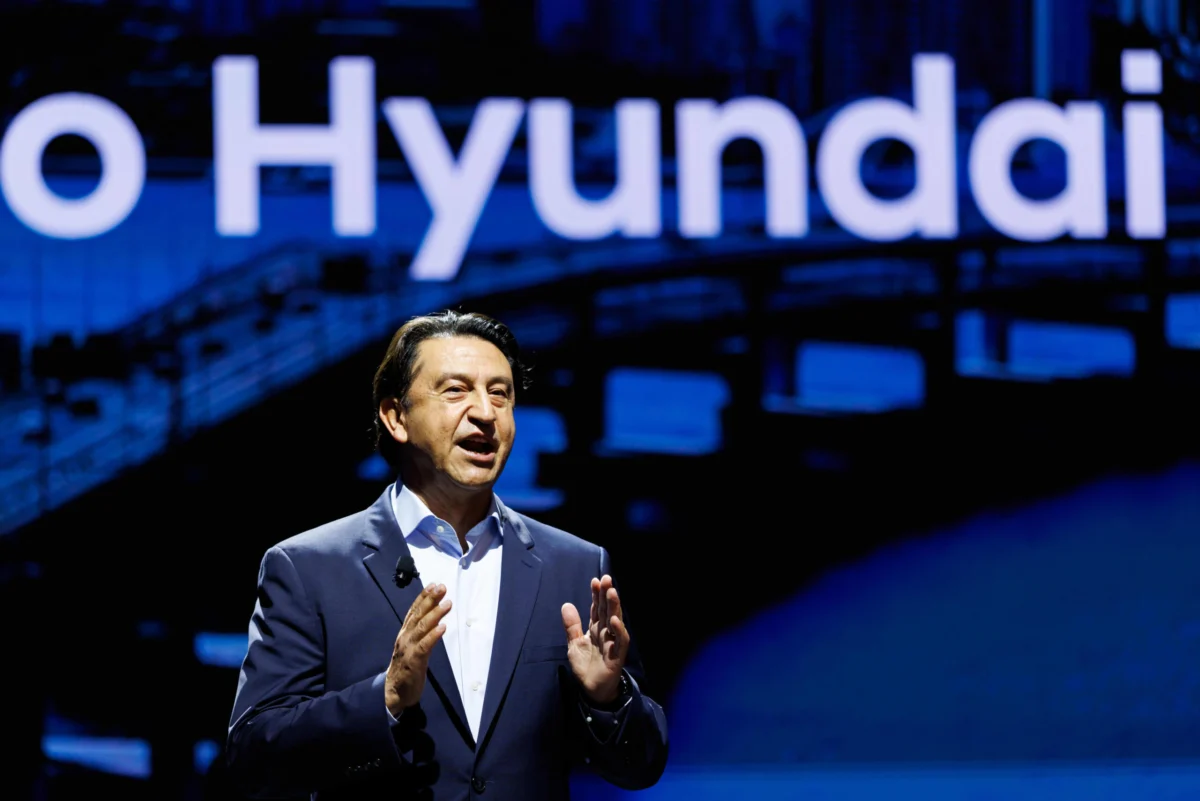
SAN FRANCISCO – Hyundai Motor Co. CEO José Muñoz embodies the audacious spirit of "mueos-ideun ganeunghada," the Korean phrase meaning "anything is possible," a philosophy deeply ingrained in the South Korean automaker’s remarkable ascent in the fiercely competitive U.S. market. Muñoz, a Spanish-U.S. dual national and the first non-Korean executive to lead the company, recently underscored this mantra at the reveal of the new flagship Genesis GV90 SUV, where fellow executives echoed the sentiment that has become a cornerstone of the company’s aggressive expansion strategy. This unwavering belief has not only propelled Hyundai Motor Group to unprecedented growth in North America but has also solidified its position as a global automotive powerhouse.
Despite a landscape marked by geopolitical shifts, inflationary pressures, and a generally slowing market, Hyundai Motor Group, encompassing Hyundai, Kia, and the luxury Genesis brands, has achieved a meteoric rise this decade. The group’s U.S. market share has surged from 8.4% in 2020 to an impressive 11.2% by the end of last year, a gain unparalleled by any other major automaker. Through the first half of the current year, this momentum has continued, pushing market share to 11.8%, according to data from Mobility Global. This represents a staggering 50% increase in sales over the same period, positioning the South Korean conglomerate as the fourth best-selling automaker in the country. To put this into perspective, electric vehicle giant Tesla, with an estimated 2.1 percentage point increase, is the only other company that comes remotely close to Hyundai’s market share gains, which are even more significant given the broader industry’s stagnant or declining trends. This exceptional U.S. performance has been a critical factor in the group’s global standing, making it the third best-selling automaker worldwide and, by Muñoz’s account, the second most profitable based on operating income.
Strategic Investments Anchor U.S. Expansion
The bedrock of Hyundai Motor Group’s continued ambition in the U.S. is a monumental $26 billion investment plan slated through 2028. A central pillar of this strategy is the new $7.6 billion "Metaplant" in Bryan County, Georgia, a facility poised to become the largest vehicle assembly plant in the country. Originally designed for a production capacity of 500,000 units, CEO Muñoz revealed plans to significantly ramp up this output to between 700,000 and 800,000 units by 2028. This rapid expansion is critical to the company’s overarching goal: to produce at least 80% of the vehicles it sells in the U.S. domestically by the end of this decade, a dramatic increase from approximately 40% in 2024.
"My top three priorities are U-S-A," Muñoz emphatically stated during a recent interview, emphasizing the pivotal role of the American market. "USA is helping us to really make good progress, not only in the most important market and the most competitive market in the world, but also elsewhere." The Georgia plant currently manufactures the all-electric Hyundai Ioniq 5 and Ioniq 9, alongside the Kia Sportage hybrid, with a robust pipeline of additional electric and hybrid vehicles slated for future production. This ambitious localization strategy is not merely about meeting demand; it’s a strategic imperative to enhance supply chain resilience, reduce exposure to fluctuating exchange rates, and navigate the evolving landscape of global trade policies.
"Bold 2030 Vision": Ambitious Global Targets Driven by U.S. Success
The $26 billion investment represents the largest in the company’s U.S. history and is intrinsically linked to Hyundai’s broader "Bold 2030 Vision" plan. Unveiled by Muñoz last year at the company’s first-ever investor day held in the U.S., this vision outlines an ambitious target to increase global sales by approximately 35% from last year, reaching 5.55 million vehicles by 2030. The U.S. market is positioned as the primary anchor for achieving this sustained profitable growth, both within North America and as a springboard for entering new global markets. During a recent CEO investor day, Muñoz reconfirmed these plans, including a targeted 6% global market share for the combined Hyundai and Genesis brands, underscoring the deep integration of the U.S. strategy within the company’s worldwide ambitions.

Euisun Chung, Hyundai Motor Group Executive Chair, while acknowledging the rapid ascent, tempered the focus on speed, stating, "It’s important, but speed doesn’t matter. How we grow in the right way [is what matters]. I think that’s more important." Despite this measured perspective, the investment community has unequivocally taken notice of the group’s impressive trajectory, with shares of the company on the Korea stock exchange appreciating by nearly 250% since 2020. This robust investor confidence reflects not just current performance but also the perceived strength and strategic foresight of Hyundai’s long-term plans.
Navigating Trade Winds: Tariffs and Domestic Production
A significant, albeit external, accelerant for Hyundai’s U.S. production plans has been the evolving trade policy environment, particularly the specter of tariffs. CEO Muñoz openly acknowledged that potential tariffs, such as the 15% levy on autos from South Korea previously proposed by President Donald Trump, have played a role in accelerating the company’s localization efforts. "Tariffs are helping accelerate our localization plan. That’s very, very simple," he stated. "The good thing is that we had already started before tariffs were announced. So in a way it’s helping us to accelerate." This proactive approach positions Hyundai to mitigate risks associated with protectionist trade policies while simultaneously capitalizing on incentives for domestic manufacturing, such as those embedded within the Inflation Reduction Act (IRA), which favors North American-made electric vehicles.
The Georgia Metaplant is therefore not just an expansion of manufacturing capacity but a strategic shield against potential trade barriers, ensuring that a larger proportion of Hyundai and Kia vehicles sold in the U.S. qualify for consumer tax credits and are less susceptible to import duties. This strategic foresight has been instrumental for both Hyundai and Kia, which have seen their U.S. sales grow by roughly 45% since 2020, significantly outpacing many rivals.
From "Cheap" to "Value" and Luxury: A Brand Transformation
Hyundai’s journey in the U.S. market began in 1986, followed by Kia in 1993. Their initial strategy was to offer more affordable alternatives to domestic and burgeoning Japanese automakers like Toyota. For decades, the brands grappled with a perception of being "cheap." However, a series of deliberate transformations, encompassing radical overhauls in quality, design, brand identity, and even dealership experiences, have culminated in their current standing as purveyors of quality and exceptional value.
Stephanie Brinley, associate director of Mobility Global’s AutoIntelligence, captures this evolution perfectly: "Both Kia and Hyundai are really good at being able to offer more in the vehicle than the consumer expects, and that they expect at that price point. It’s not about being a ‘cheap car.’ It’s just being able to offer a little bit more than expected." This focus on exceeding expectations, combined with a relentless customer-centric approach, has been a core driver of their success. Muñoz highlighted that the global reach of Hyundai Motor Group, which includes ownership of steel plants and other critical suppliers, provides a unique vertical integration advantage, ensuring competitive pricing and quality control. "We have determined that being competitive is a key element for the American consumer. So, affordability is something that we fully understand and we apply," he affirmed. "We want to offer the customer the right product, the right features at the right level of price."
This "right level" has become remarkably broad. While both Kia and Hyundai continue to offer strong entry-level vehicles starting in the $20,000s, they have simultaneously expanded their top-end offerings. The Genesis luxury brand, launched just a decade ago, exemplifies this upward trajectory, with models reaching well over $100,000, signifying a full-spectrum market presence.

The Genesis Brand: Accelerating Luxury Market Penetration
Genesis has been a particularly rapid success story, achieving 1 million global sales faster than any other luxury brand. The recent reveal of the GV90 flagship SUV, featuring innovative elements like coach doors and rotating lounge seats, was presented as a pivotal new chapter for the brand, a tangible manifestation of the "anything is possible" ethos. Tedros Mengiste, Genesis North America Chief Operating Officer, articulated this at the GV90 reveal, stating, "From the very beginning, the world took notice of Genesis. And tonight you will see mueos-ideun ganeunghada — anything is possible — come to life." This move into ultra-luxury segments demonstrates Hyundai Motor Group’s confidence in its design prowess, technological capabilities, and brand appeal, challenging established European and Japanese luxury marques.
Future Product Pipeline: Expanding Segments and Electrification
Looking ahead, Hyundai’s product strategy is equally aggressive. The company recently announced plans for more than 100 vehicle launches and refreshes across the Hyundai and Genesis brands by 2030, with 58 specifically targeting the North American market. This expansive pipeline will significantly increase its electrified vehicle offerings, crucially including a substantial number of extended-range hybrids. This hybrid strategy is particularly prescient, addressing a market that is increasingly demanding electrified options but may not yet be fully ready for pure battery electric vehicles due to range anxiety, charging infrastructure concerns, or higher upfront costs.
Furthermore, both Hyundai and Kia are poised to enter new, lucrative segments, particularly in the truck and body-on-frame SUV categories. Kia America Vice President of Sales Operations, Eric Watson, confirmed Kia’s plans to increase U.S. sales to 1.02 million vehicles by 2030, with a significant assist from its entry into pickup trucks and more capable "body-on-frame" vehicles. "We think that’s an important segment to be involved in, a body on frame vehicle/truck," Watson noted. "It’ll be an important piece of our growth strategy that we’ll look forward to announcing more in the future." Hyundai also plans to add such vehicles, including a midsize pickup truck, having already debuted a rugged concept vehicle called the Boulder, hinting at potential additional U.S. production capacity for these models. "It’s a new unexplored territory for us," Muñoz remarked, indicating a continuous assessment of market opportunities to fuel further growth.
Challenges and the Road Ahead
While Hyundai Motor Group’s trajectory is undeniably impressive, the road ahead is not without its challenges. The automotive industry is in a state of flux, navigating rapid technological shifts, intensifying competition in the EV space, and persistent supply chain vulnerabilities. Sustaining such rapid growth will require continued innovation, agile adaptation to consumer preferences, and robust execution of its ambitious manufacturing and product development plans. The sheer scale of investment in the Georgia Metaplant, while strategic, also represents a significant financial commitment that must yield projected returns.
However, with a clear "anything is possible" philosophy, a strong leadership team, massive strategic investments in localization, a diversified product portfolio spanning value to ultra-luxury, and a proactive approach to electrification and new market segments, Hyundai Motor Group appears well-equipped to navigate these complexities. Its success in the U.S. market serves not just as a testament to its current strength but also as a blueprint for its continued global dominance in the coming decade.
