

The global imperative to transition to clean energy sources has ignited an unprecedented build-out of solar infrastructure, a cornerstone of efforts to achieve energy independence and mitigate the escalating impacts of climate change. However, this ambitious deployment is encountering a significant bottleneck: a pronounced shortage of skilled labor capable of meeting the burgeoning demand for installation. Traditional industrial robotics, historically confined to controlled manufacturing environments, have struggled to adapt to the unpredictable and dynamic conditions of outdoor construction sites. This long-standing challenge, once a barrier to automation in infrastructure development, is now being fundamentally reshaped by the latest advancements in artificial intelligence models, opening new pathways for robotic solutions.
Gritt’s Vision: Accelerating Infrastructure Development with Intelligent Automation
At the forefront of this transformative shift is Gritt, a startup founded by two Carnegie Mellon-trained roboticists, CEO Puneet Puri and CTO Vishal Dugar. The company officially exited stealth mode on Tuesday morning, announcing a robust $26 million Series A funding round. This substantial investment was spearheaded by Obvious Ventures, with notable participation from Union Square Ventures and Active Impact Investment. This latest injection of capital brings Gritt’s total funding to an impressive $34 million, following an earlier seed round that drew support from prominent investors including First Round Capital, Climactic, Congruent Ventures, and VSC Ventures. Gritt’s core mission, articulated by Puri, is to develop an intelligent system designed to "help civilization build infrastructure faster," directly targeting the inefficiencies and labor constraints currently impeding renewable energy expansion.
Puri elaborated on the foundational thesis driving Gritt’s innovation in an interview with TechCrunch, stating, "Our thesis is that if we truly want to speed up construction, you need an intelligence which can work in the outdoor, chaotic environments of these construction sites, and it has to be generalizable enough that it can work in these varied environments." This philosophy underscores a crucial departure from conventional robotics, emphasizing adaptability and versatility in unpredictable settings.
The Renewable Energy Imperative and the Labor Conundrum
The urgency for accelerated solar deployment cannot be overstated. According to the International Energy Agency (IEA), solar PV additions reached a record 415 gigawatts (GW) globally in 2023, representing a staggering 85% increase from the previous year. Projections indicate a continued exponential growth, with solar expected to become the largest source of electricity generation globally by 2030 under ambitious climate scenarios. In the United States, policies like the Inflation Reduction Act (IRA) have supercharged investment in domestic renewable energy manufacturing and deployment, setting ambitious targets for clean electricity generation. The Solar Energy Industries Association (SEIA) projects that the U.S. solar industry will add hundreds of gigawatts of capacity over the next decade.
However, this rapid expansion is not without its hurdles. The construction sector, particularly in specialized fields like solar installation, faces a persistent labor shortage. The U.S. Bureau of Labor Statistics indicates that employment for solar photovoltaic installers is projected to grow 22% from 2022 to 2032, much faster than the average for all occupations. This translates to an estimated 6,000 openings each year, many of which prove difficult to fill. The work itself is physically demanding, often involving the repetitive lifting and precise placement of large, heavy solar panels—which can weigh over 100 pounds—at heights and in varying weather conditions. This not only contributes to high turnover rates but also poses significant safety risks, leading to injuries and increasing project costs due to worker compensation and slower progress. These factors collectively underscore the critical need for solutions that can augment human capabilities and streamline installation processes.
Gritt’s Technological Edge: AI-Driven Software on Off-the-Shelf Hardware
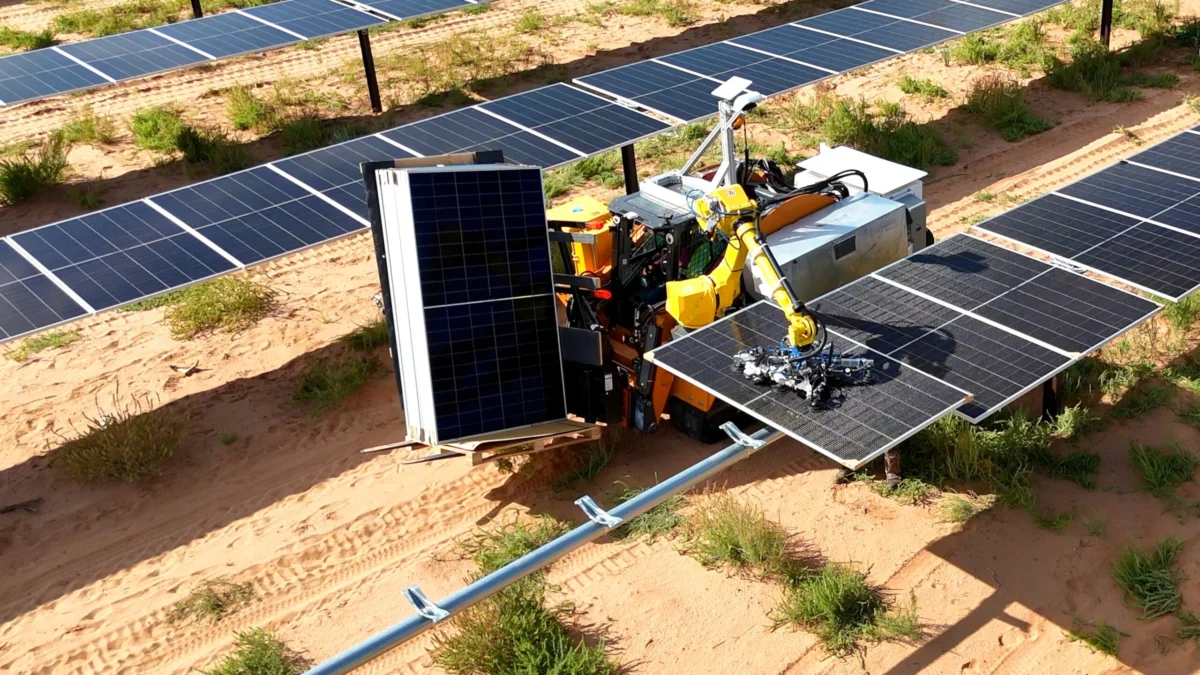
Rather than undertaking the capital-intensive and time-consuming process of designing and manufacturing proprietary robotic hardware from the ground up, Gritt has adopted a strategic approach centered on software intelligence. The company leverages commercially available, off-the-shelf hardware—including rented skidders and sophisticated robotic arms manufactured by established industrial players like Kawasaki. Gritt’s innovation lies in developing advanced AI models that serve as the "brain" controlling these diverse machines, transforming them into intelligent, autonomous systems capable of performing complex construction tasks.
The initial application of Gritt’s technology focuses on a critical phase of solar farm construction: the handling and installation of solar panels. Its systems are engineered to autonomously unload large glass solar panels from delivery trucks, meticulously transport them across challenging terrain to the designated metal frames, and then position them onto these frames with sub-millimeter accuracy. This precision is paramount for subsequent fastening by human workers, ensuring optimal alignment and structural integrity. This approach not only addresses the physical demands on workers but also significantly enhances the speed and accuracy of installation.
Andrew Beebe, the partner at Obvious Ventures who led Gritt’s Series A round, praised the founders’ unique blend of technical prowess and pragmatic entrepreneurial spirit. "There are people who used to build rockets that went into space and had infinite budget for the smallest little part, and then there are people who know what it means to get into dirty, dull, and dangerous jobs and scale them like mad," Beebe commented. "These guys are in the second camp, and that’s a special kind of entrepreneur that has the technical chops, the AI, and the machine vision skills to make it work." This sentiment highlights Gritt’s focus on practical, scalable solutions for real-world industrial challenges.
Demonstrated Efficiency and Rapid Scaling
Gritt’s intelligent systems are already yielding tangible results in the field. Currently, two of the company’s systems are actively deployed, collecting invaluable data that continuously refines and improves their autonomous behavior. The impact on productivity is remarkable: Puri reports that a typical eight-person human crew can install approximately 800 solar panels per day. However, when the same crew is augmented by Gritt’s AI-powered systems, their daily installation capacity skyrockets to between 3,000 and 4,000 panels. This represents a four- to five-fold increase in efficiency, dramatically accelerating project timelines and reducing overall labor costs per installed unit.
The market has responded positively to this demonstrated capability. Gritt has already secured contracts to assist in the installation of a formidable 2.8 gigawatts of solar panels over the next 18 months. Its growing customer base includes three of the top ten power construction companies in the United States, underscoring the trust and confidence placed in its technology by major industry players. Looking ahead, the company aims for an aggressive expansion, planning to have 48 of its intelligent systems operational within the next six months, signifying a rapid scale-up to meet the surging demand.
A Gritt customer, who chose to remain anonymous due to competitive considerations, enthusiastically endorsed the system’s transformative potential. The customer highlighted the anticipated ease of working at remote sites, where attracting and retaining a sufficient workforce is notoriously challenging. Furthermore, a significant reduction in worker injuries is expected, as the demanding and repetitive task of manually lifting 100-pound panels overhead will be largely mitigated by the robotic assistance. This directly addresses both operational efficiency and critical worker safety concerns, improving the overall quality of labor in the solar sector.
Competitive Landscape and Strategic Differentiators
The emerging field of solar installation robotics is drawing increasing attention, with several companies developing their own solutions. Competitors such as Luminous Robotics, Cosmic, and China’s Trinabot are also working on panel-installing robots. A key differentiator lies in their approach: these companies primarily focus on building their own proprietary hardware alongside their software. Gritt’s strategy, by contrast, emphasizes the development of a highly intelligent, generalizable AI layer that can operate on readily available, off-the-shelf vehicles and robotic arms.
This strategic choice could significantly impact Gritt’s growth trajectory and cost structure. By decoupling hardware development from its core AI innovation, Gritt potentially benefits from a leaner operational model, faster iteration cycles, and enhanced scalability. Leveraging existing hardware reduces capital expenditure, shortens development timelines, and allows the company to focus its resources on refining its AI and machine vision capabilities, which are the true drivers of its system’s adaptability and efficiency. As demand for solar installation robotics intensifies, this software-centric approach could grant Gritt a competitive edge in terms of speed of deployment and cost-effectiveness.
The Evolution of AI and Future Horizons
The remarkable progress Gritt has achieved is, at its heart, a testament to the recent breakthroughs in artificial intelligence. Puri and Dugar acknowledge that the advent of new, more sophisticated AI models has been the primary enabler of their vision. Puri explained that while it might have been possible to create a specialized robotic system for a single, narrow task five years ago, modern AI makes such work truly generalizable. The same underlying AI pipeline can now be reused, adapted, and continuously improved across a diverse range of tasks and environments.
This generalizability is exemplified by Gritt’s rapid expansion of capabilities. Puri cited an instance where training the system to stack cinder blocks, a distinct construction task, took several weeks. However, using the same underlying software architecture, a similar demonstration involving the complex task of rebar tying was achieved in just a single day. This dramatic reduction in training time for new applications underscores the power of current AI models to learn and adapt quickly, paving the way for Gritt to expand its robotic capabilities far beyond solar panel installation.
Gritt’s long-term roadmap envisions adding a suite of new manipulation tasks to its systems. This includes automating the fastening of solar panels, drilling posts for foundations, and even the complex assembly of the racks upon which panels are mounted. Beyond solar, the company plans to venture into other labor-intensive construction activities, such as tying rebar before concrete is poured—a physically demanding and repetitive task ripe for automation.
However, the founders believe the true potential of their systems extends beyond mere task automation. They envision Gritt’s suite of sensors and embedded intelligence transforming worksite management and decision-making. Imagine a Gritt system detecting an open trench as a storm approaches, automatically alerting workers to cover it before rain damages sensitive components. Or consider its ability to flag missing inventory or identify potential safety hazards in real-time. Puri succinctly captured this broader vision: "Gritt becomes now this layer of physical AI, which is doing this dextrous, labor-intensive task, plus it can help you take decisions on the site." This concept of "physical AI" positions Gritt not just as a labor augmentation tool, but as an intelligent, omnipresent assistant enhancing safety, efficiency, and oversight on complex construction projects.
Broader Implications for Industry and Society
The implications of Gritt’s success and the broader trend of AI-powered robotics in construction are far-reaching. Economically, accelerating solar installations through automation can drive down the levelized cost of energy (LCOE) for solar power, making it even more competitive against fossil fuels. This, in turn, can spur further investment and deployment, creating a virtuous cycle for clean energy. While concerns about job displacement often accompany automation discussions, the context of a severe labor shortage in construction suggests that robotics like Gritt’s are more likely to complement human workers, allowing them to focus on higher-value tasks, supervision, and specialized problem-solving, while improving safety and reducing strenuous physical labor. This could lead to the creation of new roles for robot operators, maintenance technicians, and AI trainers.
Environmentally, faster, more efficient deployment of solar infrastructure directly contributes to reducing global carbon emissions and combating climate change. Every gigawatt installed quicker means a faster transition away from fossil fuels, helping countries meet their climate targets. For the construction industry, Gritt represents a paradigm shift, moving towards more predictable, data-driven, and highly automated project execution. This could unlock efficiencies previously unattainable, enabling the rapid construction of not just solar farms but potentially other critical infrastructure projects in the future.
In conclusion, Gritt’s emergence from stealth with significant funding marks a pivotal moment in the intersection of artificial intelligence, robotics, and renewable energy. By leveraging advanced AI to empower off-the-shelf hardware, the company is poised to address critical labor shortages, dramatically increase efficiency, and accelerate the global build-out of solar energy. As Gritt expands its capabilities and deploys more systems, it stands to become a key player in shaping the future of infrastructure development, demonstrating how intelligent automation can drive both economic progress and environmental sustainability on an unprecedented scale.
