

Maranello, Italy – Ferrari N.V. (NYSE: RACE) on Tuesday significantly upgraded its financial guidance for the fiscal year 2026, a move that followed a solid third-quarter performance that marginally surpassed Wall Street’s consensus expectations. The iconic Italian luxury sports car manufacturer now projects higher revenue, adjusted earnings, and free cash flow, underscoring its resilience and robust demand in the ultra-luxury automotive segment despite a slight decrease in overall vehicle shipments. The revised outlook reflects strategic successes, including an unprecedented surge in customer personalization requests, favorable currency dynamics, and a strong showing in the Formula 1 World Championship.
This marks the second consecutive quarter in which Ferrari has raised its financial targets for 2026, signaling a consistent upward trajectory in its operational and financial health. The company’s updated projections now forecast revenue to reach 7.65 billion euros, an increase from the previously anticipated 7.6 billion euros. Adjusted earnings before interest, taxes, depreciation, and amortization (EBITDA) are now expected to hit 3 billion euros, up from 2.97 billion euros. Furthermore, adjusted earnings per share (EPS) are projected to be at least 9.85 euros, an improvement from the earlier guidance of at least 9.68 euros. Demonstrating strong cash generation capabilities, Ferrari also elevated its expectations for industrial free cash flow, now targeting up to 1.65 billion euros, a substantial increase from the previous floor of at least 1.55 billion euros. These revised figures paint a picture of a company confidently navigating global economic complexities, driven by its unique market position and brand allure.
A Deeper Dive into Third-Quarter Performance and Key Drivers
While specific granular figures for the third quarter of 2026 were not fully disclosed in the initial announcement, Ferrari confirmed that its performance during this period slightly exceeded the average estimates compiled by LSEG (formerly Refinitiv), a widely recognized benchmark for financial analysts. This outperformance provided the fundamental justification for the updated 2026 guidance. The company’s management highlighted several pivotal factors contributing to this positive momentum.
Firstly, customer personalization emerged as a significant revenue driver. Ferrari noted that "stronger-than-expected customer personalizations" directly contributed to the guidance improvements. For a brand like Ferrari, personalization extends far beyond optional extras; it encompasses bespoke programs, unique configurations, and even one-off creations that significantly enhance the average selling price and, crucially, the profit margins on each vehicle. This deep level of customization not only strengthens client loyalty but also transforms each vehicle delivery into a highly lucrative and personalized experience, reflecting the brand’s commitment to exclusivity and bespoke craftsmanship. The trend indicates that Ferrari’s discerning clientele are increasingly opting for unique specifications, thereby boosting the company’s financial metrics beyond standard vehicle sales.
Secondly, the impact of currency fluctuations proved less adverse than initially modeled. Ferrari cited "lower than anticipated currency headwinds" as another factor bolstering its financial outlook. In a global enterprise like Ferrari, with sales spanning continents and production costs primarily in euros, exchange rate volatility can significantly affect reported revenues and profits. A weaker-than-expected negative impact from currency movements translates directly into improved profitability and a stronger balance sheet, allowing the company to retain more of its international earnings.
Lastly, the brand’s sporting achievements on the track played a tangible role. A commendable second-place finish in the highly competitive Formula 1 championship provided a significant boost. Beyond the direct financial benefits from sponsorship and prize money, success in Formula 1 is inextricably linked to Ferrari’s brand identity and desirability. The racing prowess reinforces the brand’s heritage, technological leadership, and emotional appeal, translating into heightened demand for its road cars and merchandise. This synergistic relationship between its racing division and commercial operations is a cornerstone of Ferrari’s enduring global appeal, attracting new enthusiasts and solidifying the loyalty of existing clients.
Chronology of Sustained Growth Amidst Strategic Adjustments
Ferrari’s decision to raise its 2026 guidance for the second consecutive quarter underscores a pattern of consistent positive performance and prudent financial management. The previous guidance increase, announced after the second-quarter 2026 results, similarly reflected an optimistic outlook, building on strong order intake and operational efficiency. This ধারাবাহিক upward revision suggests that the company’s strategic initiatives, including its product pipeline and market positioning, are yielding sustained positive results.
Interestingly, this robust financial performance and optimistic guidance come despite a slight reduction in vehicle shipments. Through the first nine months of 2026, Ferrari delivered 10,170 vehicles, which represents a decrease of 318 units compared to the same period in the previous year. This decline was primarily attributed to fewer shipments to key markets such as the Americas, and the combined region of China, Hong Kong, and Taiwan. However, this reduction in volume is often viewed through a strategic lens for ultra-luxury brands. Ferrari has historically prioritized exclusivity and brand value over sheer volume. A managed reduction in shipments, particularly in certain regions, can be a deliberate strategy to maintain scarcity, protect brand desirability, and ensure premium pricing, rather than a sign of weakening demand. For Ferrari, the focus remains on enhancing the customer experience and the unique value proposition of its vehicles, which often means carefully managing supply to meet, but not saturate, demand.
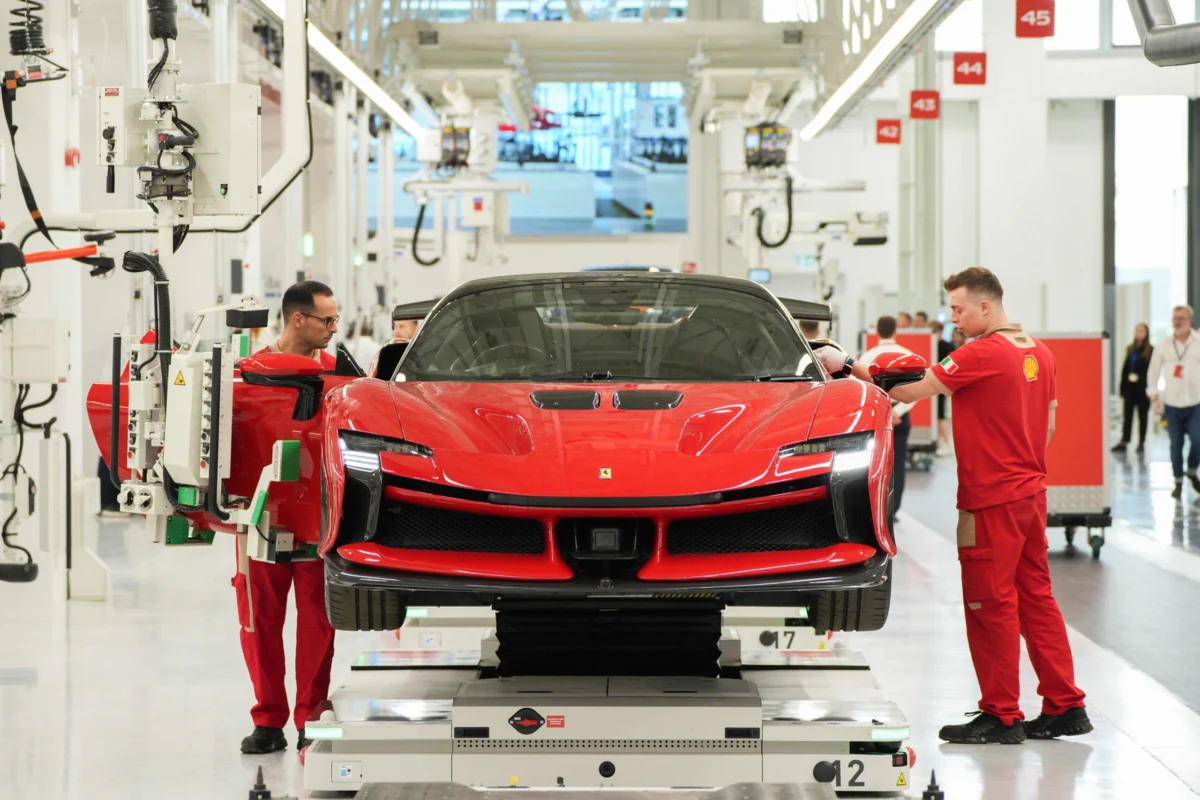
The company’s new E-building factory in Maranello, Italy, inaugurated on June 21, 2024, stands as a testament to Ferrari’s forward-looking strategy and its commitment to sustainable growth and technological evolution. This state-of-the-art facility is crucial for the production of Ferrari’s next generation of hybrid and electric vehicles, as well as for specialized internal combustion engine models. The E-building embodies Ferrari’s industrial flexibility and its dedication to integrating cutting-edge technology with traditional craftsmanship. Its operationalization provides the necessary infrastructure to support the company’s ambitious product roadmap, including upcoming launches and its eventual foray into fully electric supercars, ensuring that production capacity aligns with its long-term strategic objectives while maintaining its exacting standards of quality and exclusivity.
Leadership Insights and Market Reaction
Benedetto Vigna, Ferrari’s Chief Executive Officer, articulated the company’s strong position and strategic direction in a recent release. "Our order book now reaches into 2028, and we still have two more launches to come this year," Vigna stated. This extended order book, spanning over two years, is a powerful indicator of sustained demand and provides exceptional revenue visibility and production planning stability. It also underscores the brand’s pricing power and the unwavering desire of its clientele for its exclusive offerings. Vigna further emphasized the company’s dedication to client engagement: "In addition, we continue to create engaging events around the world to further tighten the bonds with our clients and partners across Racing, Sports Cars and Lifestyle." This holistic approach, integrating motorsports, road cars, and luxury lifestyle experiences, is central to reinforcing Ferrari’s unique ecosystem and fostering unparalleled customer loyalty.
The immediate reaction in the financial markets to Ferrari’s updated guidance was nuanced. Ferrari’s U.S. shares initially experienced a slight decline during premarket trading before rallying to turn positive, ultimately showing an increase of approximately 2%. This initial hesitancy was analyzed by industry experts. Tom Narayan, an analyst at RBC Capital Markets, commented on the market’s initial reception. He noted on Tuesday that while Ferrari’s results were "largely in line with Wall Street expectations," shares might have been "under slight pressure given some were hoping for a bigger guidance raise." However, Narayan quickly added an optimistic caveat, stating, "expect it to get better once folks realize these results are healthy." This perspective suggests that while some investors might have anticipated an even more aggressive upward revision, the underlying financial health and strategic positioning of Ferrari remain robust and fundamentally attractive for long-term investment. It highlights the high expectations placed on a company with Ferrari’s premium valuation and consistent performance.
Broader Implications for Ferrari and the Luxury Automotive Market
Ferrari’s continued upward revision of its financial outlook carries significant implications, not only for the company itself but also for the broader luxury automotive sector and the global investment community.
For Ferrari: The sustained growth trajectory, despite a deliberate moderation in shipment volumes, validates the company’s long-standing strategy of exclusivity, brand management, and premium pricing. The strength of customer personalization as a revenue driver indicates a deepening connection with its clientele and a successful monetization of its bespoke services. The robust order book extending into 2028 provides unparalleled stability and predictability for future earnings, allowing for strategic investments in new technologies, such as electrification, facilitated by the new E-building. This performance cements Ferrari’s position as a benchmark for financial health and brand strength in the ultra-luxury segment. The continued success in Formula 1 further reinforces its brand equity, which is invaluable in a market driven by passion and heritage.
For the Luxury Automotive Market: Ferrari’s performance serves as a key indicator of the health and resilience of the ultra-luxury segment. While mass-market automotive manufacturers may face headwinds from economic uncertainties, supply chain disruptions, and evolving consumer preferences, the demand for high-end, exclusive vehicles often remains robust. Wealthy consumers, who constitute Ferrari’s primary customer base, tend to be less affected by broader economic downturns, ensuring a steady demand for aspirational and status-defining products. Ferrari’s success underscores that brands with unique heritage, cutting-edge technology, and an unwavering commitment to exclusivity can thrive, even as the industry transitions towards new propulsion technologies. It suggests a bifurcated market where the top tier continues to command premium valuations and consistent demand.
For Investors: The successive guidance raises provide strong confidence to investors, signaling a management team that is not only delivering on its promises but also consistently finding avenues for enhanced profitability. The combination of strong revenue growth, improved profitability metrics, and robust free cash flow generation makes Ferrari an attractive proposition in a volatile market. The long order book mitigates short-term risks and provides clear visibility into future earnings. While initial market reactions might be influenced by short-term trading dynamics and potentially overly ambitious expectations, the fundamental health of the business, as highlighted by analyst commentary, supports a premium valuation. This performance reinforces the narrative that investing in established luxury brands with strong pricing power and global appeal can offer stability and growth potential.
In conclusion, Ferrari’s third-quarter performance and subsequent upward revision of its 2026 financial guidance underscore the company’s exceptional brand strength, strategic agility, and robust operational execution. By effectively leveraging customer personalization, managing currency impacts, and capitalizing on its racing heritage, Ferrari continues to defy broader market challenges, setting a high bar for excellence in the global luxury automotive landscape. The future, with an extended order book and new models on the horizon from its advanced E-building, appears exceptionally bright for the iconic Prancing Horse.
