

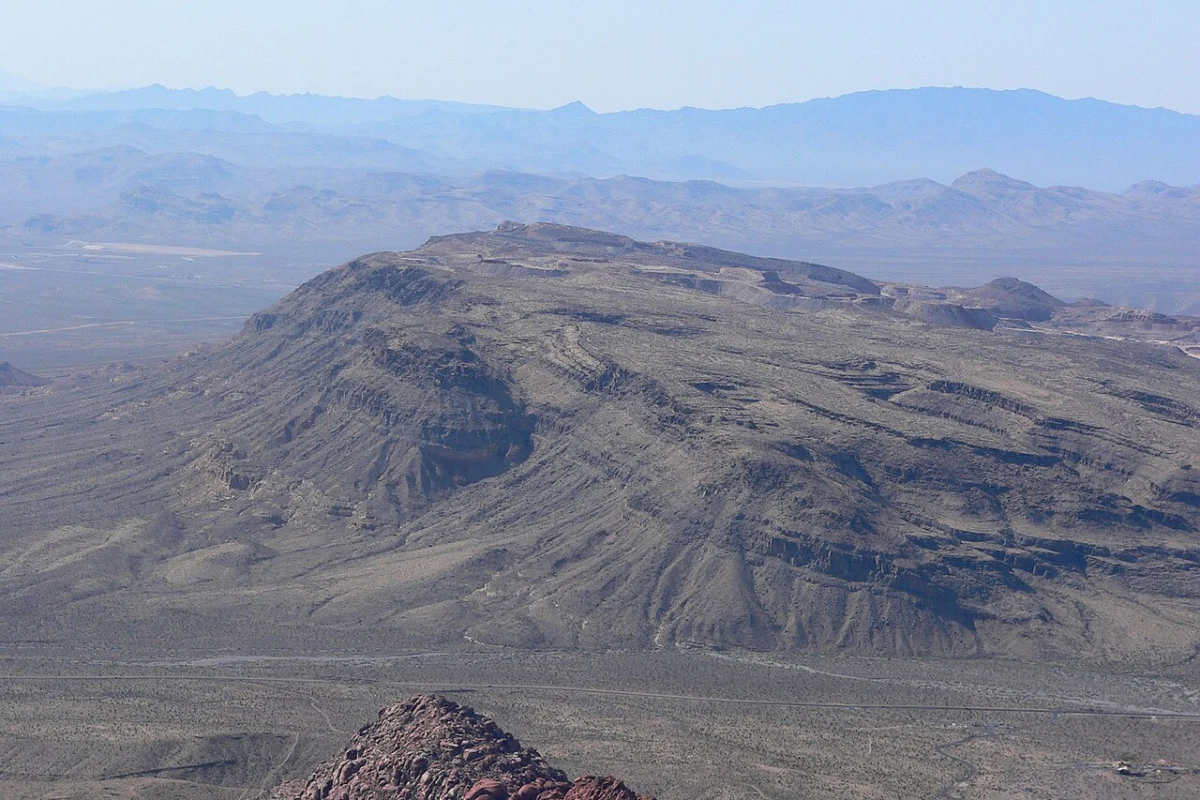
The Federal Energy Regulatory Commission (FERC) has issued a preliminary permit to Desert Bloom Energy Storage, LLC, for a massive hydroelectric pumped storage project on Blue Diamond Hill, a move that has reignited a decades-old debate over land use, water conservation, and the environmental integrity of the Red Rock Canyon National Conservation Area. Located approximately 15 miles southwest of Las Vegas, the proposed Desert Bloom Project represents a significant attempt to bolster Nevada’s renewable energy infrastructure, yet it faces formidable opposition from local water authorities, environmental advocates, and federal land managers who argue the project is fundamentally incompatible with the arid realities of the Mojave Desert.
The Desert Bloom Project is envisioned as a closed-loop pumped storage facility designed to generate approximately 1,170 gigawatt-hours of electricity annually. According to developer estimates, this output would theoretically be sufficient to provide power for hundreds of millions of homes, although such figures are often calculated based on peak demand mitigation rather than constant baseload supply. The issuance of the preliminary permit on May 4 does not grant the developers the right to begin construction or disturb the soil at the site; rather, it provides Desert Bloom Energy Storage, LLC, a three-year window of "priority" to conduct feasibility studies, environmental assessments, and financial modeling without competition from other developers for the same site.
Technical Specifications and the Pumped Storage Mechanism
The proposed facility relies on a well-established but resource-intensive technology known as pumped storage hydropower. In a closed-loop system, two reservoirs are constructed at different elevations. During periods of low electricity demand—typically when solar and wind generation are at their peak—excess electricity from the grid is used to pump water from the lower reservoir to the upper reservoir. When energy demand spikes, the water is released from the upper reservoir, flowing through high-capacity turbines to generate electricity as it returns to the lower basin.
For the Desert Bloom Project, the plan involves the construction of two massive reservoirs on Blue Diamond Hill, requiring an estimated 9,800 acre-feet of water. To put this volume into perspective, one acre-foot is roughly 326,000 gallons, meaning the project would require more than 3.1 billion gallons of water to fill and maintain. This volume represents approximately 5% of the total annual consumptive water use for the entire Las Vegas Valley Water District (LVVWD) service area.
The project’s proposal remains vague regarding the exact source of this water. In filings with FERC, the developers stated that the water necessary to fill and periodically replenish the reservoirs—which will lose significant volume due to the high evaporation rates characteristic of Southern Nevada—would be "either hauled or piped in from a yet-to-be-determined source."
A Chronology of Failure: Thirty-Five Years of Proposals
The Desert Bloom Project is not a novel concept; rather, it is the latest iteration in a long line of attempts to industrialize Blue Diamond Hill for hydroelectric purposes. The site’s elevation changes make it topographically attractive for pumped storage, but the logistical and environmental hurdles have proven insurmountable for previous developers.
The history of the site dates back to at least 1989, when the Blue Diamond South Pumped Storage Power Company and Blue Diamond Power Partners Limited Partnership first explored a 200-megawatt hydroelectric project. By 1996, regulators had issued a final environmental impact statement, and a license was granted in 1997. However, the project languished for nearly a decade without significant progress. In 2005, federal regulators officially terminated the license, citing a total lack of construction activity.

In 2017, a company named Control Technology Inc. proposed the "Blue Diamond Project," a plan nearly identical in scope and design to the current Desert Bloom proposal. That project reached the scoping phase but was plagued by missed deadlines and regulatory scrutiny. The Southern Nevada Water Authority (SNWA) and the Bureau of Land Management (BLM) raised significant objections, leading to the project’s eventual rejection by FERC in early 2024.
Despite this rejection, the Desert Bloom Project was filed shortly thereafter under new leadership. While the technical plans remain largely the same, the change in corporate entity allowed the proposal to bypass the immediate dismissal that would have met a refiling by the original company.
The Water Scarcity Conflict
The most significant barrier to the project is the availability of water in a region defined by a Tier 1 shortage on the Colorado River and aggressive conservation mandates. The Las Vegas Valley Water District has been vocal in its opposition, characterizing the project as a direct threat to the region’s long-term sustainability goals.
Bronson Mack, a spokesperson for the LVVWD, emphasized that Southern Nevada has spent decades cultivating a culture of conservation to stretch its limited allocation from the Colorado River. "A project that will consume approximately 10,000 acre-feet of water simply does not align with Southern Nevada’s conservation goals," Mack stated. He noted that the priority for the district is the "safeguarding of community water supplies through efficient water use," not the facilitation of large-scale industrial consumption that offers no direct benefit to the local water cycle.
Data from the Southern Nevada Water Authority further illustrates the scale of the demand. In previous filings regarding the site, the SNWA noted that the water required to fill the reservoirs would be equivalent to the total water needs of the entire Las Vegas Valley for an average of 11 days. Under current infrastructure constraints, it would take more than 400 days of continuous filling just to reach operational levels, a timeline that does not account for the massive evaporative losses that occur in the Mojave Desert, where annual evaporation rates can exceed ten feet of water depth.
Ecological Sensitivity and Land Management
The Bureau of Land Management, which oversees the public lands adjacent to the Red Rock Canyon National Conservation Area, has previously signaled that it will not authorize hydropower projects on the site if water rights cannot be secured. The BLM’s stance is rooted in the principle of preventing "unnecessary and undue degradation" of public lands.
The area is a critical habitat for several protected and sensitive species. Most notable is the Mojave Desert tortoise, which is listed as threatened under the Endangered Species Act. Additionally, the site is home to rare flora, including the Blue Diamond cholla and two species of two-toned penstemon (yellow and rosy). Construction of massive reservoirs, access roads, and high-voltage transmission lines would likely result in permanent habitat fragmentation and loss for these species.
In a 2022 letter regarding the previous iteration of the project, the BLM warned that authorizing such a project without a guaranteed water source would be a violation of federal land management standards. The agency noted that the industrialization of Blue Diamond Hill would have "severe impacts" on the visual and ecological integrity of the Red Rock Canyon area, which is one of Nevada’s most visited natural landmarks.

The Regulatory and Energy Landscape
The push for the Desert Bloom Project comes at a time of intense pressure to expand renewable energy storage. As Nevada strives to meet its Renewable Portfolio Standard (RPS) of 50% renewable energy by 2030, energy storage has become the "holy grail" of grid management. Pumped storage is often preferred over battery arrays because of its long lifespan and ability to provide large-scale discharge over several hours.
However, the "green versus green" conflict—where renewable energy goals clash with conservation and water management goals—is particularly acute in the American West. Patrick Donnelly, the Great Basin director for the Center for Biological Diversity, argues that developers are attempting to capitalize on the "energy emergency" to push through projects that would otherwise be non-starters.
"Pump storage is fundamentally not appropriate for the desert," Donnelly said. "This is not how we need to be using our water in the West." He further suggested that the project faces such significant "headwinds" that it is unlikely to ever receive final licensing, regardless of the preliminary permit.
Implications and Future Outlook
The issuance of the FERC preliminary permit is merely the beginning of a lengthy and likely litigious process. Over the next three years, Desert Bloom Energy Storage, LLC, must produce a series of reports detailing their progress on environmental studies and water acquisition. If they fail to meet strict deadlines, as their predecessors did, the permit will likely be revoked.
If the project moves forward, it will require a full Environmental Impact Statement (EIS) under the National Environmental Policy Act (NEPA). This process will involve extensive public comment periods and rigorous scientific review. Given the united opposition from the SNWA, the LVVWD, the Center for Biological Diversity, and local residents—including major real estate developer Jim Rhodes, who has his own history of contested development plans for the hill—the path to construction remains fraught with obstacles.
The Desert Bloom Project serves as a case study for the challenges of the energy transition in water-stressed environments. While the promise of 1,170 GWh of clean energy is attractive to grid operators, the cost of 3.1 billion gallons of water and the potential degradation of a national conservation treasure may prove too high a price for Nevada to pay. For now, Blue Diamond Hill remains a quiet backdrop to the Las Vegas skyline, but the battle over its future is once again moving into the federal spotlight.
