

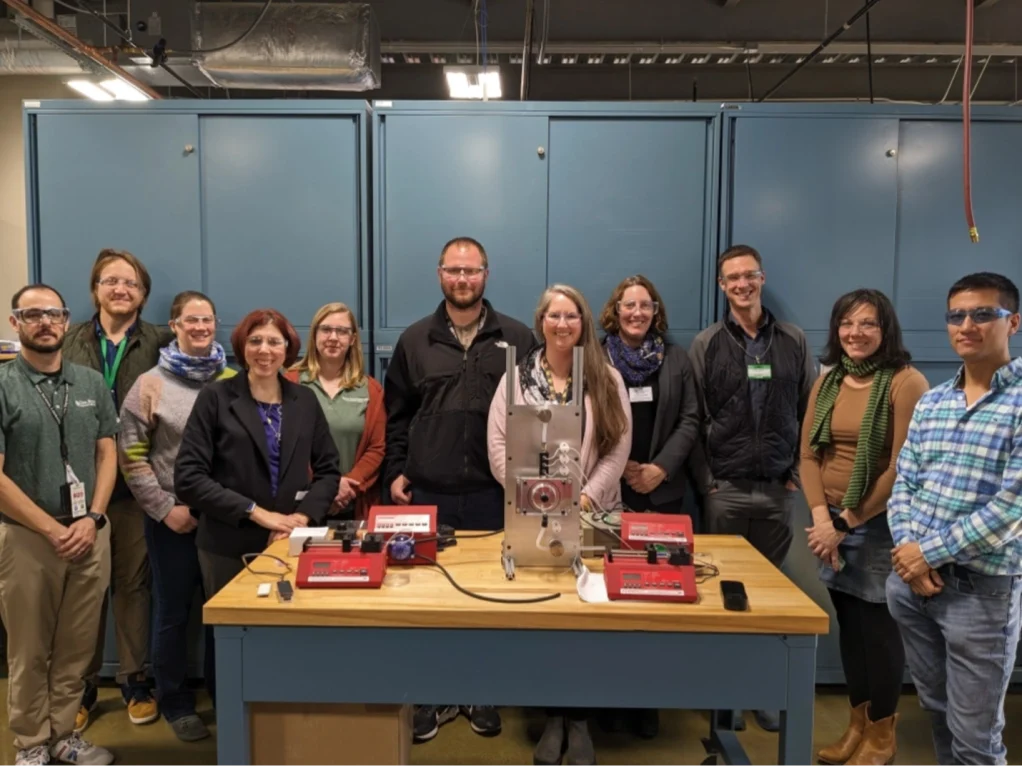
In a landmark collaboration aimed at transforming how scientists monitor aquatic ecosystems, researchers from two U.S. Department of Energy (DOE) national laboratories and a leading private biological equipment manufacturer have unveiled a pioneering autonomous aquatic robot. Known as the "eDNA-bot," this field-ready device is designed to collect, process, and analyze environmental DNA (eDNA) in real-time, leveraging artificial intelligence to make independent operational decisions. This technological leap promises to significantly reduce the cost and labor associated with traditional biological surveys while providing more comprehensive data for hydropower licensing, invasive species detection, and public health monitoring.
The project brings together the specialized expertise of Oak Ridge National Laboratory (ORNL) and Pacific Northwest National Laboratory (PNNL) alongside Smith-Root, a Vancouver, Washington-based company renowned for its biological surveying technology. By integrating AI-driven autonomy with sophisticated molecular analysis, the eDNA-bot represents a shift from reactive to proactive environmental stewardship, allowing for continuous monitoring in environments that were previously too remote or hazardous for human researchers.
The Science of Environmental DNA: A Non-Invasive Revolution
Environmental DNA, or eDNA, refers to the genetic material shed by organisms into their surroundings. As fish, mammals, insects, and microorganisms move through a water body, they leave behind traces of DNA through waste excretion, skin shedding, mucus, and reproductive activities. Even the decay of deceased organisms contributes to this "genetic soup."
Historically, assessing the biodiversity of a river or reservoir required physical capture methods such as netting, trapping, or electrofishing—a process where an electric current is used to temporarily stun fish for counting. While effective, these methods are labor-intensive, expensive, and can be stressful or harmful to the organisms being studied. Furthermore, traditional methods often miss "elusive species" that are rare, nocturnal, or inhabit inaccessible crevices.
The eDNA-bot bypasses these limitations by sampling the water itself. By filtering water and extracting genetic sequences, the device can identify the presence of specific species without ever seeing or touching them. This "molecular fingerprinting" allows researchers to detect the arrival of invasive species like zebra mussels or Asian carp long before they become established enough to be caught in a net.
A Strategic Partnership: Bridging the "Valley of Death" in R&D
The development of the eDNA-bot is facilitated by a Cooperative Research and Development Agreement (CRADA) between the national laboratories and Smith-Root. This partnership is designed to bridge the gap between laboratory-scale innovation and commercial viability, often referred to in the tech industry as the "Valley of Death."
Oak Ridge National Laboratory recently secured a patent for the eDNA-bot technology, providing the intellectual property foundation for the project. For Smith-Root, the collaboration offers access to high-level engineering and molecular biology resources that would be prohibitively expensive to develop in-house.
"It saves us as a company from having to do the R&D internally," said Austen Thomas, a scientist at Smith-Root, Inc. "There’s a huge capital expense to designing a system like this. Some of the components of this system are at an R&D level that we can’t achieve, so having the engineering and biology staff of the national labs available to develop that technology is a huge benefit. It reduces our risk as a company."
This model of public-private partnership ensures that taxpayer-funded research at national labs translates into tangible economic growth and practical tools for the private sector.
Chronology of Development: From Concept to Field-Ready Prototype
The journey of the eDNA-bot began in 2020 at ORNL, driven by the need for more efficient biomonitoring at hydropower facilities.
- 2020: Foundational Research. ORNL researchers began conducting experiments to understand the persistence and transport of eDNA in moving water. They sought to determine how long DNA remains detectable after an organism leaves an area and how water flow impacts the accuracy of localized sampling.
- 2021–2022: Reservoir Testing. The team conducted extensive field evaluations at several hydropower reservoirs, including sites managed by the Tennessee Valley Authority (TVA). The TVA, which manages approximately 40,000 miles of rivers and streams in the Southeast, provided a complex real-world environment for testing.
- 2023: Patent and AI Integration. As the hardware matured, ORNL moved to patent the system and began integrating AI algorithms. This allowed the bot to transition from a simple sampler to an autonomous decision-maker capable of adjusting its sampling frequency based on detected signals.
- 2024: The Smith-Root CRADA. The formal partnership with Smith-Root was established to begin the process of miniaturization and ruggedization for commercial use.
During the TVA reservoir trials, the eDNA-bot demonstrated its superiority over conventional methods by detecting several elusive species that had not been recorded in previous physical surveys. This confirmed the technology’s potential to provide a more accurate census of aquatic life.
Technical Specifications and the Role of Artificial Intelligence
The current iteration of the eDNA-bot is a sophisticated piece of machinery, but the team’s primary goal is miniaturization. Project lead Kristine Moody, a molecular ecologist at ORNL, envisions a device that is as portable as it is powerful.
The target specification for the next generation of the bot includes:
- Weight: Under 100 pounds, allowing for two-person transport.
- Size: Ideally "suitcase-sized" for easy transport on standard aircraft.
- Power: Long-lasting battery power capable of supporting autonomous missions for weeks or months.
- Autonomy: AI-driven navigation and sampling protocols.
The integration of AI is what distinguishes the eDNA-bot from standard automated samplers. The AI can be programmed to "hunt" for specific genetic markers. For example, if the bot detects a trace amount of a high-priority invasive species, the AI can trigger more frequent sampling or change its navigation path to "trace" the DNA plume back to its source. This real-time processing eliminates the weeks-long delay usually required to send samples to a shore-based laboratory.
Streamlining Hydropower Licensing and Environmental Compliance
One of the most significant economic impacts of the eDNA-bot lies in the hydropower sector. In the United States, hydropower licensing and relicensing through the Federal Energy Regulatory Commission (FERC) is an arduous and expensive process that can take five to ten years and cost millions of dollars.
A substantial portion of this cost is dedicated to environmental impact assessments. Power producers must prove that their operations are not harming endangered species or disrupting local ecosystems. Currently, this requires hiring large teams of biological consultants to conduct seasonal surveys over several years.
The eDNA-bot could streamline this process by:
- Reducing Labor Costs: Providing continuous data collection without the need for constant human presence.
- Improving Data Accuracy: Offering a year-round longitudinal view of the ecosystem rather than "snapshots" taken during biannual surveys.
- Enhancing Safety: Accessing tailwaters and high-flow areas near dams that are dangerous for human divers or boat-based surveyors.
By providing regulators with higher-quality data at a lower cost, the technology could expedite the deployment and maintenance of clean energy infrastructure.
Broader Implications: Invasive Species and Public Health
Beyond hydropower, the eDNA-bot has vast implications for biosecurity and public health. The ability to detect invasive species at the "early arrival" stage is critical. Once an invasive species like the emerald ash borer or the zebra mussel becomes established, eradication is often impossible, and management costs can reach billions of dollars. The eDNA-bot acts as an early-warning system, allowing for rapid response measures.
Furthermore, the technology is being eyed for wastewater and pathogen monitoring. During the COVID-19 pandemic, wastewater surveillance became a vital tool for tracking virus prevalence in communities. An autonomous bot capable of real-time pathogen detection could be deployed in municipal water systems or near industrial discharge points to monitor for outbreaks or illegal pollutant dumping.
"The bot would let us sample continuously and unobtrusively for months at a time," Moody noted. "It also would allow us to access sites that are too remote or too dangerous to easily accommodate human surveyors."
Future Outlook: Saltwater Adaptation and Global Reach
The next phase of the R&D process involves preparing the eDNA-bot for the harshest environments on Earth. While freshwater testing has been successful, the corrosive nature of saltwater presents a new set of engineering challenges.
Researchers at PNNL’s marine research center in Sequim, Washington, will lead the effort to ruggedize the bot for marine applications. This involves testing specialized coatings and seals to prevent salt corrosion and biofouling (the growth of barnacles and algae on the device).
The success of saltwater adaptation would open the door for the eDNA-bot to be used in offshore wind farm assessments, deep-sea mining monitoring, and open-ocean biodiversity studies. As the global community moves toward "Biodiversity Net Gain" policies and more stringent environmental regulations, the demand for autonomous, high-fidelity monitoring tools like the eDNA-bot is expected to surge.
By combining the analytical power of molecular biology with the efficiency of robotics and AI, ORNL, PNNL, and Smith-Root are not just building a robot; they are creating a new paradigm for how humanity interacts with and protects the natural world. The "suitcase-sized" future of environmental monitoring is no longer a distant vision, but a rapidly approaching reality.
