

The catastrophic impact of Winter Storm Uri, the multiday freeze that paralyzed the Texas power grid in February 2021, continues to resonate through the American automotive and energy sectors. For Kenneth Kovar, a 64-year-old resident of New Braunfels, Texas, the memories of that crisis remain vivid. Although his home did not lose electrical power during the freeze, the localized failure of infrastructure meant he could not operate his independent septic system. To keep his household functioning, Kovar was forced to manually fill his toilets with water drawn from his backyard swimming pool. This experience served as a catalyst for a significant shift in how he viewed his next vehicle purchase. When Kovar acquired a Ford F-150 last fall, he was not merely looking for a truck for transportation; he was investing in a mobile power plant capable of securing his home against future utility failures.
Today, Kovar utilizes a sophisticated hardware setup from Ford Motor Company that allows drivers of specific F-150 models to bridge the gap between the driveway and the living room. By plugging his vehicle directly into a specialized transfer switch installed at his electric meter, Kovar can bypass grid failures and maintain essential home functions. This development is part of a broader, high-stakes pivot by global automakers. As the growth of electric vehicle (EV) sales experiences a notable deceleration in the United States, car manufacturers are aggressively leveraging their multibillion-dollar investments in battery technology to enter the home energy business. This transition aims to transform EVs from simple modes of transport into critical components of domestic infrastructure and grid resiliency.
The Engineering of Residential Energy Integration
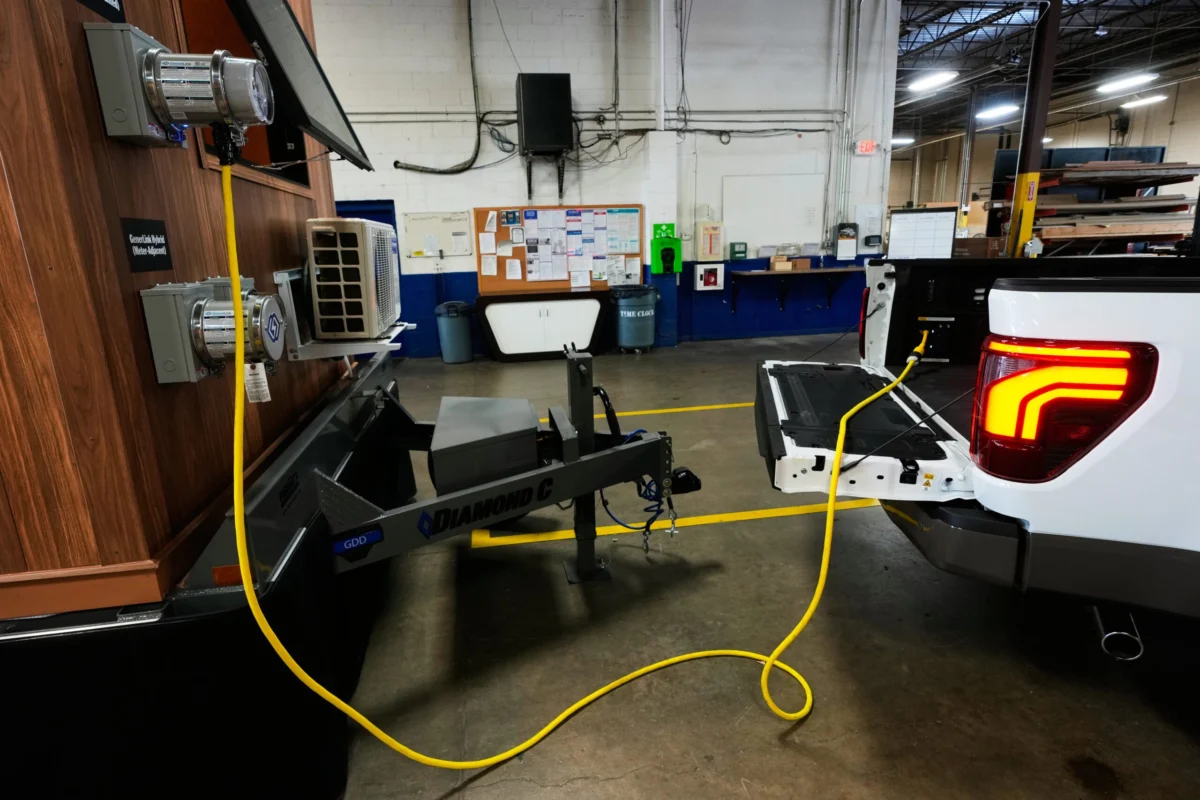
The latest technological offering from Ford simplifies the process of home backup power for owners of the F-150 PowerBoost hybrid and the all-electric F-150 Lightning. The system utilizes a one-foot-long adapter designed in collaboration with Global Power Products. This adapter connects to a 240-volt outlet located in the truck’s bed, which then links to a heavy-duty cable and a transfer switch mounted directly to the home’s electric meter.
Unlike more complex bidirectional systems that require extensive electrical overhauls, this solution allows homeowners to manually select which circuits in their breaker box they wish to energize. "The way we think about it, especially for customers who already have a compatible vehicle is, you already own the power source, it’s in your driveway," said Amanda Roraff, Ford’s lead for grid and energy services business acceleration. The capabilities of these vehicles are substantial: a fully charged F-150 Lightning can sustain a typical home’s essential loads for two to three days, while the PowerBoost Hybrid can provide power for up to five days by utilizing its internal combustion engine as a generator fed by a single tank of gasoline.
This approach offers a significant cost advantage over traditional emergency power solutions. Permanent, diesel- or natural gas-powered standby generators often require professional installation costs ranging from $5,000 to $15,000. In contrast, Ford’s meter-based solution starts at approximately $1,100, plus installation, making it an accessible entry point for the roughly 200,000 compatible Ford trucks currently on the road.
A Chronology of Grid Vulnerability and Automotive Innovation
The move toward vehicle-to-home (V2H) technology has been accelerated by a decade of increasing grid instability across North America.
- 2012–2019: Early Experimentation. Automakers began exploring "Vehicle-to-Load" (V2L) capabilities, primarily allowing users to plug tools or camping equipment into the car’s outlets.
- February 2021: The Texas Catalyst. Winter Storm Uri resulted in the deaths of over 200 people and left millions without power. The event highlighted the fragility of the centralized grid and sparked consumer interest in decentralized energy storage.
- May 2021: The Lightning Reveal. Ford debuted the F-150 Lightning with "Intelligent Backup Power," marking the first time a major U.S. automaker marketed a vehicle specifically as a home backup solution.
- 2022–2023: The Rise of Ecosystems. General Motors launched "GM Energy," a dedicated business unit designed to provide a suite of hardware and software for residential and commercial energy management.
- 2024–2026: Market Standardization. Industry leaders began moving toward universal standards for bidirectional charging, allowing vehicles to not only power homes but also sell energy back to the grid during peak demand.
Comparative Landscape: Tesla, GM, and Kia
Ford is not alone in its pursuit of the domestic energy market. The landscape is increasingly crowded with legacy manufacturers and tech-forward brands seeking to monetize the "gigawatt-hours" currently sitting idle in residential garages.
Tesla, long a leader in the stationary storage market with its Powerwall product, has integrated its Cybertruck into a similar ecosystem. The Cybertruck features full V2H capability, allowing it to interface with Tesla’s home hardware to provide seamless backup during outages. While older Tesla models primarily support V2L (powering specific appliances), the company is moving toward a unified bidirectional architecture across its fleet.
General Motors has taken a software-centric approach through partnerships with companies like WeaveGrid. This allows GM EV owners—specifically those with Ultium-platform vehicles—to enroll in utility programs that support grid reliability. When the system detects a grid failure, it can automatically disconnect the home from the utility lines and initiate power flow from the vehicle. Wade Sheffer, Vice President of GM Energy, noted that the goal is to provide customers with "full control of their energy," moving beyond simple transportation to a holistic management of domestic power.
Similarly, Kia has partnered with Wallbox, an EV charging specialist, to offer bidirectional solutions for its EV6 and EV9 models. This partnership focuses on "peak shaving"—using the vehicle’s battery to power the home during hours when utility rates are highest—and "Vehicle-to-Grid" (V2G) support, where homeowners can receive credits for discharging power back into the municipal system during emergencies.

Supporting Data: The Economic and Policy Shift
The urgency of these energy solutions is underscored by shifting market dynamics in the automotive industry. According to a July 2026 report from Cox Automotive, sales of pure electric vehicles in the United States fell by 23.8% year-over-year in the first half of the year. This slowdown has been attributed to high interest rates, consumer anxiety regarding charging infrastructure, and a shift in federal policy priorities.
However, as EV sales cool, the value proposition of the "battery on wheels" has become a vital marketing tool. Data suggests that over 630,000 vehicles on U.S. roads currently possess some form of bidirectional or exportable power capability. For many consumers, the ability to offset the cost of a home generator—or to avoid the high costs of peak-hour electricity—is becoming a primary driver of the "total cost of ownership" calculation.
Furthermore, the demand on the U.S. electrical grid is projected to grow by nearly 5% annually through 2030, driven by the electrification of heating, manufacturing, and data centers. With the North American Electric Reliability Corporation (NERC) warning that large swaths of the continent are at risk of energy shortfalls during extreme weather, the role of EVs as a distributed energy resource (DER) is moving from a niche luxury to a strategic necessity.
Challenges and Technical Hurdles
Despite the promise of V2H technology, several significant barriers remain. From a technical perspective, these systems must undergo rigorous third-party safety testing to meet Underwriters Laboratories (UL) standards. Ensuring that a vehicle does not "backfeed" electricity into a downed grid—which could be fatal for utility line workers—requires sophisticated "islanding" hardware and software.
Regulatory hurdles are equally daunting. In most jurisdictions, a homeowner must obtain an "interconnect agreement" from their local utility provider before they can legally connect a bidirectional power source to their meter. These approvals can take months or even years, depending on the utility’s familiarity with the technology.
Parth Vaishnav, an assistant professor of sustainable systems at the University of Michigan, suggests that while the technology is ready, the business models are still evolving. "Automakers are trying to look for other businesses that they might sell into," Vaishnav said, noting that the transition requires consumers to become much more literate in energy management. Homeowners must learn to manage their vehicle’s state of charge, ensuring they have enough "fuel" for both a morning commute and a potential midnight blackout.
Analysis of Implications for the Future
The convergence of the automotive and energy industries represents a fundamental shift in the American economy. If the millions of EVs expected to hit the road by 2030 are equipped with bidirectional technology, they will collectively represent a storage capacity far exceeding that of all existing pumped-hydro and stationary battery projects combined.
This decentralized "virtual power plant" could potentially eliminate the need for expensive "peaker" power plants—facilities that only run during times of extreme demand and are often the most polluting. By using EVs to stabilize the grid, utilities could lower overall costs for all consumers, not just those who own electric trucks.
For residents like Kenneth Kovar, the immediate benefit remains more personal. As extreme weather events become more frequent and the national grid ages, the peace of mind provided by a 2,000-pound battery in the driveway is becoming an essential feature of modern homeownership. Scott Samuelsen, engineering professor emeritus at the University of California, Irvine, summarizes the trend: "We already know during an outage its impact, providing electricity to the home. This is going to become very, very popular."
As automakers continue to refine these systems and lower the barrier to entry, the vehicle is no longer just a way to get from point A to point B; it is an insurance policy against an increasingly unpredictable world. The success of Ford’s new meter-based adapter may well signal the beginning of an era where the car is as integral to the home’s infrastructure as the furnace or the water heater.
