

DETROIT – Ford Motor Company is undergoing a significant executive realignment, marked by the departure of Doug Field, its chief EV, digital, and design officer, as the automaker consolidates critical functions under a newly established "Product Creation and Industrialization" organization. This strategic pivot aims to streamline operations and accelerate Ford’s ambitious targets for electric vehicles, advanced software, and an extensive product refresh cycle.
Field, a high-profile recruit from Tesla and Apple, who joined Ford in 2021 to spearhead its electric vehicle and software endeavors, has "elected to leave the company after a transition over the next month," according to a Ford statement issued on Wednesday. While the announcement hinted at a "next chapter" for Field, the executive refrained from disclosing specific future plans during a media call. His exit comes as Ford grapples with the complexities of its EV transition, including substantial investments, mounting losses in its Model e division, and intense market competition.
The announcement of Field’s departure was intricately linked with the unveiling of Ford’s new executive framework. This restructuring sees the creation of the "Product Creation and Industrialization" unit, an "end-to-end organization" designed to integrate responsibilities previously fragmented across various divisions. This crucial new entity will be led by Kumar Galhotra, a seasoned Ford veteran who currently serves as Chief Operating Officer. The company emphasized that this integration is designed to bolster its capacity to achieve key financial and operational objectives, including an aggressive target of an 8% adjusted EBIT (Earnings Before Interest and Taxes) margin by 2029.
The Strategic Imperative: Consolidating for the Future
Ford’s decision to not directly replace Field underscores a strategic shift towards a more integrated, systems-level approach to product development and manufacturing. Field’s initial hiring in 2021 was hailed by Ford CEO Jim Farley as a "watershed moment," signaling a profound commitment to leveraging Silicon Valley expertise in software and advanced technology. Field’s background, having played pivotal roles in developing the Tesla Model 3 and leading Apple’s secretive car project, brought a potent blend of EV and consumer electronics innovation to Ford. His mandate was to elevate Ford’s connected vehicle platforms, embedded software, and advanced driver-assistance systems (ADAS) to industry-leading standards.
However, the journey has been fraught with challenges. While Field was instrumental in setting the technological foundation for Ford’s next-generation EVs, the automaker has faced significant headwinds. The Model e division, responsible for Ford’s electric vehicle business, reported substantial pre-tax losses, including a staggering $4.7 billion in 2023, following $2.1 billion in 2022. These losses, significantly higher than anticipated, have prompted Ford to reassess its EV strategy, including scaling back some production targets and re-evaluating investment timelines. Most notably, in December, Ford announced a massive $19.5 billion write-down related to its EV pullback and a realignment of business priorities, dwarfing comparable charges from rivals like General Motors, which reported roughly $7.6 billion in similar charges. These financial setbacks highlight the immense capital requirements and market volatility inherent in the automotive industry’s transition to electrification, even for a legacy automaker with Ford’s scale.
A New Era Under Kumar Galhotra: Product Creation and Industrialization
The new "Product Creation and Industrialization" unit under Kumar Galhotra represents Ford’s intensified focus on execution and integration. This organization is tasked with delivering "one of the most intensive product, software, and services rollouts in Ford’s history." Its mandate is comprehensive, encompassing everything from vehicle concept and design to engineering, supply chain management, and manufacturing processes. By consolidating these functions, Ford aims to eliminate potential silos, accelerate decision-making, and ensure a seamless transition from innovative ideas to mass production.
Galhotra, with his extensive experience across Ford’s global operations, including leading Ford North America and previously overseeing global product development, is well-positioned to steer this integrated approach. His leadership signifies a return to a more traditional automotive leadership structure, albeit one heavily infused with the advanced technological ambitions championed by Field. The new structure suggests an emphasis on industrial efficiency and manufacturing prowess alongside cutting-edge design and software.
Ambitious Product Refresh and Electrification Timeline
At the core of this restructuring is an aggressive product strategy. Ford plans to refresh a substantial portion of its global portfolio by 2029: 80% of its North American volume and 70% of its global volume. This ambitious overhaul will span its most iconic vehicles, including the next-generation F-150 and the larger F-Series Super Duty lineup, alongside a cascade of new offerings.
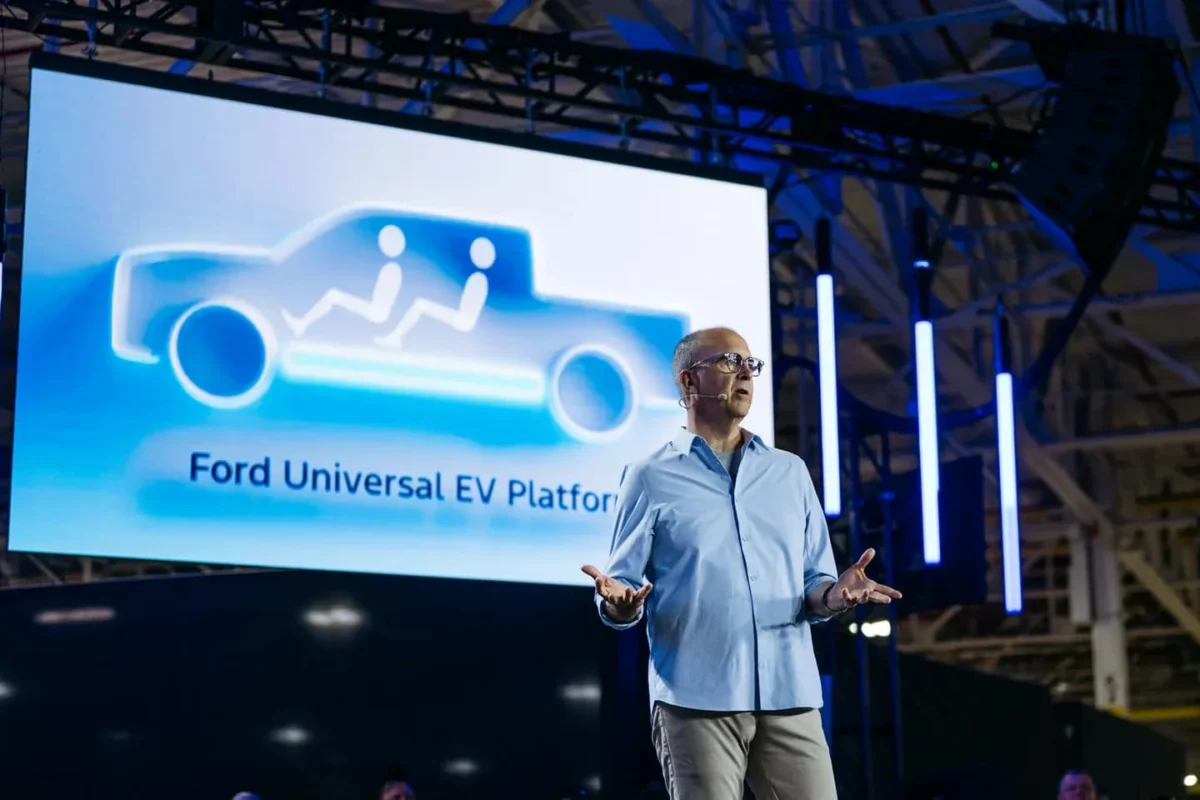
A cornerstone of this strategy is the "Universal Electric Vehicle" (UEV) platform. This modular architecture is designed to underpin a wide range of future EVs, promising economies of scale and accelerated development cycles. The first vehicle slated to emerge from this platform is a crucial midsize pickup truck, anticipated to launch next year. CEO Jim Farley has previously underscored the transformative potential of this next generation of electric vehicles, likening their significance to that of the iconic Model T, which democratized personal transportation a century ago. Both Farley and Field, on the media call, affirmed that the UEV pickup project is in a robust position to proceed seamlessly within the new organizational structure, despite Field’s impending departure.
By 2030, Ford has set a target for 90% of its global nameplates to offer electrified powertrains, which will include a mix of hybrids, extended-range electric vehicles, and full battery electric vehicles (BEVs). This multi-pronged approach acknowledges varying customer preferences and infrastructure readiness across different markets, providing flexibility in its transition away from purely internal combustion engine (ICE) vehicles.
Software-Defined Vehicles and Autonomous Driving Aspirations
Beyond hardware, Ford is making a significant push into software-defined vehicles. By 2030, the company aims for 90% of its vehicles by volume to feature updated "electrical architectures, in-house developed user experiences and hardware, and next-generation over-the-air (OTA) capabilities." These advancements are critical for delivering continuous improvements, new features, and personalized experiences to customers throughout the vehicle’s lifecycle. OTA updates, popularized by Tesla, allow automakers to deploy software fixes, enhance performance, and even unlock new functionalities remotely, transforming the vehicle from a static product into an evolving digital platform.
Crucially, these technological foundations will enable the rapid rollout of advancements to Ford’s digital experience for customers and its BlueCruise advanced driver assistance system. BlueCruise, Ford’s current Level 2 ADAS offering, allows for hands-free driving on designated highways. The company has a stated goal to achieve "eyes-off Level 3 autonomous driving" by 2028. Level 3 autonomy, as defined by SAE International (formerly the Society of Automotive Engineers), signifies "conditional automation," where the vehicle can handle most driving tasks under specific conditions, but still requires the human driver to be ready to intervene when prompted. This ambitious target places Ford at the forefront of the race towards higher levels of vehicle autonomy, a technology that promises to revolutionize safety, convenience, and potentially, business models within the transportation sector. The progression from Level 0 (no automation) to Level 5 (full automation) involves increasing technological sophistication and a gradual reduction in human driver involvement, with Level 3 being a critical step before full self-driving capabilities.
Leadership Commentary and Broader Industry Context
During the media call, Jim Farley spoke highly of Doug Field’s contributions, describing him as an "invaluable partner" who "has built a world-class team at Ford." This sentiment reflects the appreciation for Field’s technological vision and his role in instilling a Silicon Valley mindset within Ford’s product development culture. However, the subsequent restructuring and Field’s departure also tacitly acknowledge the formidable challenges of integrating disruptive technologies into a legacy automotive giant, particularly amidst a fiercely competitive and rapidly evolving global market.
The broader automotive industry is navigating a complex landscape characterized by a slowdown in EV demand growth, persistent supply chain disruptions, and the escalating costs of developing both electric and software-intensive vehicles. Traditional automakers like Ford are under immense pressure to transition their vast manufacturing infrastructure, retrain their workforce, and fundamentally redefine their business models while simultaneously defending market share against agile new entrants and established tech giants. The write-downs and strategic realignments seen at Ford and other legacy players are indicative of the recalibration underway as the industry adjusts its expectations for the pace and profitability of the EV transition.
This comprehensive restructuring at Ford, culminating in Field’s departure and the creation of the Product Creation and Industrialization unit, signals a renewed emphasis on streamlined execution and integrated strategy. It represents Ford’s determined effort to navigate the complexities of the automotive future, aiming to leverage its scale and manufacturing prowess to deliver on its ambitious electrification, software, and autonomous driving promises, ultimately striving for sustained profitability in a rapidly transforming industry.
