

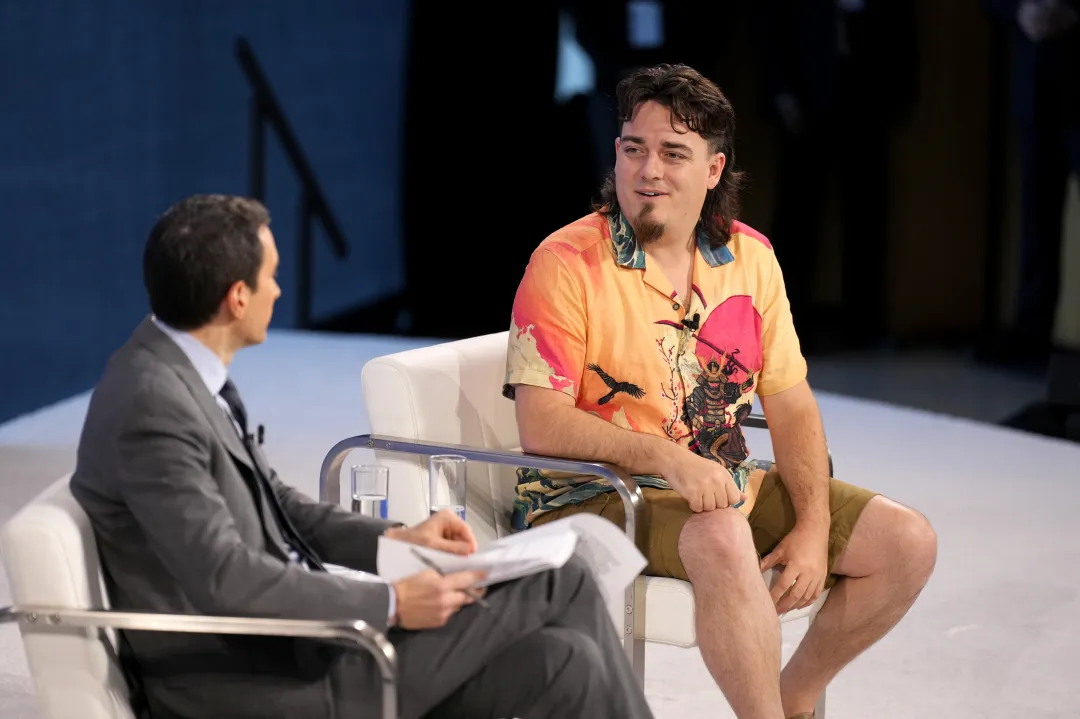
Defense technology magnate Palmer Luckey, whose multi-billion dollar drone and weapons enterprise Anduril Industries is heavily vested in government defense contracts, recently articulated a stark warning about the nation’s vulnerability to catastrophic events, urging Americans to adopt a survivalist mindset. During a pivotal conversation with Andrew Ross Sorkin at the Dealbook Summit on Wednesday, Luckey, a figure known for his innovative yet unconventional views, painted a grim picture of potential societal disruptions, hinting at undisclosed cyber warfare activities and the urgent need for individual and collective preparedness. His remarks, delivered against a backdrop of recent, high-profile system outages across critical sectors, underscore a growing concern among some tech and defense elites about the resilience of modern infrastructure against sophisticated threats.
The Dealbook Summit: A Platform for Urgent Warnings
The annual Dealbook Summit, hosted by The New York Times, serves as a prominent forum where global leaders in finance, technology, and politics converge to discuss pressing economic and geopolitical issues. It was within this influential setting that Palmer Luckey, co-founder of Oculus VR before establishing Anduril, seized the opportunity to share his disquieting outlook. His dialogue with veteran financial journalist Andrew Ross Sorkin quickly veered from conventional tech discourse into an unsettling exploration of national security, cyber fragility, and the necessity for basic emergency readiness. Luckey’s presence, representing a company valued at an estimated $90 billion that specializes in advanced autonomous defense systems, lent significant weight to his pronouncements, positioning them beyond mere speculative rhetoric.
Anduril Industries: Reshaping Modern Warfare
To understand the gravity of Luckey’s warnings, it is crucial to appreciate the nature and mission of Anduril Industries. Founded in 2017, Anduril has rapidly ascended to become a formidable player in the defense technology landscape. The company’s core focus lies in developing artificial intelligence-powered autonomous systems for military applications, including drones, surveillance towers, and command-and-control software. By leveraging cutting-edge AI and machine learning, Anduril aims to modernize defense capabilities, offering solutions that promise greater efficiency, precision, and adaptability in complex operational environments. Its impressive valuation and numerous government contracts underscore a strong belief in its innovative approach to national security. Luckey, as the public face and visionary behind this enterprise, holds a unique vantage point on the evolving nature of threats, particularly those involving advanced technology and cyber warfare. His company’s work inherently involves understanding the most sophisticated forms of attack and defense, making his public statements about systemic vulnerabilities particularly resonant.
A String of Unsettling Outages: The Immediate Context
Luckey’s cautionary statements were not made in a vacuum. They followed a series of significant, large-scale system outages that had recently plagued major technological and governmental entities, triggering widespread concern and speculation. In November 2026, several high-profile incidents disrupted critical services:
- Apple Services: On November 17, 2026, Apple’s ecosystem experienced widespread disruptions, affecting key services including iCloud, the App Store, and Apple Music. Millions of users globally reported difficulties accessing essential digital platforms, causing significant inconvenience and raising questions about the resilience of even the most robust tech infrastructures.
- Microsoft Cloud Crisis: Just days prior, on November 13, 2026, Microsoft faced a severe global cloud crisis, beginning with email outages that escalated to impact a broader range of its cloud services. This incident underscored the interconnectedness of modern digital life and the cascading effects when foundational cloud providers experience failures.
- National Security Agency (NSA) Network Downtime: A highly classified national security communications network used by the NSA reportedly went down around November 17, 2026. While details remained sparse due to the sensitive nature of the system, such an outage within a critical intelligence agency sparked considerable alarm regarding national security vulnerabilities.
- Federal Aviation Administration (FAA) Grounding: Also on November 13, 2026, the U.S. government was forced to ground all flights across the United States due to what was described as "extraordinary circumstances" affecting the FAA’s systems. This unprecedented event paralyzed air travel nationwide, demonstrating the profound impact of infrastructure failures on daily life and economic activity.
Collectively, these incidents fueled public concern that the nation might be under coordinated cyberattack by malicious actors. While government officials, including a U.S. official cited on November 17, 2026, publicly stated that these recent tech woes were not tied to cyberattacks, Luckey offered a more cryptic and unsettling perspective.
The Cyber Warfare Enigma: Beyond Official Narratives
Luckey explicitly challenged the official narrative regarding the recent outages, suggesting a deeper, more sinister undercurrent. "Look, all the 4chan schizo posters are like 12 hours ahead of the mainstream media on this. You guys are going to find out what’s going on soon enough," he remarked, alluding to fringe online communities often associated with early, albeit unverified, dissemination of information. This statement from a defense industry leader carries significant weight, implying that the public and even mainstream media might be lagging behind in understanding the true nature of unfolding events, particularly in the realm of cyber conflict.
When pressed by Sorkin about backstage comments regarding a potential "cyber war that seems to be going on around us," Luckey elaborated on a fundamental "mismatch." He described a perilous imbalance between the advanced, AI-powered cyberattacks that are increasingly prevalent and the "old, outdated systems that are not able to adopt technology as quickly as it is developed." This technological disparity, he argued, creates a critical vulnerability for national infrastructure. His call to action was unequivocal: "I think people are going to have to pick up the pace. It’s time to start running."
The Accelerating Pace of AI in Cyber Warfare
Luckey’s concerns about AI-powered cyberattacks are well-founded in contemporary cybersecurity discourse. Artificial intelligence and machine learning are rapidly transforming the landscape of both offensive and defensive cyber operations. On the offensive side, AI can be leveraged to:
- Automate Exploitation: Identify and exploit vulnerabilities in target systems at machine speed, far faster than human operators.
- Evolve Malware: Create self-modifying malware that can evade detection and adapt to defensive measures.
- Sophisticated Phishing: Generate highly personalized and convincing phishing campaigns that are difficult to distinguish from legitimate communications.
- Reconnaissance and Mapping: Automate the mapping of network topologies and identification of critical assets within target organizations.
Conversely, AI is also crucial for defense, but its adoption can be slow for organizations burdened by legacy systems, budgetary constraints, or a lack of skilled personnel. This creates the "mismatch" Luckey highlighted, where attackers benefit from agility and advanced tools, while defenders struggle with reactive measures on outdated platforms. The implications for critical infrastructure – including energy grids, water treatment plants, transportation networks, and financial systems – are particularly alarming, as successful attacks could lead to widespread societal disruption, economic paralysis, and even loss of life.
Palmer Luckey: The Proponent of Preparedness
Sorkin directly challenged Luckey with the question, "What does that mean? Are you a prepper?" Luckey, rather than refuting the label, embraced it with a characteristic blend of humor and earnestness. "I own a missile base 200 feet underground," he quipped, eliciting laughter from the audience. He quickly qualified this, acknowledging that a missile base, while a substantial asset, is "actually a pretty bad way to run from the apocalypse" due to its known location and design for specific types of attacks.
However, Luckey pivoted to advocate for more fundamental, accessible forms of preparedness. "The point is, like everyone should have three days of water. Everyone should have three days of dry food. If you have prescription medication, don’t go refill it when you run out. Make sure you refill it 72 hours before you run out." He lamented what he perceives as a societal amnesia regarding basic emergency readiness: "People used to be taught this in middle school, and now everyone who remembers that is treated like a nut."
This sentiment reflects a broader debate about individual responsibility versus systemic resilience. While governments and corporations work to secure critical infrastructure, Luckey argues for a baseline of personal preparedness that he believes has been lost in an era of perceived stability and instant gratification. His advice aligns closely with general emergency guidelines promoted by agencies like the Federal Emergency Management Agency (FEMA) and the American Red Cross, which advocate for maintaining emergency kits with food, water, medicine, and other essentials for at least 72 hours.
A History of "Prepping": Luckey’s Long-Standing Convictions
Luckey’s current advocacy for preparedness is not a recent development but rather a long-standing personal conviction. As far back as 2017, a person familiar with the billionaire’s lifestyle described him as a "prepper." His acquisition of decommissioned Cold War-era underground bases is well-documented. These aren’t isolated purchases; reports indicate he owns several such facilities. In 2024, he revealed that one of these subterranean bunkers serves as a secure repository for his massive video game collection, illustrating a practical application of his preparedness philosophy, even for his hobbies.
This history suggests that Luckey’s concerns about societal collapse or cataclysmic events predate the recent string of outages. His work in defense technology, therefore, can be seen as two sides of the same coin: building advanced systems to prevent such events, while simultaneously preparing for their potential failure. This dual approach distinguishes him from many of his tech peers, who often focus solely on innovation without publicly addressing the potential downsides or extreme contingencies.
Broader Implications and The Call for Resilience
Palmer Luckey’s Dealbook Summit appearance serves as a potent reminder of the fragility inherent in our increasingly interconnected, digitally dependent world. His warnings resonate with a segment of the public and expert community that believes the pace of technological advancement in offensive cyber capabilities is outstripping defensive measures, particularly for legacy systems.
The implications of his statements are multi-faceted:
- National Security: Acknowledging a "cyber war" suggests a state of ongoing, undeclared conflict with potentially severe consequences for national infrastructure and defense capabilities.
- Public Trust: Luckey’s cryptic remarks about "4chan" and delayed mainstream media reporting could erode public trust in official government assurances regarding the nature of system outages.
- Economic Stability: Widespread and prolonged outages, whether from cyberattacks or other causes, can cripple economies, disrupt supply chains, and lead to massive financial losses. The recent FAA grounding alone likely cost airlines and related industries millions.
- Societal Preparedness: His emphasis on individual readiness highlights a gap in modern civic education and encourages a re-evaluation of basic survival skills in an era where many take constant connectivity and services for granted.
- Technological Investment: Luckey’s "mismatch" argument implicitly calls for accelerated investment in advanced cybersecurity solutions, particularly those leveraging AI, to protect critical infrastructure.
While the government continues to reassure the public that recent outages were not cyberattack-related, the warnings from figures like Palmer Luckey, deeply embedded in the defense technology sector, inject a note of urgency and caution. They compel a deeper examination of national resilience, both at the governmental and individual levels, in the face of an ever-evolving and increasingly complex threat landscape. The question remains whether society is truly "picking up the pace" or merely running in place as the digital world accelerates towards an uncertain future.
