

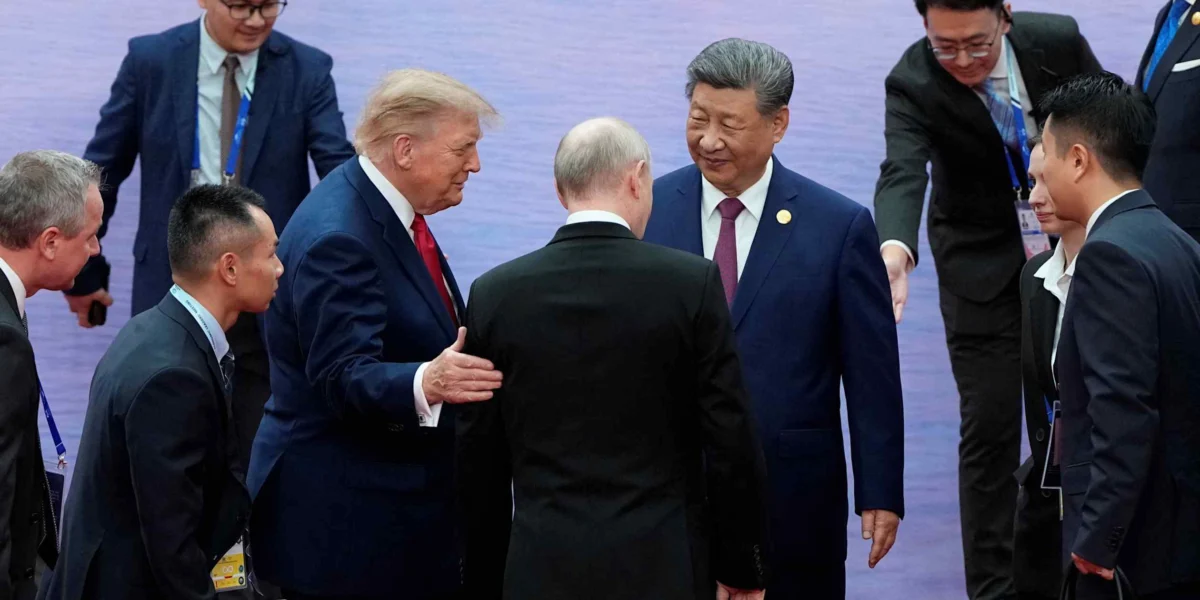
SHENZHEN — Chinese President Xi Jinping is hosting a pivotal Asia-Pacific Economic Cooperation (APEC) forum in the southern tech hub of Shenzhen, an event unfolding against a backdrop of escalating global conflicts and a complex superpower rivalry. The summit, which commenced with a CEO Summit and transitioned into an Economic Leaders’ Meeting, is marked by the anticipated presence of U.S. President Donald Trump and Russian President Vladimir Putin. On the sidelines, Xi is expected to engage in his third summit of the year with Trump, a crucial engagement aimed at navigating the fraught relationship between the world’s two largest economies. The confluence of leaders, particularly the potential for a trilateral meeting involving Xi, Trump, and Putin, has drawn historical parallels to the Yalta Conference of 1945, underscoring the gravity of the geopolitical discussions anticipated.
The presence of President Trump in Shenzhen adds another layer of intrigue, with reports suggesting a potential meeting with North Korean leader Kim Jong Un. This surprise announcement, made before Trump’s departure for Asia, could further elevate the summit’s status as a critical diplomatic crossroads. Nikkei Asia is on the ground in Shenzhen, providing comprehensive coverage of these high-stakes meetings.
APEC Summit: A Stage for Geopolitical Dynamics
The Asia-Pacific Economic Cooperation (APEC) forum, established in 1989, serves as a multilateral platform for dialogue and cooperation among 21 economies in the Asia-Pacific region. Its primary objective is to promote free trade and economic integration, fostering sustainable growth and prosperity. However, this year’s gathering in Shenzhen transcends typical economic discussions, evolving into a significant geopolitical arena. The city itself, a testament to China’s rapid technological advancement and economic transformation from a fishing village to a global innovation hub, provides a fitting backdrop for discussions on the future of global trade and technology.
The summit’s agenda is packed with discussions on expanding mutual openness, exploring innovation-driven growth, and broadening opportunities for practical cooperation. Yet, the shadow of ongoing conflicts, including the protracted war in Ukraine and simmering tensions with Iran, casts a long shadow over the proceedings. The potential for a trilateral summit between Xi, Trump, and Putin on Thursday, as indicated by the White House, is a focal point of international attention, reminiscent of the post-World War II power realignments.
Key Developments and Diplomatic Maneuvers
Thursday, November 19, 2026
-
08:00 a.m. (Shenzhen Time): The most anticipated day of the APEC gathering is set to unfold. President Trump’s schedule includes an APEC Leaders’ Plenary Session at 09:45 a.m., followed by a bilateral meeting with President Xi, and then the highly scrutinized trilateral summit with Xi and Putin. The possibility of North Korean leader Kim Jong Un’s attendance, though speculative, remains a significant wildcard, given the opaque nature of information from Pyongyang.
-
12:10 a.m. (Shenzhen Time): In a significant sideline engagement, Japanese Prime Minister Sanae Takaichi held a 30-minute meeting with Russian President Vladimir Putin. This marked the first face-to-face leaders’ encounter between the two nations since Russia’s invasion of Ukraine in 2022. According to the Japanese government, Prime Minister Takaichi urged President Putin to facilitate the release of a Japanese journalist detained for over a month and to reverse measures placing Japan Tobacco’s Russian subsidiaries under local management. Both leaders agreed to maintain ongoing communication channels.
Wednesday, November 18, 2026
-
9:20 p.m. (Shenzhen Time): At the APEC leaders’ banquet, President Xi Jinping, in his welcome address, urged APEC leaders to strive for "concrete results" in their discussions. He emphasized the importance of addressing issues such as expanding mutual openness, charting paths for innovation-led growth, and broadening opportunities for practical cooperation across diverse sectors. Xi eloquently highlighted Shenzhen’s transformation from a small fishing village into a "gateway for China’s high-standard opening-up," underscoring that "openness is in Shenzhen’s DNA."
-
9:00 p.m. (Shenzhen Time): Images and footage emerging from the APEC leaders’ banquet provided a glimpse of crucial diplomatic interactions. President Trump and President Putin were observed shaking hands, a visual prelude to their much-anticipated trilateral summit. President Xi was also seen engaging in a handshake with Japanese Prime Minister Sanae Takaichi. This meeting was particularly noteworthy given the frosty relations between China and Japan over the past year, exacerbated by Prime Minister Takaichi’s past remarks regarding a potential Taiwan crisis. The photograph captured Prime Minister Takaichi smiling broadly, suggesting a moment of diplomatic thaw.
-
7:00 p.m. (Shenzhen Time): Chinese President Xi Jinping and his wife, Peng Liyuan, hosted a banquet at the Shenzhen International Exchange Center for APEC leaders. Live broadcasts from state broadcaster CCTV showed the arrival of U.S. President Donald Trump at the venue.
-
6:00 p.m. (Shenzhen Time): South Korean President Lee Jae Myung held bilateral talks with President Xi Jinping. The meeting occurred amidst growing speculation about a potential encounter between President Trump and North Korean leader Kim Jong Un in Shenzhen. According to South Korean National Security Adviser Wi Sung-lac, as quoted by Yonhap news agency, President Xi conveyed his willingness to support "various efforts aimed at easing tensions on the Korean Peninsula, including a North Korea-U.S. dialogue." President Lee had urged China to play a "constructive role" in addressing Korean Peninsula issues, describing them as a "do or die" matter for South Korea. Notably, Chinese state-owned news outlet Xinhua’s account of the meeting did not mention a potential Trump-Kim summit or Korean Peninsula tensions. Xi and Lee acknowledged the upcoming 35th anniversary of their countries’ diplomatic relations, with Xi viewing it as an opportunity to foster steady ties. Xi also remarked that both nations are "beneficiaries of multilateralism and free trade," a subtle contrast to the U.S. under Trump’s protectionist policies. President Lee emphasized strengthening bilateral relations based on "mutual trust and friendship."
-
5:05 p.m. (Shenzhen Time): President Xi Jinping greeted President Trump upon his arrival at the airport, reciprocating a gesture Trump had made during his visit to Washington in September. Despite recent escalations in tensions between the U.S. and China concerning technology restrictions and other contentious issues, the Shenzhen gathering presents an opportunity to preserve their fragile trade truce. The atmosphere at the airport appeared cordial, with both presidents engaging in conversation and smiles before proceeding past an honor guard and a welcoming delegation. Xi was seen waving as Trump departed in his heavily armored limousine, "The Beast."
-
4:45 p.m. (Shenzhen Time): President Trump’s Air Force One landed in Shenzhen, with television footage capturing the aircraft taxiing at the airport.
-
3:30 p.m. (Shenzhen Time): Australian Prime Minister Anthony Albanese shared his early impressions of Shenzhen with fellow CEOs, recalling his first visit in 1998 when the city was far from the technological powerhouse it is today. He remarked on the city’s profound transformation, likening it to Thailand’s Anutin, who also highlighted Shenzhen as an exemplar of regional success.
-
3:00 p.m. (Shenzhen Time): Thai Prime Minister Anutin Charnvirakul recounted a conversation with Chinese Premier Li Qiang in Bangkok, where Li emphasized Shenzhen’s remarkable evolution from a fishing village to a global business metropolis over four decades. Charnvirakul interpreted this narrative as a powerful illustration of how economic transformation is achievable through openness. He also highlighted Thailand’s preparations for OECD accession, noting its role in improving governance, regulatory standards, and transparency. Addressing the issue of online scam operations, particularly in Thailand’s border regions, Charnvirakul stressed the necessity of a "global partnership" to combat cross-border organized crime.
-
2:15 p.m. (Shenzhen Time): Canadian Prime Minister Mark Carney addressed the APEC business gathering, detailing Canada’s "practical steps" towards financial cooperation with China, including measures for times of economic stress. He also pointed to growing collaboration in the green economy, acknowledging the opportunities presented by China’s wind and solar industries. Carney, whose government has sought to improve relations with China despite traditional U.S. alignment, praised China’s leadership for transforming Shenzhen into a tech hub, stating, "The choices that built this city will lift this whole region." He added that "Canada has made our choice to build a more stronger, prosperous and a more sovereign future." Carney acknowledged the challenging global geopolitical climate but affirmed APEC’s commitment to tangible cooperation.
-
12:00 p.m. (Shenzhen Time): South Korean President Lee Jae Myung met with President Xi Jinping on the sidelines of the summit. President Lee expressed a desire to collaborate on promoting peace and stability on the Korean Peninsula. President Xi conveyed China’s willingness to work with South Korea on preserving stable industrial supply chains. This meeting occurred amidst growing speculation about a potential appearance by North Korean leader Kim Jong Un at APEC, with U.S. Secretary of State Marco Rubio indicating Trump’s serious interest in engaging with Kim.
-
11:30 a.m. (Shenzhen Time): Russian President Vladimir Putin delivered a speech implicitly criticizing "former dominant powers" for attempting to suppress the development of other nations. He asserted that "economic domination and coercion are now a thing of the past," praising countries that have maintained their identities and independence. Putin argued that sanctions and tariffs have not hindered Russia’s progress. He lauded Shenzhen as a "modern vibrant megacity" symbolizing China’s and Asia’s technological, economic, and social transformation, suggesting the region is setting an example for a "more fair, democratic and equal world order." Putin expressed anticipation for significant outcomes from his upcoming trilateral meeting with Xi and Trump.
-
11:15 a.m. (Shenzhen Time): Malaysian Prime Minister Anwar Ibrahim addressed business leaders, offering praise for the host nation while delivering a thinly veiled critique of the U.S. without naming it directly. He underscored the importance of free and open business practices, stating, "You can’t say in one voice [that you’re] promoting trade and investment, but only to your country."
-
11:10 a.m. (Shenzhen Time): Stan Shih, founder of Acer and Taiwan’s representative to the APEC summit, departed from Taipei expressing his intent to "actively" engage with other members in Shenzhen. APEC is one of the few international forums that includes Taiwan, participating as "Chinese Taipei." The administration has sent Shih in lieu of President Lai Ching-te, whom Beijing considers a "separatist." Shih described Taiwan as a "trustworthy" regional player and an indispensable partner in global technology and AI, vowing to "show the international community Taiwan’s strength and contributions." He added, "Taiwan will go with a smile."
-
10:10 a.m. (Shenzhen Time): President Xi Jinping delivered a keynote address at the APEC CEO Summit, his first in-person appearance since 2018. Positioning himself as a proponent of stability, Xi called for resolving differences through dialogue and defending free and open trade. He discussed the contemporary dilemmas facing economies, such as choosing between openness and closure, cooperation and division, and change versus a conservative approach, stating, "These are all questions of our time that we must answer."
-
9:45 a.m. (Shenzhen Time): The second day of APEC proceedings was set to commence. President Putin had arrived in Shenzhen overnight, while President Trump was expected to arrive later in the day, as was Japanese Prime Minister Sanae Takaichi. Several leaders, including Xi and Putin, were scheduled to deliver speeches to business participants, with further bilateral meetings anticipated on the sidelines.
Tuesday, November 17, 2026
-
5:30 p.m. (Shenzhen Time): President Xi Jinping continued his schedule of bilateral meetings, engaging separately with Mexico’s Claudia Sheinbaum, Peru’s Keiko Fujimori, and Chile’s Jose Antonio Kast. Mexico’s recent decision to approve higher tariffs on countries without trade deals, impacting hundreds of products and perceived as an effort to curb "backdoor" imports to the U.S., has drawn attention. Sheinbaum expressed eagerness to enhance cooperation with China in technology, agriculture, water, health, and tourism.
-
4:30 p.m. (Shenzhen Time): Speculation intensified regarding a potential appearance by North Korean leader Kim Jong Un at APEC and a subsequent meeting with President Trump. Russia’s Interfax news agency cited the Kremlin indicating that President Putin might also meet Kim if he attends, lending further credence to the possibility of Kim’s visit. President Trump himself had hinted at such a meeting prior to his departure for Asia, having met Kim three times during his previous presidency.
-
3:30 p.m. (Shenzhen Time): BYD Chairman and President Wang Chuanfu, speaking on a panel, highlighted the significant local employment generated by the electric carmaker’s plants in Thailand and Indonesia, each creating approximately 6,000 jobs with predominantly local hires. He articulated BYD’s objective as fostering mutually beneficial cooperation and "win-win outcomes" through local employment and tax revenue, rather than solely exporting Chinese technology. Wang noted that BYD’s Thailand factory sources over half of its components domestically. These comments come amid rising trade tensions fueled by a surge in Chinese vehicle exports to some partner economies.
-
2:00 p.m. (Shenzhen Time): Papua New Guinea Prime Minister James Marape assured President Xi Jinping that Taiwan no longer operates within his country. PNG had actively pushed for the closure of Taipei’s representative office in its capital, Port Moresby, which was subsequently shut down. Marape expressed hope that this move would "assist you in your efforts for reunification," a reference to China’s claim over Taiwan. Taiwan, a significant buyer of PNG’s gas, announced it would halt spot purchases in response to the office closure. China, in turn, committed to increasing its gas purchases from PNG.
-
12:30 p.m. (Shenzhen Time): Canadian Prime Minister Mark Carney met with President Xi Jinping in Shenzhen, stating that there is now "greater predictability and stability" in Canada-China relations. President Xi affirmed that exchanges and cooperation between the two nations have fully resumed since their agreement to promote a "strategic partnership" in January. Carney’s visit to Beijing in January had helped to thaw relations, which had been severely strained following the 2018 detention of Huawei executive Meng Wanzhou in Canada and the subsequent imprisonment of two Canadians on espionage charges, all of whom were later released. A statement from Carney’s office indicated that Canada has "recalibrated our relationship with China — strategically, pragmatically, and decisively." The two sides agreed to extend and expand a preliminary trade agreement, granting Canadian farmers and seafood harvesters greater access to the Chinese market and securing tariff relief for approximately 400 million Canadian dollars ($280 million) worth of exports. The statement also outlined initiatives to boost trade, e-commerce, educational exchanges, and air travel.
-
11:30 a.m. (Shenzhen Time): President Trump’s Air Force One made a refueling stop in Alaska and a layover in the Philippines, where Manila was hosting ASEAN leaders and related summits. Prior to his departure, Trump had indicated the possibility of a meeting with North Korean leader Kim Jong Un in China. South Korean officials had downplayed the likelihood of such a meeting, as North Korea is not an APEC member. Trump’s participation in APEC contrasts with his early departure from the previous year’s summit, signaling an effort to maintain constructive ties with Xi ahead of their expected meeting at the G20 Summit in Miami.
-
9:30 a.m. (Shenzhen Time): Beijing had not yet formally responded to Washington’s latest measures to restrict China’s access to advanced artificial intelligence chips through overseas data centers. Vice Premier He Lifeng had previously expressed concerns over U.S. restrictions in a phone call earlier in the month. The broader AI boom has also impacted markets, with Shenzhen’s tech-heavy ChiNext Index experiencing a significant decline.
-
9:00 a.m. (Shenzhen Time): Foreign leaders began arriving in Shenzhen. Canadian Prime Minister Mark Carney, Mexican President Claudia Sheinbaum, and Papua New Guinea Prime Minister James Marape arrived on Monday. These leaders were expected to hold bilateral meetings with President Xi on Tuesday. Prime Minister Carney’s visit marked his second trip to China this year, following an earlier meeting with Xi where Canada adjusted tariffs on Chinese electric vehicles. Discussions were expected to include Chinese investment in Canada’s auto sector. Trade tensions were a significant factor in President Sheinbaum’s visit, given Mexico’s recent imposition of import tariffs on various goods from countries without free trade agreements.
Analysis and Implications
The Shenzhen APEC summit is more than just an economic forum; it is a critical juncture for global diplomacy. The presence of President Trump and President Putin alongside President Xi Jinping creates a unique dynamic, potentially reshaping geopolitical alliances and the future of international trade. The comparisons to Yalta highlight the potential for significant power realignments and the division of spheres of influence, albeit in a 21st-century context dominated by technological competition and economic interdependence.
The summit’s focus on technological prowess, particularly China’s advancements in AI and electric vehicles, underscores the growing importance of these sectors in the global economy and the intensifying competition among nations to lead in innovation. BYD Chairman Wang Chuanfu’s emphasis on local job creation and revenue generation in its international operations reflects a broader trend of Chinese companies seeking to integrate into global supply chains while addressing concerns about trade imbalances.
The delicate dance between cooperation and competition, evident in the various bilateral meetings and the overarching trilateral discussions, will likely define the outcomes of the Shenzhen summit. As leaders navigate complex geopolitical currents and economic uncertainties, the decisions made in Shenzhen could have far-reaching implications for global stability and prosperity in the years to come. The event serves as a stark reminder of the interconnectedness of global affairs and the critical role of dialogue and diplomacy in managing a complex and often volatile world.
