

The United States power grid is currently facing a systemic development crisis as the pace of transmission construction fails to keep pace with the rapidly accelerating demand for electricity. While billions of dollars in private capital are flowing into renewable energy generation and battery storage projects, the physical infrastructure required to transport that power remains the primary bottleneck for the nation’s energy transition. According to recent industry data and federal reports, the gap between the necessary grid expansion and actual construction has reached an alarming threshold, threatening both reliability and the integration of new clean energy resources.
An exhaustive report issued by Grid Strategies and Americans for a Clean Energy Grid highlights the severity of this infrastructure deficit. In 2024, only 322 miles of high-voltage (345 kV+) transmission lines were completed across the entire United States. This figure represents a stagnation in grid development that has persisted for several years. To put this into historical perspective, the U.S. successfully constructed approximately 4,000 miles of new transmission lines in 2013. The current rate of construction is less than 10% of that peak, despite a significantly more complex and demanding energy landscape today.
The Widening Gap Between Demand and Infrastructure
The U.S. Department of Energy (DOE), in its 2024 National Transmission Planning Study, provided a stark assessment of the requirements for a stable future grid. The study concluded that to meet future demand growth and maintain system reliability at the lowest cost, the transmission system in the contiguous United States must expand by 2.1 to 2.6 times its 2020 capacity by the year 2050. Under scenarios characterized by high-demand growth—defined as an annual increase of 2.7% or more—the system would need to grow by as much as 3.3 times its 2020 size.

Current demand projections suggest these high-growth scenarios are increasingly likely. The U.S. Energy Information Administration (EIA) anticipates that domestic electricity consumption will grow by 1% in 2024 and surge by 3% in 2027. This growth is driven by several factors, including the proliferation of energy-intensive data centers, the electrification of the transportation sector, and a resurgence in domestic manufacturing. To meet these needs, the U.S. would theoretically need to commission approximately 5,000 miles of new transmission every year—a target that current construction rates are missing by an order of magnitude.
Federal Intervention and the $1.9 Billion Funding Opportunity
In response to these challenges, the federal government is attempting to catalyze grid modernization through targeted financial support. The DOE’s Office of Electricity recently announced a $1.9 billion funding opportunity aimed at accelerating "urgently needed" upgrades. This initiative is part of a broader strategy to maximize the efficiency of existing lines while laying the groundwork for new capacity.
The funding targets several key technological areas:
- Reconductoring: Replacing existing transmission lines with advanced conductors that can carry significantly more power within the same rights-of-way.
- Advanced Transmission Technologies (ATTs): Deploying hardware and software solutions to improve the resilience and flexibility of the grid.
- Grid-Enhancing Technologies (GETs): Implementing smart-grid solutions such as dynamic line rating and power flow controllers to optimize existing infrastructure.
- Regional Planning: Exploring better ways to integrate large-scale loads, such as artificial intelligence (AI) data centers, into long-term regional transmission strategies.
Dylan Reed, managing director at Advanced Energy United and a former DOE Senior Advisor, emphasized the need for speed in deploying these funds. He noted that while industry leaders are prepared to respond, the administrative and regulatory hurdles must be cleared quickly to prevent the bottleneck from tightening further.

Major Strategic Acquisitions: The ArcLight-Invenergy Deal
While transmission remains a hurdle, the secondary market for power generation assets is seeing significant activity as investors seek to secure reliable capacity. ArcLight Capital Partners recently signed a definitive agreement to acquire a 50% stake in Invenergy AMPCI Thermal Power (IATP). Invenergy, the largest privately-held developer and operator of independent power infrastructure in North America, will retain its operational role and the remaining 50% interest.
The IATP portfolio consists of 11 large-scale power infrastructure assets across seven North American markets. These include highly efficient combined-cycle gas generation facilities such as the Nelson Energy Center in Illinois and the Lackawanna Energy Center in Pennsylvania. Angelo Acconcia, president of ArcLight, stated that such strategic portfolios are critical for meeting the reliability needs of a grid increasingly burdened by AI-driven demand and electrification.
The transaction, expected to close in the second half of 2025, underscores a growing trend: the valuation of "firm" power sources—assets that can provide consistent electricity regardless of weather conditions—as a necessary complement to intermittent renewable sources.
Financing the Storage Revolution: Arevon and Aypa Power
As the grid becomes more reliant on renewables, energy storage has become the primary tool for managing intermittency. Two massive financing deals closed this week, totaling more than $1.4 billion, highlighting the scale of the battery energy storage system (BESS) market.

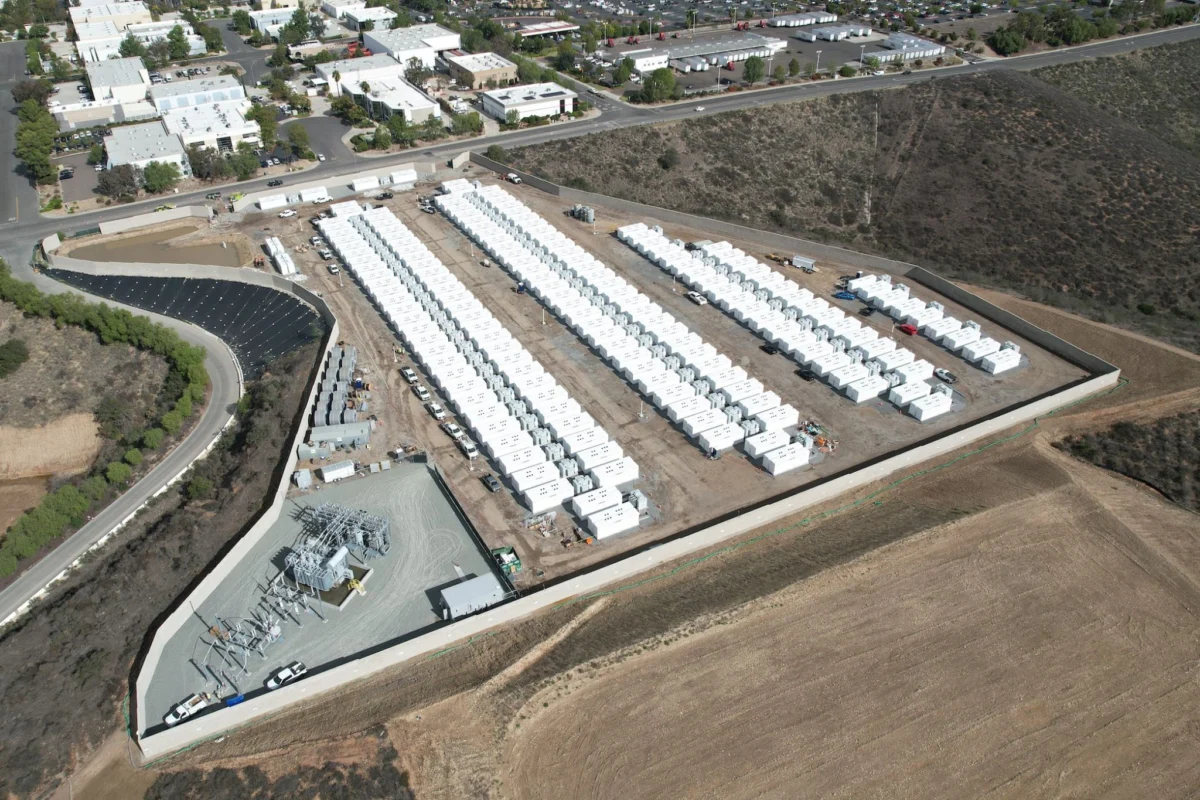
In California, Arevon Energy secured $920 million for its Nighthawk Energy Storage Project. Located in Poway, the 300 MW / 1,200 MWh facility is currently under construction and will utilize lithium iron phosphate (LFP) technology. The project is backed by a long-term agreement with Pacific Gas and Electric Company (PG&E) to provide resource adequacy capacity. The financing structure for Nighthawk is particularly notable for its complexity, involving a $482 million debt facility, a $169 million preferred equity investment from Goldman Sachs Alternatives, and a $268 million tax credit transfer commitment. This highlights how developers are utilizing the "transferability" provisions of the Inflation Reduction Act to monetize tax credits and fund large-scale infrastructure.
Simultaneously, in Canada, Aypa Power (a Blackstone portfolio company) and the Six Nations of the Grand River Development Corporation closed on approximately CA$700 million ($512 million) for the Elora and Hedley BESS projects in Ontario. These projects, with a combined capacity of 422 MW / 1,688 MWh, were awarded contracts under Ontario’s Independent Electricity System Operator (IESO) Long-Term 1 (LT1) procurement. Scheduled for operation in 2027, these facilities represent one of the largest battery storage commitments in Canadian history.
International Benchmarks: Australia’s Blind Creek Project
The challenges and opportunities of the energy transition are not confined to North America. In New South Wales, Australia, Octopus Australia has broken ground on the $900 million Blind Creek Solar Farm and Battery project. This "hybrid" site will feature a 300 MW solar farm integrated with a 243 MW / 486 MWh battery.
The Blind Creek project serves as a model for "agrivoltaics"—the co-location of agriculture and energy production. Initiated in partnership with local sheep farmers, the project was designed to allow animal grazing to continue beneath and around the solar arrays. This approach helps mitigate local opposition to large-scale energy projects by preserving the agricultural character of the land. The project is funded by a mix of global capital and Australian superannuation funds, demonstrating the international appetite for integrated renewable assets that offer both generation and storage capabilities.

Expanding Solar Portfolios in PJM and ERCOT
Back in the United States, Sol Systems is advancing its utility-scale solar footprint with the financial close of two major projects totaling $634 million. The Blossom Solar Project in Ohio (144 MW) and the Nightfall Solar Project in Texas (180 MW) represent strategic entries into two of the nation’s most vital power markets: PJM Interconnection and the Electric Reliability Council of Texas (ERCOT).
The Nightfall project in Uvalde County, Texas, is expected to reach full operations later this year, providing power to approximately 58,000 homes. The Blossom project in Morrow County, Ohio, marks Sol Systems’ first utility-scale foray into the PJM market, which has recently struggled with a massive backlog of interconnection requests. Richard Romero, CFO of Sol Systems, noted that these projects are essential for supporting corporate decarbonization goals while strengthening local economies through tax revenue and job creation.
Analysis: The Path Forward for Grid Modernization
The flurry of activity in generation and storage financing stands in stark contrast to the sluggish pace of transmission development. While the $1.9 billion in DOE funding is a positive step, it addresses only a fraction of the total investment required. Industry analysts suggest that without significant permitting reform and a streamlined process for interstate transmission planning, the U.S. risks a "gridlock" scenario where new, funded energy projects cannot deliver their power to the markets that need it most.
The chronology of these events suggests a two-speed energy transition:

- Generation and Storage: Moving at high speed, fueled by massive private equity investment and federal tax incentives.
- Transmission and Distribution: Moving at a crawl, hampered by regulatory complexity, local opposition (NIMBYism), and a lack of coordinated national planning.
The broader implications are clear. If the transmission bottleneck is not resolved, the cost of electricity is likely to rise due to congestion charges, and the reliability of the grid could be compromised during extreme weather events. The "urgently needed" upgrades identified by the DOE are no longer a matter of environmental policy alone; they have become a matter of national economic security and industrial competitiveness. As the U.S. enters a period of high demand growth not seen in decades, the success of the energy transition will depend less on the ability to build batteries and solar panels and more on the ability to build the wires that connect them to the American consumer.
