

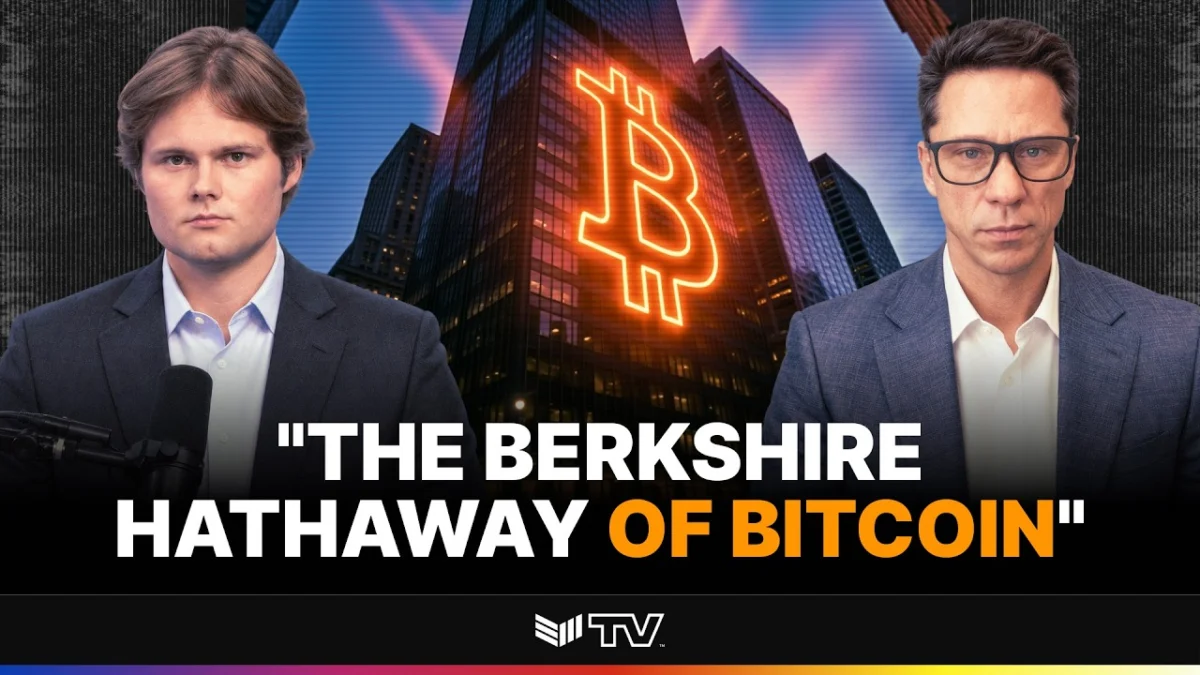
Twenty One Capital, a prominent entity in the digital asset investment landscape, currently holds approximately 43,000 Bitcoin, a substantial allocation that represents a significant portion of its holdings. Despite this considerable Bitcoin reserve, the company’s market valuation trades at a discount, a situation that CEO Rapha Zagury is actively addressing through a multi-faceted strategic approach. In a recent discussion, Zagury provided detailed insights into the calculation of Twenty One Capital’s Net Asset Value (mNAV), explored the potential for share buybacks, and articulated the unique, permanent capital advantage derived from its strategic relationship with Tether.
The Strategic Core: Bitcoin Holdings and Market Valuation
Twenty One Capital’s significant Bitcoin holdings are a cornerstone of its investment thesis. This allocation, standing at roughly 43,000 BTC, positions the company as a major holder within the digital asset ecosystem. However, the market’s current valuation of Twenty One Capital does not fully reflect the intrinsic value of these Bitcoin reserves, leading to a persistent discount. Zagury’s efforts are focused on bridging this valuation gap and ensuring that the market recognizes the full worth of the company’s assets.
Deconstructing Net Asset Value (mNAV) in the Bitcoin Context
A key element of Zagury’s strategy involves transparently communicating the company’s Net Asset Value (mNAV). While he acknowledges the utility of mNAV, Zagury also expresses reservations about its application to an operating company like Twenty One Capital. The metric, typically used to assess the value of investment funds or holding companies based on their underlying assets, can be a useful benchmark. However, for a company actively engaged in building and expanding its operational arms, mNAV alone may not capture the full spectrum of its value creation.
The calculation of Twenty One Capital’s mNAV would inherently involve valuing its Bitcoin holdings at current market prices, alongside any other liquid assets or investments. The discrepancy between this calculated mNAV and the company’s market capitalization is the source of the current discount. Zagury’s objective is to implement strategies that not only increase the mNAV but also drive the market capitalization to converge with, and ideally exceed, this intrinsic value.
Share Buybacks as a Value Realization Tool
The potential for share buybacks has emerged as a significant consideration in Zagury’s strategy to address the valuation discount. Share buybacks, where a company repurchases its own outstanding shares from the open market, can have several positive effects on shareholder value. They reduce the number of outstanding shares, thereby increasing earnings per share (EPS) and potentially boosting the stock price. Furthermore, buybacks can signal management’s confidence in the company’s future prospects and its belief that its shares are undervalued.
For Twenty One Capital, a share buyback program would be a direct mechanism to return value to shareholders and reduce the gap between its market price and its underlying asset value. The decision to initiate such a program would likely depend on several factors, including the company’s cash flow, its ongoing investment needs, and the prevailing market conditions. Zagury’s willingness to discuss this option underscores a commitment to actively managing shareholder returns.
The Tether Advantage: Permanent Capital and a Strategic Edge
A critical component of Twenty One Capital’s long-term strategy, and one that provides a distinct competitive advantage, is its relationship with Tether. Zagury highlights that Tether’s backing offers Twenty One Capital "permanent capital." This is a profound assertion in the volatile world of finance and particularly within the rapidly evolving digital asset space.
Permanent capital refers to capital that is not subject to redemption requests or maturity dates, providing a stable and enduring foundation for long-term strategic initiatives. For traditional treasury companies, capital is often raised through debt or equity, both of which carry inherent obligations and potential limitations. Debt must be repaid with interest, and equity investors may seek liquidity or dividends.
In contrast, a stable backing from a significant stablecoin issuer like Tether, which is designed to maintain a 1:1 peg with the US dollar, offers a unique form of enduring capital. This stability allows Twenty One Capital to undertake ambitious projects, invest in infrastructure, and weather market downturns without the immediate pressure of capital calls or redemptions. This permanence is crucial for building out the "Berkshire Hathaway of Bitcoin," a vision Zagury has articulated, which requires a long-term perspective and consistent capital deployment.
Building the "Berkshire Hathaway of Bitcoin"
Zagury’s ambition to build the "Berkshire Hathaway of Bitcoin" situates Twenty One Capital within a framework of a diversified, value-oriented conglomerate, albeit one focused on the digital asset frontier. Warren Buffett’s Berkshire Hathaway is renowned for its disciplined approach to investing, its long-term holding strategy, and its ability to generate significant shareholder value through a diverse portfolio of businesses.
Applying this model to Bitcoin means building a company that not only holds Bitcoin as a core asset but also develops complementary businesses and investments that leverage Bitcoin’s unique properties and the broader digital asset ecosystem. This could encompass:
- Bitcoin Capital Markets: Developing financial instruments and services tailored to the Bitcoin market, including lending, derivatives, and structured products.
- Energy Trading: Capitalizing on the energy-intensive nature of Bitcoin mining by potentially participating in energy markets or developing energy solutions.
- Acquisition Targets: Identifying and acquiring businesses that align with Bitcoin’s ethos and offer synergistic growth opportunities.
The "Five Pillars" mentioned by Zagury likely represent the foundational elements of this conglomerate strategy. While not explicitly detailed in the provided text, these pillars could include direct Bitcoin holdings, strategic investments in Bitcoin-related companies, operational ventures in mining or energy, financial services, and potentially venture capital arms focused on the broader Web3 space.
Bitcoin Acquisition Targets: A Discerning Approach
When considering acquisitions, Twenty One Capital, under Zagury’s leadership, appears to adopt a discerning approach. The emphasis is likely on targets that exhibit strong fundamentals, a clear path to profitability, and a strategic alignment with the company’s long-term vision. In the context of Bitcoin, this could mean companies involved in:
- Mining Infrastructure: Efficient and technologically advanced mining operations.
- Bitcoin Development: Companies contributing to the core Bitcoin protocol or layer-2 solutions.
- Custody and Security: Firms providing secure storage and management solutions for digital assets.
- Financial Services: Fintech companies integrating Bitcoin into traditional financial systems.
The focus would be on long-term value creation rather than speculative plays, mirroring the patient and value-driven investment philosophy of Berkshire Hathaway.
The Role of Bitcoin in Modern Finance and Macro Uncertainty
Zagury’s perspective also touches upon Bitcoin’s burgeoning role as a superior collateral asset compared to traditional stores of value like gold, particularly amidst global macro uncertainty. The inherent scarcity and decentralized nature of Bitcoin make it an attractive asset in an environment of inflationary pressures and geopolitical instability.
- Bitcoin vs. Gold: Historically, gold has been considered the ultimate safe-haven asset. However, Bitcoin’s digital nature, its global accessibility, and its predictable supply schedule (capped at 21 million coins) offer distinct advantages. In times of economic uncertainty, investors often seek assets that can preserve purchasing power. Bitcoin’s limited supply, in contrast to fiat currencies that can be subject to quantitative easing, positions it as a potential hedge against inflation.
- Collateral for Lending: Bitcoin’s properties make it an ideal collateral for lending. Its transparency on the blockchain allows for real-time valuation and risk assessment, while its immutability ensures the integrity of collateral. This opens up new avenues for financial innovation within the digital asset space, enabling the creation of more efficient and accessible credit markets.
The Future of Institutional Adoption
The article alludes to institutions as the "next big buyers" of Bitcoin. This is a crucial sentiment for the maturation of the Bitcoin market. As regulatory clarity improves and institutional-grade infrastructure becomes more robust, large financial players are increasingly allocating capital to Bitcoin. This trend is driven by:
- Diversification: Bitcoin offers a low correlation to traditional asset classes, making it an attractive addition to institutional portfolios for diversification purposes.
- Potential for High Returns: Despite its volatility, Bitcoin has historically delivered significant returns, attracting investors seeking alpha.
- Digital Gold Narrative: The growing narrative of Bitcoin as "digital gold" resonates with institutions looking for a hedge against inflation and systemic risk.
Twenty One Capital, by holding a substantial Bitcoin reserve and actively building its operational capacity, is well-positioned to benefit from this institutional inflow and to serve as a gateway for such capital.
Bitcoin Mining and the AI Connection
The discussion also touches upon the Bitcoin mining industry, specifically mentioning a "Hash Rate Bear Market" and the implications of Artificial Intelligence (AI).
- Hash Rate Bear Market: A bear market in the hash rate typically occurs when the profitability of Bitcoin mining declines, leading less efficient miners to shut down their operations. This can be due to a combination of factors, including a drop in Bitcoin’s price, an increase in the network’s difficulty, or rising energy costs. However, these periods often lead to a consolidation of the industry, with more efficient miners emerging stronger.
- AI and Bitcoin Mining: The intersection of AI and Bitcoin mining is an emerging area of interest. AI can be used to optimize mining operations, predict market trends, and improve energy efficiency. Furthermore, the vast computational power required for Bitcoin mining could potentially be leveraged for AI training or other computationally intensive tasks, creating new synergistic opportunities.
Conclusion: A Strategic Vision for Enduring Value
Twenty One Capital’s strategic positioning, anchored by its substantial Bitcoin holdings and its innovative approach to capital management through its Tether relationship, signifies a deliberate effort to build a resilient and enduring entity in the digital asset economy. CEO Rapha Zagury’s articulation of the company’s mNAV, the exploration of share buybacks, and the emphasis on permanent capital underscore a commitment to shareholder value and long-term growth. By aiming to become the "Berkshire Hathaway of Bitcoin," Twenty One Capital is not merely a passive holder of digital assets but an active architect of a new financial paradigm, poised to capitalize on the evolving landscape of blockchain technology and digital finance. The company’s journey, marked by strategic acquisitions, operational development, and a keen understanding of market dynamics, positions it as a key player in the ongoing institutional adoption of Bitcoin and the broader transformation of global finance.
