

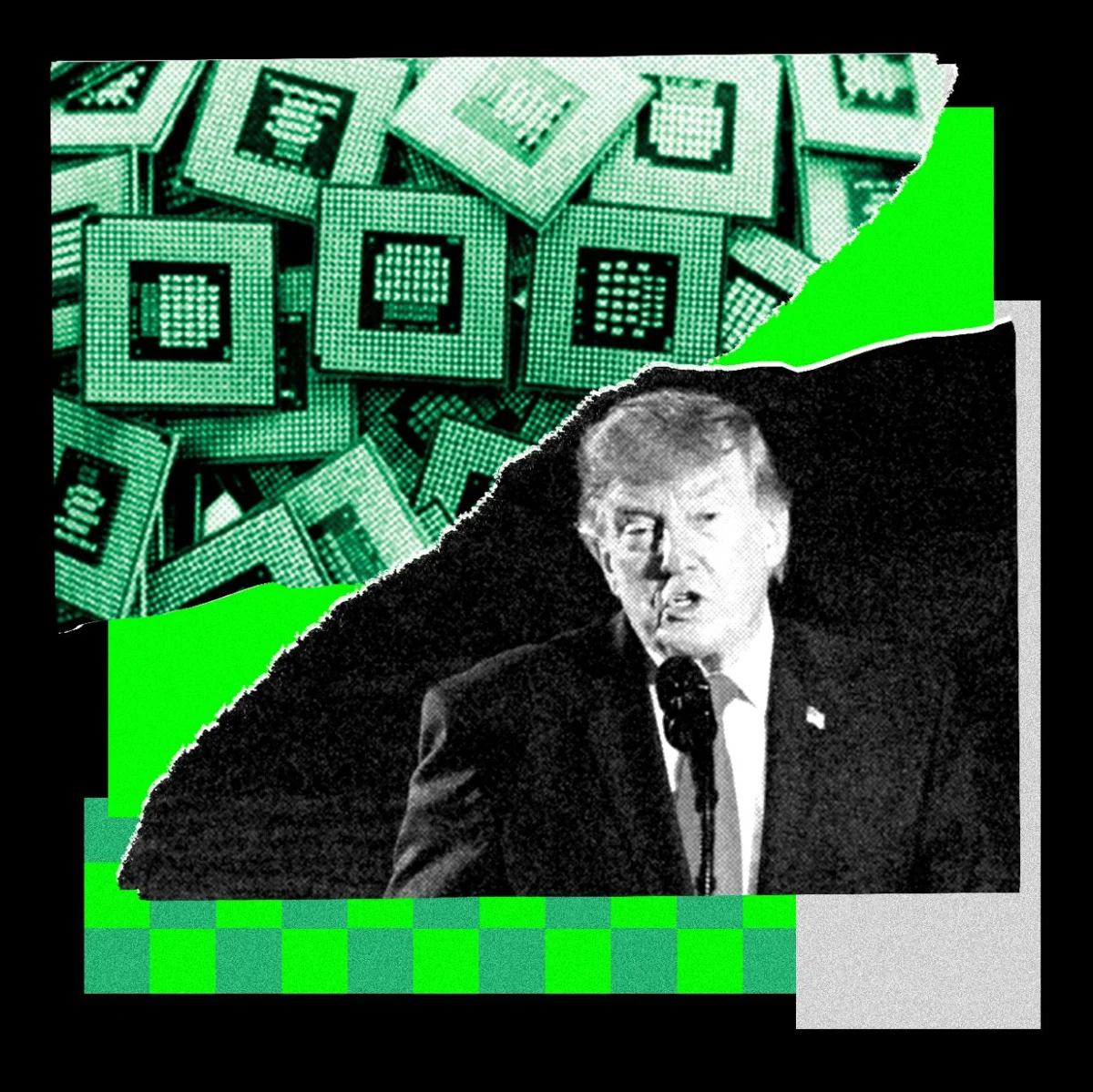
The Trump administration has significantly escalated its efforts to restrict Chinese companies’ access to advanced artificial intelligence (AI) chips, introducing new regulations that impose substantial hurdles for overseas data centers providing computing power to China. This move, announced earlier this week, represents a notable expansion of U.S. policy aimed at curbing China’s technological advancements in AI, a strategy that has been evolving since the Obama administration and has seen increased intensity under subsequent presidencies.
Historically, major Chinese tech firms such as Alibaba and ByteDance have circumvented U.S. export controls on physical chip imports into China by leveraging remote access to powerful AI chips, particularly those manufactured by Nvidia, hosted in data centers located outside of China. This practice, known as "cloud computing" or "remote access," allowed these companies to utilize cutting-edge technology for training sophisticated AI models without directly importing restricted hardware. However, the newly announced policy mandates that overseas data centers wishing to offer substantial computing power to Chinese entities will now require special licenses and navigate a labyrinth of new regulatory requirements.
Simultaneously, the White House has implemented stricter rules on the shipment of advanced chips to five countries, including Singapore and Malaysia. U.S. officials have cited suspicions of significant chip smuggling activities originating from these locations as a primary driver for these enhanced controls. While these policy ideas have been circulating in Washington for some time, the timing of this latest announcement has drawn particular attention, coinciding with revelations of a personal scandal involving a key figure in the semiconductor industry.
The Shadow of a Personal Scandal
The recent policy shift has been inextricably linked to the public admission by Jensen Huang, co-founder and CEO of Nvidia, regarding an affair with Alice Huang, a Chinese businesswoman with alleged ties to Chinese intelligence services. Alice Huang was previously associated with Megaspeed, a Singapore-based data center company. This company has been under scrutiny for offering remote access services and for its alleged involvement in chip smuggling operations.
Sources suggest that the highly publicized personal scandal may have created an environment of embarrassment for the administration, prompting a swift demonstration of regulatory control. A White House spokesperson, in prior statements to WIRED, indicated that the new regulations were designed to "crack down on the smuggling of advanced U.S. SI chips" and to "ensure that America’s most advanced chips go first to U.S. SI innovators, not Chinese shell companies." This statement underscores the administration’s stated objective of safeguarding American technological leadership.
A Evolving Strategy to Contain China’s AI Ambitions
The current administration’s approach to limiting China’s AI capabilities has its roots in regulations unveiled by the Biden administration in the fall of 2022. These initial rules aimed to fundamentally alter the landscape of AI development by restricting China’s access to the advanced semiconductors essential for training powerful AI models, as well as the manufacturing equipment required to produce such chips.
This strategy represented a significant departure from traditional export control measures, which typically focused on preventing the proliferation of sensitive technology to specific military programs, regimes, or entities accused of human rights abuses. The Biden administration’s policy was far more ambitious, seeking to leverage U.S. influence over the global semiconductor supply chain to impede the progress of the world’s second-largest economy in a strategically critical technological frontier.
The underlying logic of this strategy was straightforward: the development of the most advanced AI models necessitates immense computing power, and U.S. companies, particularly Nvidia, dominate the market for the specialized chips that provide this capability. By curtailing China’s access to these chips, Washington aimed to maintain its technological edge.
The Challenges of Enforcement and the Rise of Smuggling
Four years into this ambitious strategy, the United States cannot claim unqualified success. The enforcement of these complex export controls has proven to be a formidable challenge, largely falling under the purview of the Bureau of Industry and Security (BIS), a relatively small and underfunded agency within the Commerce Department. The BIS operated with a budget of approximately $235 million in 2026, a sum that pales in comparison to the weekly revenues of semiconductor giants like Nvidia.
The complexity of the BIS’s task has only increased as successive rounds of increasingly intricate restrictions have been introduced by the Biden administration. These measures have been a reactive attempt to close loopholes as chip manufacturers and their clients have devised ever more sophisticated methods to circumvent existing regulations. A significant hurdle has been the burgeoning industry dedicated to smuggling AI chips into China.
Megaspeed has emerged as a prominent example of this problem, although it is far from the only entity suspected of involvement, nor necessarily the largest, according to individuals familiar with the matter. Bloomberg reported that approximately 50,000 of the estimated 136,000 AI chips Megaspeed imported into Malaysia and Indonesia in 2024 and 2025 were not accounted for in Nvidia’s initial inventory checks, raising questions about their ultimate destination. Nvidia later stated that it had located at least some of these chips.
Even if all of Megaspeed’s unaccounted-for chips had ended up in China, they would represent a fraction of the advanced semiconductors believed to have been smuggled into the country over recent years. Research from the Institute for Progress estimates that by the end of 2026, China could have amassed smuggled computing power equivalent to roughly one million of Nvidia’s high-end H100 chips.
The Unintended Consequences and the Shifting Landscape
Crucially, Chinese companies had an alternative avenue for accessing advanced computing power without direct physical import: renting it from overseas data centers. This practice, which did not violate existing U.S. export controls, was a known factor among policymakers and researchers involved in shaping chip restrictions. The decision to permit this practice for an extended period was influenced by several considerations.
Some analysts argued that allowing Chinese firms to utilize American technology abroad could foster a dependency on U.S. innovation, potentially slowing the development of domestic alternatives. Furthermore, enforcing restrictions on remote access would have been exceedingly difficult and could have negatively impacted U.S. technology companies that rely on global cloud services.
The current administration’s decision to move into this regulatory territory marks a significant escalation. In 2022, the focus was on preventing the acquisition of U.S.-made chips. Now, four years later, the policy aims to regulate the usage of these same chips by Chinese companies, even when the hardware is located outside of China.
Assessing the Impact and Future Implications
The effectiveness of these export controls in achieving their stated objectives remains a subject of ongoing assessment. Evidence suggests that these measures have made it considerably more difficult for Chinese AI companies to acquire the same level of computing power as their American counterparts. However, precisely quantifying the impact of these policies has proven to be exceptionally challenging.
This strategy is not without significant risks and consequences, creating clear winners and losers. The requirement for U.S. chip companies to curtail their sales to Chinese customers has come at a considerable cost to American businesses. A study by the Federal Reserve Bank of New York on earlier U.S. export restrictions found that affected American suppliers struggled to compensate for lost Chinese business with new clients elsewhere. The study estimated that these restrictions reduced the combined market value of these companies by $130 billion, while also negatively impacting their profitability and employment.
Moreover, these restrictions have provided China with a powerful incentive to develop its own AI capabilities independently of American technology. Companies like Huawei have innovated by developing methods to link powerful chips into larger, more potent "megachip" systems. Similarly, the Chinese AI lab DeepSeek has demonstrated that optimizing training processes can enable developers to build competitive AI models with fewer resources.
The expanding scope of U.S. intervention, now seeking to control not only the purchase of chips but also the global usage of American technology by Chinese entities, raises concerns. This broad regulatory ambition, driven in part by the complexities of international trade and potentially influenced by extraneous factors, could prove challenging to implement and sustain. The long-term implications of such a comprehensive approach on global technological development, international relations, and the competitive landscape of the AI industry are significant and will continue to unfold in the years to come.
This article is an edition of Will Knight’s AI Lab newsletter.
