

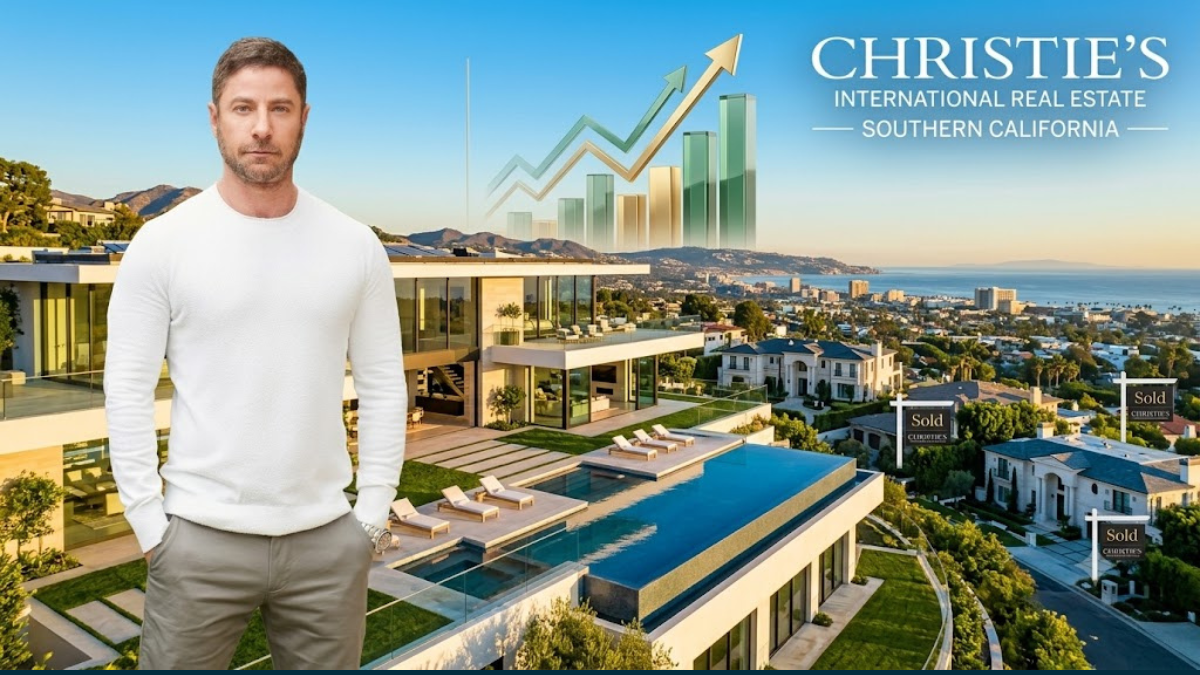
The trajectory of the modern real estate professional is increasingly defined by the ability to pivot in the face of rapid technological disruption and shifting consumer expectations. For Aaron Kirman, the CEO of Christie’s International Real Estate | Southern California, this evolution from a high-performing solo agent to a brokerage leader represents a calculated response to a landscape where traditional sales models are being challenged by automation and globalized capital. Kirman’s recent insights into his business philosophy reveal a strategy rooted in "specialized intelligence," a concept he believes will separate the elite tier of the industry from a shrinking middle class of generalist agents. By embracing artificial intelligence (AI), cryptocurrency, and specialized new development divisions, Kirman is positioning his firm to capture a market where information is ubiquitous but expert interpretation remains rare.
The Chronology of Growth From Solo Success to Institutional Leadership
Kirman’s rise began in the competitive trenches of the Los Angeles luxury market, where he established himself as a dominant solo practitioner. However, the limitations of the individual model became apparent as his sales volume approached the $500 million threshold. In 2017, recognizing that the scale of modern luxury transactions required a more robust infrastructure, he founded the Aaron Kirman Group (AKG). At the time, the "mega-team" model was still in its infancy, and many in the industry questioned whether a team structure would dilute the personal brand of a top-tier producer.
The transition proved prescient. AKG grew from a small cohort of seven agents to a powerhouse of over 100 professionals, leveraging shared resources and technology to dominate the Southern California region. This growth occurred largely under the banner of Compass, where Kirman’s team became one of the highest-grossing units in the country. Yet, by late 2022, Kirman identified another shift in the industry: the need for boutique autonomy combined with a legacy luxury brand. This led to the launch of Christie’s International Real Estate | Southern California, a move that allowed Kirman to transition from a team leader within a larger corporation to the CEO of his own brokerage entity, now operating under the Compass International Holdings umbrella.
This chronological progression reflects a broader trend in the real estate sector where top producers are increasingly seeking "brokerage-within-a-brokerage" models or independent ownership to better control their branding and service standards. For Kirman, the shift to CEO has been a steep learning curve, requiring a transition from the art of the deal to the science of corporate management. He notes that running a brokerage involves managing tight margins and complex operational systems, a far cry from the singular focus of representing a buyer or seller.
Technological Early Adoption as a Competitive Advantage
One of the defining characteristics of Kirman’s leadership has been a willingness to adopt emerging technologies long before they become industry standards. While many real estate firms are only now grappling with the implications of generative AI, Kirman began integrating AI-driven programs into his workflow six years ago. This early adoption was not merely about automation but about data synthesis—using technology to predict market movements and identify potential buyers before they even enter the search phase.
The firm’s technological reach extended further with the launch of a dedicated cryptocurrency division. As digital assets became a significant portion of global wealth, Kirman recognized that high-net-worth individuals required a seamless way to liquidate or leverage these assets for real estate acquisitions. By providing a structured framework for crypto-based transactions, the firm opened doors to a global pool of investors who were previously sidelined by the traditional banking system’s slow adaptation to blockchain technology.
However, the integration of technology has not been without its friction. Kirman highlights a growing challenge: the "democratization of data" through consumer-facing AI tools. He recounts a recent $60 million transaction that nearly collapsed when the buyer used ChatGPT to value the property. The AI, lacking the nuanced understanding of Los Angeles’ hyper-local market dynamics and the architectural significance of the home, suggested a valuation $8 million lower than the agreed-upon price. Kirman argues that this incident underscores the future role of the agent: not as a provider of data, which is now free and ubiquitous, but as a "nuance expert" who can explain why the data might be misleading or incomplete.
The New Development Frontier and Global Expansion
In recent months, Kirman’s firm has pivoted toward the high-stakes world of new luxury developments. This strategic move was prompted by an influx of inquiries from international developers looking to capitalize on the Los Angeles high-rise boom and the perennial demand for ultra-luxury estates in Beverly Hills. Since its inception just months ago, the new development division has already secured representations for projects valued in the billions of dollars.
The scope of this division is notably international, with projects stretching from the hills of Southern California to the skyline of Dubai. This global footprint is essential in a market where luxury real estate is increasingly viewed as a mobile asset class. Investors in Dubai are often the same individuals looking for secondary or tertiary residences in Los Angeles, and by representing projects at both ends of that corridor, Kirman’s firm creates a closed-loop ecosystem of high-value clientele.
This expansion into new developments also serves as a hedge against the volatility of the resale market. New construction projects offer a different revenue stream and allow the brokerage to engage in long-term branding and marketing efforts that span several years, providing a level of institutional stability that traditional residential sales sometimes lack.
Analyzing Market Consolidation and the 5 Percent Prediction
Looking toward the next decade, Kirman offers a sobering forecast for the real estate profession. He anticipates a radical consolidation of the industry, predicting that 5% of agents will eventually handle 90% of all transactions. This "Pareto principle" on steroids is driven by several factors, including the rising cost of lead generation, the complexity of legal and regulatory requirements, and the aforementioned technological gap.
Data from the National Association of Realtors (NAR) and various industry analysts suggest that the "middle-class agent" is indeed under pressure. As commission structures face scrutiny and the barrier to entry for high-level marketing continues to rise, smaller teams and solo agents may find it difficult to compete with the specialized intelligence of large, tech-enabled brokerages. Kirman’s strategy is to ensure his firm remains within that elite 5% by doubling down on specialization.
To achieve this, the firm is moving away from the "generalist" model. Instead of agents who attempt to cover all neighborhoods and price points, Kirman is fostering a culture of experts. This includes specialists in specific architectural styles, experts in the tax implications of cryptocurrency transactions, and advisors who understand the unique structural requirements of hillside developments. The goal is to provide "brokerage intelligence" that cannot be replicated by an algorithm or a standard web search.
Navigating Geopolitical and Economic Noise
A significant portion of Kirman’s role as a leader involves helping his team navigate what he calls "the noise." The real estate market is currently bombarded by external stressors, including fluctuating interest rates, geopolitical instability, and a shifting domestic economic outlook. For luxury agents, these factors can lead to paralysis among buyers and sellers.
Kirman emphasizes the importance of being "highly educated but singularly focused." While he keeps a close eye on Federal Reserve decisions and global economic shifts to better advise his clients, he encourages his agents to "stay in their lane" and focus on the fundamentals of the trade. The luxury market often operates on a different set of rules than the broader housing market; for the ultra-wealthy, real estate is as much about wealth preservation and lifestyle as it is about shelter. By filtering out the sensationalism of the news cycle, Kirman’s firm aims to provide a stable, advisory-based environment for its clients.
Implications for the Future of the Industry
The evolution of Christie’s International Real Estate | Southern California serves as a blueprint for the future of the luxury brokerage. The implications of Kirman’s approach suggest that the real estate professional of 2030 will look more like a private wealth manager than a traditional salesperson. The value proposition is shifting from "finding the house" to "navigating the complex financial, technological, and emotional landscape of a high-value acquisition."
Furthermore, the firm’s focus on AI-driven productivity aims to automate the administrative "drudge work" that consumes much of an agent’s day. By offloading tasks like listing descriptions, basic lead follow-ups, and data entry to AI, agents are freed to focus on high-touch relationship building and complex negotiation. Kirman’s "bet" is that in an increasingly digital world, the human element becomes more valuable, provided it is backed by superior data and specialized knowledge.
As the firm continues to scale its new development and crypto divisions, the industry will be watching closely to see if Kirman’s 5% prediction holds true. If it does, the current era of real estate may be remembered as the Great Consolidation, where the industry shifted from a fragmented collection of independent contractors to a streamlined field of specialized, institutional-grade powerhouses. For now, Kirman remains focused on the "next evolution," constantly tweaking systems and procedures to ensure that his firm doesn’t just keep pace with change but remains the primary architect of it.
