

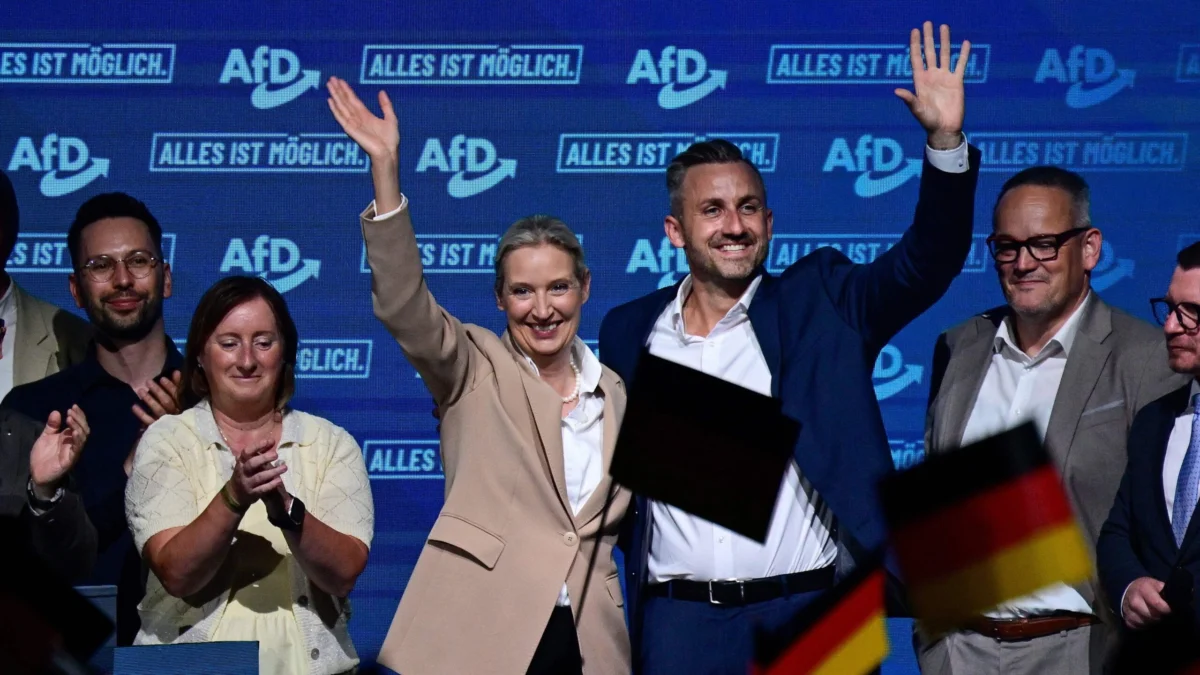
Magdeburg, Germany – The Alternative for Germany (AfD) party has launched its election campaign for the state of Saxony-Anhalt with an ambitious declaration: to install the first-ever AfD Minister-President in Germany. This bold assertion was made by party co-chair Alice Weidel during the campaign’s kickoff event in Magdeburg, signaling a shift from opposition to a self-proclaimed future governing party. The event, attended by thousands of supporters waving German flags and chanting the name of lead candidate Ulrich Siegmund, underscored the AfD’s determined push to seize power in the upcoming state election on September 6th.
A Bold Declaration of Intent
The atmosphere in the Magdeburg exhibition hall was electric, transforming into a sea of black, red, and gold flags long before Weidel took the stage. Above the podium, the campaign slogan "Alles ist möglich" (Everything is possible) was emblazoned in white letters. In front of it, bright blue heart-shaped posters featuring the likeness of Siegmund, bearing the slogan "Ministerpräsident der Herzen" (Minister-President of the Heart), were prominently displayed. According to party estimates, approximately 3,000 people attended the rally, with many documenting the proceedings with their smartphones.

This confident display by the AfD is not without basis. Recent opinion polls consistently place the party with over 40 percent of the vote, a significant lead over the Christian Democratic Union (CDU), the traditional dominant force in the state. With several smaller parties struggling to surpass the electoral threshold for entering the state parliament, the possibility of the AfD securing an absolute majority of seats is no longer a distant prospect, but a tangible scenario.
Weidel’s Vision for Saxony-Anhalt and Beyond
Upon her arrival at the podium, Weidel was met with a vociferous ovation. "Dear people, you are such a wonderful audience. And I can already say, before I’ve even started speaking: I love you," she exclaimed to the enthusiastic supporters. "You are so great."
In her address, Weidel painted a picture of a party on the cusp of a major political breakthrough. She attributed Germany’s current challenges to the federal government, claiming it had led the nation into a severe crisis. In contrast, the AfD, she asserted, promised a return to "normalization." "We want normal politics. We want a future for our children," she stated, advocating for an "abandonment of the extremist policies of the old parties" and a move towards "sensible politics."

Weidel’s economic and energy policy proposals garnered the loudest applause. The AfD pledged to abolish energy taxes and reduce the value-added tax on fuels. "We will make everything affordable and inexpensive again," she promised, emphasizing the need for "affordable and secure energy" for Germany. To achieve this, she called for a return to nuclear energy and the procurement of oil and gas "wherever it is cheapest."
Challenging the Status Quo: Security and Foreign Policy
Beyond domestic policy, Weidel sharply criticized the federal government’s approach to foreign affairs. The AfD, she declared, aims for "balance between West and East." Germany, she argued, must re-engage in dialogue with Russia, the United States, and China, "because these countries are important trading partners." Concurrently, she reiterated the party’s opposition to Ukraine’s NATO and EU membership, announcing that under an AfD government, Germany would cease delivering weapons to Ukraine.
Her critique of the European Union was equally pointed. Weidel demanded a fundamental reform of the EU, asserting that Germany should no longer accept directives from Brussels, such as the ban on internal combustion engines. "We want the sovereignty of the fatherlands," she declared.

A particularly strong reaction from the crowd followed Weidel’s remarks regarding security agencies. She labeled the proposed legislation granting expanded powers to the domestic intelligence agency, the Verfassungsschutz, as evidence of an increasingly authoritarian state. "When we are in government, we will abolish the Verfassungsschutz," she vowed. It is important to note that in Saxony-Anhalt, the AfD is classified by the Verfassungsschutz as verifiably right-wing extremist.
Immigration and the "Middle of Society"
The AfD’s stance on immigration was another focal point of Weidel’s speech. She called for a more rigorous deportation policy and a review of naturalizations that have occurred since 2015. "We will deport illegal immigrants," she stated, warning against the acceptance of "parallel societies" and "no-go areas" within Germany. She underscored that security is a prerequisite for peaceful coexistence.
The attendees responded with sustained applause, with many rising from their seats, waving flags, and filming the speeches.

Siegmund’s Ambitions: "Minister-President of the Heart" and Sole Governance
Following Weidel, lead candidate Ulrich Siegmund took the stage, reinforcing the party’s aspiration to form the state government. "45 percent plus X – that is the goal we want to achieve together," Siegmund stated, referring to the current polling numbers. He later elaborated on his ambitions, declaring, "I want to govern alone. I want to lead a stable government." He expressed his belief that after five years, "every decent citizen of Saxony-Anhalt" would acknowledge that "it was the right decision to vote for the AfD."
Siegmund began his address by departing from his prepared notes, stating, "I simply want to speak from the heart to you." He repeatedly expressed gratitude to campaign workers, donors, and party colleagues, lending the event an atmosphere more akin to a movement rallying for victory than a conventional political rally.
Content-wise, Siegmund highlighted the party’s previously unveiled 100-day program and its comprehensive 160-page government platform, promising a radical policy shift. He assured the audience that the AfD would not compromise its principles. As an immediate action upon taking office, Siegmund announced the termination of the State Media Treaty.

Positioning the AfD as the "Middle of Society"
Siegmund sharply distinguished the AfD from its political rivals, particularly the CDU. "There is no longer any difference," he stated, alleging a "unity between the CDU, the Left Party, and the Greens" in parliament. He positioned the AfD as "the last conservative hope for our country."
Addressing the crowd directly, Siegmund sought to portray the party as a broad-based popular movement rather than a fringe group. "There are no right-wing extremists here. The middle of society is sitting here. Your neighbors are sitting here. Your colleagues," he asserted, aiming to counter perceptions of extremism.
The speeches were met with widespread approval within the hall. In his closing remarks, Siegmund returned to the day’s central theme of unity and historical significance. "We stand together. We stick together," he proclaimed to his supporters. "Let us make history on September 6th."

Broader Context and Implications
The AfD’s surge in Saxony-Anhalt reflects a broader trend of rising support for the party across Germany. This surge is often attributed to voter dissatisfaction with the federal government’s policies on immigration, energy, and economic issues, as well as concerns about inflation and the cost of living. The upcoming state election in Saxony-Anhalt is seen as a significant bellwether for national political sentiment and could influence the dynamics of federal politics.
The party’s ambitious goal of securing an absolute majority, while still a significant hurdle, is now within the realm of possibility, according to current polling data. This scenario would present unprecedented challenges for coalition building and governance in Germany, as major parties have consistently ruled out forming coalitions with the AfD at both state and federal levels.
The explicit threat to abolish the Verfassungsschutz, a key institution responsible for monitoring extremist groups, has drawn sharp criticism from across the political spectrum and civil society organizations. Critics argue that such a move would undermine democratic safeguards and embolden extremist elements.

The AfD’s platform, emphasizing national sovereignty, stricter immigration controls, and a rollback of climate policies, resonates with a segment of the electorate disillusioned with mainstream political parties. The party’s strategy appears to be one of consolidating its base while attempting to broaden its appeal by presenting itself as a pragmatic alternative for governing.
The election on September 6th will therefore be closely watched, not only for its implications for Saxony-Anhalt but also for its potential to reshape the German political landscape. The AfD’s determined push for state-level power represents a critical juncture in its trajectory and raises significant questions about the future of democratic politics in Germany.
Background and Timeline
Saxony-Anhalt, a state in eastern Germany, has a history of fluctuating political allegiances. The state election on September 6th, 2021, will be a crucial test for the established political order. The AfD’s current strong polling performance is a notable shift from previous elections, where while significant, it did not reach such dominant levels in pre-election surveys. The party’s strategy of presenting itself as a governing alternative, rather than purely an opposition force, marks a strategic evolution. This campaign kickoff event is a key moment in their strategy to solidify public perception and mobilize voters for the upcoming election.
Related Topics
- AfD: The Alternative for Germany is a right-wing populist political party in Germany, founded in 2013. It has seen a significant rise in popularity in recent years, particularly in eastern Germany.
- Alice Weidel: Co-chair of the AfD and a prominent figure in the party, known for her strong rhetoric and focus on national issues.
- Sachsen-Anhalt: The state in eastern Germany where the election is taking place. Its political landscape is currently being significantly influenced by the AfD’s growing support.
- Deutschland: Germany, the federal republic where these political developments are unfolding, with national implications.
- CDU: The Christian Democratic Union is a major center-right political party in Germany, traditionally a dominant force in state and federal politics.
- Europäische Union: The European Union, a political and economic union of 27 member states located primarily in Europe. The AfD has been a vocal critic of the EU’s policies and influence.
