

In the nascent days of Bitcoin, a revolutionary idea emerged from the mind of Satoshi Nakamoto, a pseudonymous figure whose vision for a decentralized digital currency would fundamentally alter the financial landscape. Nakamoto began his work on Bitcoin as early as 2007, operating in solitude until shortly after the publication of the Bitcoin white paper on October 31, 2008. It was then, a few weeks post-white paper release, that Nakamoto extended an invitation to Hal Finney, a respected cryptographer and early cypherpunk, marking the project’s first collaborative step and the introduction of its inaugural contributor.
The critical role Finney played in Bitcoin’s initial survival cannot be overstated. Recently unearthed emails reveal a pivotal moment when Nakamoto’s own node struggled to establish incoming connections for the first day or two after the genesis block was mined. During this crucial period, Finney’s node was the sole point of contact for other users, single-handedly sustaining the nascent network. Nakamoto himself acknowledged this in a private email to Finney, stating, "Your node receiving incoming connections was the main thing keeping the network going the first day or two." This dependency underscored the fragility of the early network and Finney’s indispensable contribution.
Finney was not merely a passive recipient of Nakamoto’s confidence; he was an active participant in the pre-release review and development process. Nakamoto shared the nascent Bitcoin software with a select group of cypherpunk luminaries, including Finney, before its public debut. Evidence suggests Finney even contributed code prior to the official launch. Ray Dillinger, another early confidant of Nakamoto, corroborated this, recalling in an interview published on Dillinger’s blog that Finney was involved in reviewing the transaction scripting language. "It was when we started talking about floating-point types in accounting code that I learned Finney was involved in the effort," Dillinger stated. "Finney was reviewing the transaction scripting language, and both the code he had, and the code I had, interacted with the accounting code."
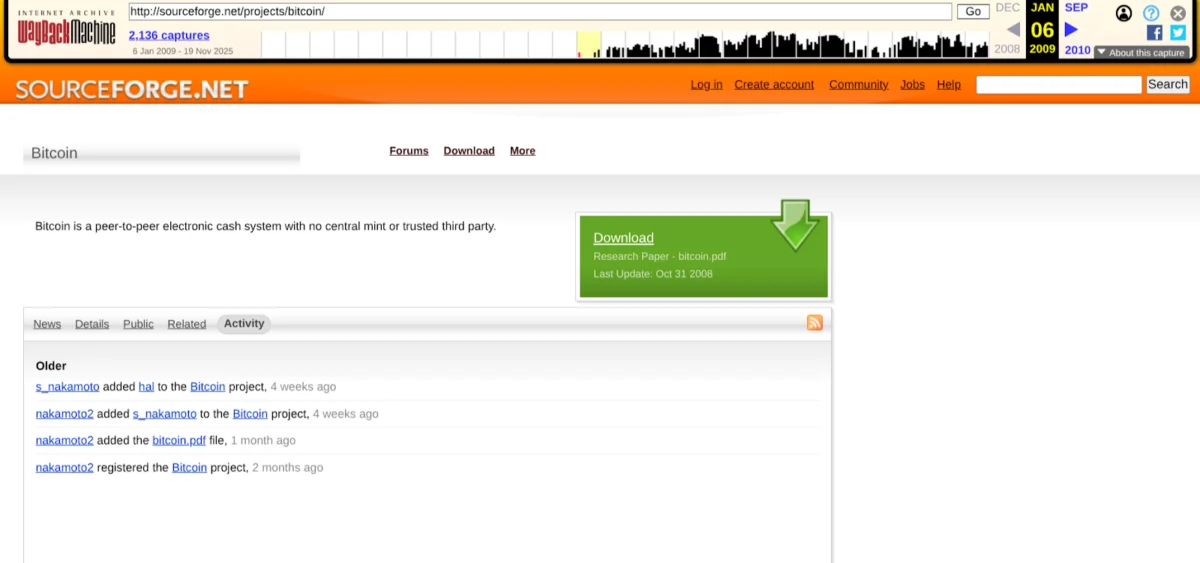
This period of intense early development aligns with historical records. The Bitcoin project’s oldest archived activity page on Sourceforge indicates that Nakamoto added Finney to the project on December 18, 2008. This action is significant as it likely marked the first time "maintainer-level" permissions were granted to an individual other than Nakamoto, potentially elevating Finney to a developer status within the Sourceforge project, empowering him to download, modify, and upload versions of Bitcoin.
Defining the Maintainer Role
The concept of a "Maintainer" within software development, particularly for a project as complex and critical as Bitcoin, carries significant weight. At its core, a Maintainer is an individual entrusted with the authority to merge code changes into the primary development branch, often referred to as the "master" or "main" branch. Contributors can submit their work through "pull requests," but it is the Maintainer who possesses the "commit access" and the ultimate decision-making power to integrate these contributions.
However, the role of a Bitcoin Core Maintainer transcends mere technical access. It necessitates a strong reputation within the developer community, a consistent track record of valuable contributions, and a deep understanding of the project’s architecture and long-term goals. Maintainers are expected to act as stewards of the codebase, rigorously reviewing and auditing proposed changes to ensure they align with the project’s principles and technical standards. This often involves a delicate balance of accepting well-vetted contributions while rejecting those that may introduce vulnerabilities, break consensus, or deviate from the project’s established direction.
The history of Bitcoin development reveals that this role is not without its challenges and controversies. Several prominent Maintainers have faced scrutiny, with some even having their access revoked due to perceived compromises or controversial endorsements. The case of Gavin Andresen, who publicly supported Craig Wright’s unsubstantiated claims of being Satoshi Nakamoto, serves as a stark example of how a Maintainer’s reputation and standing can be impacted by external factors. Similarly, Gregory Maxwell stepped down from his Maintainer role amidst targeted harassment, highlighting the personal toll the position can exact.
A fundamental expectation within the Bitcoin development community is that the Maintainer role should remain apolitical, focusing solely on technical merit and implementation details. Discussions surrounding code changes are ideally confined to the technical aspects, with political or ideological debates relegated to separate forums. This ethos aims to ensure that decisions are driven by objective evaluation rather than personal biases or external pressures.
Despite the immense responsibility, the authority vested in Maintainers has evolved over Bitcoin’s history. As the project has matured and the developer community has grown, the decision-making process has become more decentralized. Instances where code merged into the master branch has later been reverted after further review underscore that even Maintainer decisions are subject to ongoing scrutiny and refinement. This iterative process, while sometimes challenging, is a testament to the project’s commitment to robustness and consensus-driven development.
The inherent power of a Maintainer to approve or reject code changes is a necessary mechanism for maintaining the integrity and stability of an open-source project like Bitcoin. Without such a filtering process, the network would be vulnerable to malicious actors or poorly conceived modifications. The goal is to foster a meritocracy where code suggestions are judged on their technical soundness, ensuring that the project remains secure and reliable.
The role of Maintainer has remained a constant throughout Bitcoin’s development, with the composition and responsibilities of the team adapting to the project’s evolving needs. This emergent form of leadership, particularly in technical matters, has consistently attracted the attention and curiosity of the wider Bitcoin community.
The Satoshi Nakamoto Era: Genesis of a Decentralized Project
The genesis block, mined by Nakamoto on January 3, 2009, marked the official launch of Bitcoin. Embedded within this block was a profound message, a headline from The Times newspaper dated January 3, 2009: "Chancellor on brink of second bailout for banks." This historical timestamp served as a subtle yet powerful declaration of Bitcoin’s raison d’être – a response to the perceived failings of traditional financial systems.
On January 8, 2009, Nakamoto released version 0.1.0 of Bitcoin to the public, announcing it on various forums, including the cypherpunk mailing list. The announcement emphasized Bitcoin’s core tenets: "Announcing the first release of Bitcoin, a new electronic cash system that uses a peer-to-peer network to prevent double-spending. It’s completely decentralized with no server or central authority." The initial release, compiled by Nakamoto, was distributed via a .rar file on Sourceforge.net, solidifying Nakamoto’s position as the founder and de facto Lead Maintainer.
During this formative period, Nakamoto meticulously reviewed and merged code contributions from other developers, releasing new versions of Bitcoin. This hands-on approach defined his role from version 0.1.0 up to version 0.3.19, before his eventual departure in December 2010.
The collaborative evolution of Bitcoin quickly took shape. By the end of January 2009, Martti Malmi, operating under the username "sirius-m," made the first official commit to the Sourceforge project, introducing the Subversion (SVN) version control system. This action positioned Malmi as the second official Maintainer in Bitcoin’s history. Throughout 2009, Malmi made significant contributions, including the development of the first Linux version of Bitcoin, released as version 0.2.0.
Laszlo Hanyecz, a name now etched in Bitcoin lore for his pioneering purchase of two pizzas for 10,000 BTC, joined the ranks of Maintainers in August 2010. His inclusion followed his contribution of the first iOS version of Bitcoin for the 0.3.0 release. Nakamoto’s stewardship extended beyond code; he personally engaged with early miners, including Hanyecz, who was among the first to mine Bitcoin with GPUs. Nakamoto advised Hanyecz to moderate his mining rate in 2009, stating, "The longer we can delay the GPU arms race, the more mature the OpenCL libraries get, and the more people will have OpenCL compatible video cards." This strategic guidance aimed to prolong the CPU mining era, incentivizing wider participation when the future value of Bitcoin was highly uncertain.
A critical security enhancement, the checkpointing system, was introduced by Nakamoto on July 17, 2010, with version 0.3.2. This feature involved hard-coding specific block heights and their corresponding valid hashes to protect the blockchain from potential deep reorganizations by malicious miners. Nakamoto explained that this was to prevent "the unwanted non-zero possibility of revision months later." The responsibility for updating these checkpoints fell to subsequent Bitcoin Maintainers.
The Value Overflow Incident: A Test of Decentralization
Nakamoto’s authority as Lead Maintainer was most vividly demonstrated during the value overflow bug incident in October 2010. This critical vulnerability allowed for the creation of an unintended 184 billion Bitcoin through three transactions, effectively breaking consensus. The sheer magnitude of the error caused transaction validation code to "overflow when summed," leading to the creation of coins that should not have existed.
Recognizing the existential threat to the project, Nakamoto acted swiftly. Collaborating with several contributors, including Gavin Andresen, he developed and released a patched version of Bitcoin. Nakamoto then urged miners to adopt the updated software and resynchronize the blockchain. This led to a network-wide rollback of approximately 19 hours of blocks, effectively nullifying the fraudulent transactions. This event, often referred to as the "inflation bug," represented a peak in Bitcoin’s centralization under Nakamoto’s direct leadership and a singular instance of the Lead Maintainer role wielding such concentrated power.
Following this incident, Nakamoto implemented the Alert System in version 0.3.11. This controversial feature allowed nodes to display warnings and disable essential functions if they detected a critical bug. Messages for this system required signing with a key held exclusively by Nakamoto, who justified it as a necessary safeguard against unforeseen risks. However, Nakamoto later disabled this system in his final release.
The SVN records indicate that Nakamoto was the sole individual responsible for merging code from other contributors and releasing official Bitcoin versions until December 19, 2010. On this date, Gavin Andresen officially assumed the role of Lead Maintainer. Andresen had been actively contributing code since February of that year, with his first commit to the SVN trunk occurring in October, shortly before Nakamoto’s final version release and subsequent disappearance from public view. At the time of this writing, over 1,200 individuals have contributed code to the Bitcoin Core project.
The Gavin Andresen Era: Transition and Expansion
With Satoshi Nakamoto’s departure, Gavin Andresen emerged as a central figure, holding significant commit access and effectively becoming the default Lead Maintainer. While Nakamoto never formally announced this transition, an email to Mike Hearn, a frequent contributor, stated, "I’ve moved on to other things. It’s in good hands with Gavin and everyone."
Under Nakamoto’s implicit blessing, Andresen took the helm. His tenure was marked by efforts to expand the Maintainer team and initiate the crucial migration from Sourceforge to GitHub, a process that spanned several years. The first commit merged to Bitcoin from Andresen’s official GitHub account occurred on July 14, 2011. This marked a shift in the code integration process, with GitHub playing a more prominent role, although the open-source nature of the project ensured that all code changes remained auditable.
The official shutdown of the Sourceforge Bitcoin project occurred on September 13, 2011, with GitHub becoming the primary collaboration platform. This migration effectively concluded the direct commit access for early contributors like Malmi and Hanyecz who primarily operated within the Sourceforge environment and had slowed their contributions.
The first release under Andresen’s leadership, version 0.3.21 on April 27, 2011, included a significant addition: a README file with a PGP-signed message detailing the update, providing hashes for installables, and acknowledging contributors. This release notably named 16 contributors, including prominent figures like Luke Dashjr, Matt Corallo, Pieter Wuille, and Jeff Garzik.
The subsequent years witnessed a deliberate expansion of the Maintainer team, a strategic move to decentralize the perceived power and responsibility held by the Lead Maintainer and to fill the gaps left by Nakamoto, Malmi, and Hanyecz. Chris Moore, using the username "dooglas," gained commit access from January to March 2011 and continues to contribute to the project.
Pieter Wuille joined as a Maintainer on June 1, 2011, after discovering Bitcoin in November 2010 and rapidly contributing to the project. Wuille, known by the username "sipa," has become a highly respected Core Developer, credited with numerous performance optimizations and significant contributions that have enhanced user experience. He currently holds the third-highest commit count on Bitcoin Core, according to GitHub data.
Jeff Garzik followed on June 6, 2011, bringing his extensive experience from the Linux open-source ecosystem to Bitcoin. Garzik is recognized for his contributions to improving the stability of the Bitcoin client. However, his commit access was revoked in the summer of 2016 due to several months of inactivity, coinciding with the escalating "block size war." Garzik’s alignment with the "big block" faction led to considerable friction within the community, and he later led the failed Segwit2x fork.
Mara van der Laan (then identifying as Wladimir) was granted commit access on July 5, 2011, becoming the eighth official Maintainer. Van der Laan, who had been active on the Bitcointalk forum since November 2010, focused initially on the GUI of the Bitcoin QT client, leveraging deep academic expertise in computer graphics.
Nils Schneider, known as "tcatm," gained commit access on September 19, 2011. His contributions focused on optimizing Bitcoin’s background operation and internationalization, adding multiple language support updates. He also oversaw the removal of the Crypto++ library, reducing unnecessary dependencies. Schneider served as a Maintainer for nearly a year, with his last commit in May 2012.
Gregory Maxwell, "gmaxwell," merged his first commit on February 11, 2012, after a year of active technical commentary on Bitcointalk. His three-year tenure as a Maintainer saw him focus on the P2P networking layer, consensus, and validation. Maxwell is held in high regard within the Bitcoin community for his technical insights. He relinquished commit access in December 2015, citing internet harassment and concerns related to the block size debate, aligning himself with the "small block" position.
The Bitcoin Foundation and the Shift in Leadership
On September 27, 2012, Andresen announced a significant initiative: the establishment of the Bitcoin Foundation. Modeled after the successful Linux Foundation, this organization aimed to support the development and adoption of Bitcoin by funding core contributors and Maintainers. While it garnered considerable support, it also faced criticism. Andresen envisioned the foundation as an "open, member-driven organization" that would foster the project’s growth.
The Wladimir van der Laan Era: Sustained Stewardship
In April 2014, Wladimir van der Laan was appointed Lead Maintainer by Gavin Andresen, who transitioned to a "Chief Scientist" role. Andresen announced this succession in a blog post on the Bitcoin Foundation website, stating, "Wladimir van der Laan has been paid to work on Bitcoin Core full-time for several months now… and has been doing a fantastic job. He has agreed to take over for me as the ‘Bitcoin Core Maintainer.’"
Under the usernames "Laanwj" and "wumpus," van der Laan oversaw nearly nine years of Bitcoin Core development, accumulating the highest number of commits to the Bitcoin repository to date, with over 7,419 commits, predominantly merges. He relinquished the role in February 2023 for "personal reasons."
A pivotal development during van der Laan’s stewardship was the implementation of the trusted-keys system on December 20, 2014, committed by Matt Corallo. This system addressed the historical opacity surrounding Maintainer access by introducing a file with PGP public key fingerprints into the master repository, along with verification tools. This enhanced transparency by ensuring that Maintainer commits were PGP-signed and verifiable against the trusted-keys list. Corallo explained that the system’s primary goal was to "avoid trusting GitHub" for merging developer code, a practice that had become common during Andresen’s tenure.
Jonas Schnelli was granted commit access on November 13, 2015, as the GUI Maintainer. Schnelli, who began contributing in 2013, rose to become one of the top 10 contributors by commit count. His six-year tenure as Maintainer concluded in October 2021, citing personal reasons.
Marco Falke was appointed Testing & QA Maintainer on April 13, 2016. Falke contributed to Core until 2023, when he stepped down for personal reasons. Less than a month later, on May 6, 2016, Gavin Andresen’s commit access was removed by van der Laan following Andresen’s endorsement of Craig Wright, who falsely claimed to be Satoshi Nakamoto. This incident highlighted the community’s sensitivity to claims of authenticity and the potential for controversy surrounding key figures.
Samuel Dobson, "MeshCollider," was appointed wallet Maintainer on December 4, 2018. Dobson, who had been contributing since at least 2017, made over 300 commits focusing on the wallet codebase. He relinquished his role in February 2023 to pursue his PhD.
Michael Ford, "Fanquake," gained commit access on June 7, 2019, representing a new generation of Maintainers. Ford’s nomination, reportedly by contributor consensus at a core developer meetup in Amsterdam, signaled a trend towards a more decentralized approach to granting commit access. Ford, who began contributing in 2012, is now the second most prolific Maintainer with 4,920 commits.
The Contributor Consensus Era: Decentralizing Core Development
On January 21, 2021, van der Laan published a blog post signaling a significant shift away from the Lead Maintainer model established by Nakamoto and Andresen. Recognizing Bitcoin’s growth, van der Laan proposed decentralizing core development. This involved delegating responsibilities, moving the bitcoincore.org website to organizational ownership, exploring alternative code contribution platforms beyond GitHub, and implementing a threshold signing scheme for release signing to prevent reliance on a single individual. This announcement marked the end of the Lead Maintainer era and a maturation milestone for Bitcoin.
Hannadii Stepanov, "hebasto," became GUI Maintainer on March 19, 2021, after over a thousand contributions since 2018. He remains a Maintainer today, ranking fifth in commit count.
Ava Chow, "achow101," gained commit access as wallet Maintainer on December 12, 2020. Chow’s contributions extend beyond code to historical research and educational livestreams on Twitch, making her a significant figure in the Bitcoin development community. She ranks fourth in commits and retains commit access.
Gloria Zhao, "glozow," was granted commit access as mempool and policy Maintainer on August 7, 2022, following contributor consensus. Zhao, who began contributing in March 2020, had accumulated over 200 commits before becoming a Maintainer and ranks ninth in commit count.
Russ Yanofsky, "ryanofsky," joined as interface Maintainer on June 10, 2023, nominated by contributor consensus. Yanofsky, specializing in modularization and multiprocess work, has been contributing since 2016 and holds the seventh-highest commit count.
The evolution of Bitcoin Core Maintainers reflects the project’s journey from a solitary endeavor to a complex, globally distributed open-source ecosystem. Each Maintainer, from Hal Finney’s foundational role to the current era of contributor consensus, has played a vital part in shaping the future of decentralized finance. The ongoing efforts to decentralize governance and decision-making processes underscore Bitcoin’s commitment to its core principles of resilience and robustness.
