

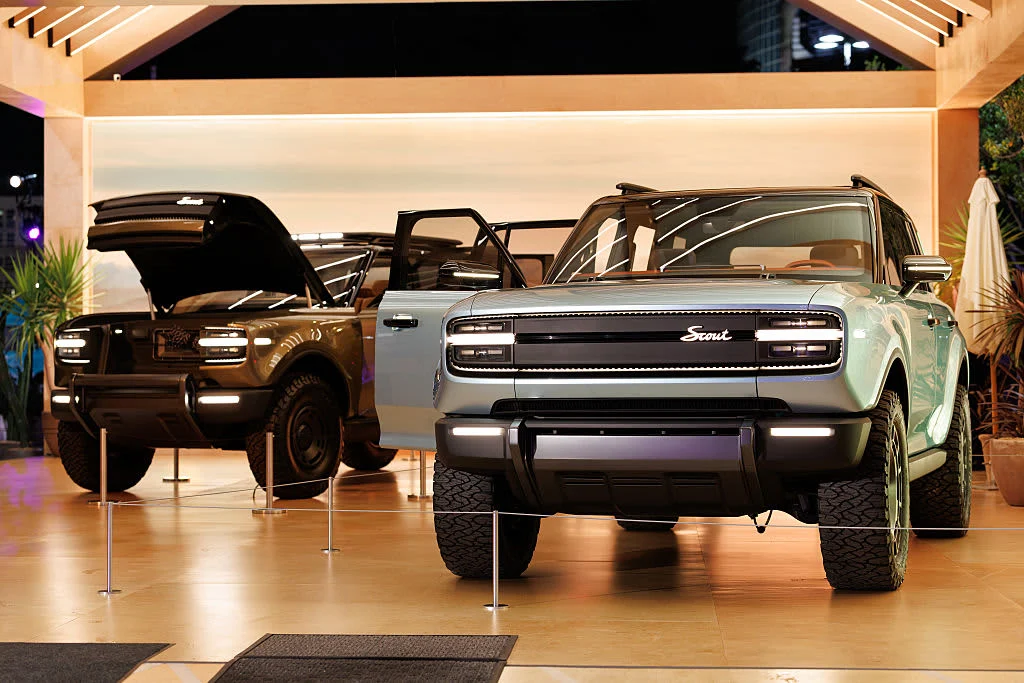
BLYTHEWOOD, S.C. – Electric vehicle (EV) startup Scout Motors, a resurrected iconic American brand backed by German automotive giant Volkswagen, has announced a significant milestone, accumulating approximately 212,000 reservations for its forthcoming Terra pickup truck and Traveler SUV. The disclosure comes as the company’s new $2 billion manufacturing facility in Blythewood, South Carolina, approaches its final phases of construction, signaling a critical juncture for the ambitious venture. CEO Scott Keogh revealed the reservation figures during an interview at the plant site, emphasizing the robust early interest in the rugged, heritage-inspired vehicles.
Scout’s Revival and Volkswagen’s Strategic Ambitions in the U.S.
The journey of Scout Motors represents a bold re-entry into the competitive American automotive market, particularly within the burgeoning electric and off-road segments. Originally a revered brand from International Harvester, known for its durable and versatile SUVs and trucks between 1961 and 1980, Scout was revived by Volkswagen in 2022. This move was a cornerstone of Volkswagen’s broader strategy to significantly expand its footprint in the crucial U.S. market, especially in the highly profitable pickup truck and rugged SUV categories where European automakers have historically struggled to gain substantial traction against entrenched American brands. Volkswagen’s investment in Scout was initially envisioned as an all-electric offensive, aiming to carve out a distinct niche for robust, adventure-ready EVs. The brand’s revival under VW’s aegis underscores a long-term commitment to diversify its portfolio beyond its traditional passenger car and mainstream SUV offerings, targeting consumers seeking capability, heritage, and modern electric performance.
The Blythewood Manufacturing Hub: A $2 Billion Investment
The construction of Scout’s state-of-the-art manufacturing facility in Blythewood, outside Columbia, South Carolina, represents a monumental $2 billion investment. This facility is not merely a production plant but a strategic hub designed to anchor Scout’s operations and contribute substantially to the local and state economy. As of recent reports, the plant is approximately 85% complete, with crucial supporting infrastructure and a $300 million supplier park still under development. The project is expected to create over 4,000 permanent jobs, alongside thousands more in related industries and the supply chain, injecting significant economic vitality into the region. South Carolina actively courted Scout, offering substantial incentives, highlighting the state’s growing prominence as an automotive manufacturing center, building on existing operations from BMW and Volvo Cars. The choice of location was strategic, offering logistical advantages for supply chain management and distribution across North America, as well as access to a skilled workforce and favorable business environment. The plant’s anticipated full production next year, leading to customer deliveries in 2028, sets a definitive timeline for Scout’s market debut.
Reservation Numbers: A Double-Edged Sword in the EV Market
The accumulation of 212,000 reservations for the Terra pickup and Traveler SUV is a testament to the strong initial brand interest and the allure of Scout’s re-imagined identity. CEO Scott Keogh expressed optimism, suggesting that these figures could "easily be up over 400,000" without extensive additional marketing efforts by the time production commences. However, Keogh also acknowledged the industry’s nuanced understanding of reservations, stating that the more critical objective is to "convert early interest into actual sales as production nears." This sentiment echoes a lesson hard-learned by the U.S. automotive industry over the past decade, particularly within the EV segment. Highly anticipated electric trucks like the Ford F-150 Lightning, Tesla Cybertruck, and Rivian R1T garnered hundreds of thousands of reservations, but these did not always translate into a proportionate number of firm purchases and deliveries. Factors such as prolonged production delays, price adjustments, evolving market conditions, and competition can significantly erode initial reservation enthusiasm. For instance, while the F-150 Lightning saw immense early interest, Ford eventually capped reservations, and its sales, while strong, did not fully match the initial reservation fervor. Similarly, the Tesla Cybertruck faced years of delays, testing the patience of early adopters. Scout’s challenge will be to maintain engagement, manage expectations, and ensure a smooth, timely transition from reservation to delivery, especially given its relatively late entry into a segment already populated by established and emerging players.
The Strategic Pivot to Extended-Range Electric Vehicles (EREVs)

Perhaps the most significant strategic development for Scout Motors has been its decision to offer extended-range electric vehicles (EREVs) in addition to purely all-electric models. This pivot marks a departure from Volkswagen’s initial vision for Scout to be an exclusively EV brand. The shift was prompted by a confluence of factors, primarily a slower-than-expected adoption rate of all-electric vehicles across the broader market, coupled with persistent consumer concerns regarding range anxiety, charging infrastructure availability, and the higher upfront costs associated with battery-electric vehicles. EREVs, which combine an electric powertrain with a small internal combustion engine acting as a generator, offer a compelling bridge solution. They provide the immediate torque and environmental benefits of electric driving for daily commutes while mitigating range concerns with the flexibility of gasoline for longer journeys, effectively addressing a key barrier to EV adoption for many consumers.
Keogh’s data indicates a strong market preference for this hybrid approach, with approximately 87% of current reservations opting for EREV models and 75% for SUVs. This overwhelmingly favors the EREV strategy, underscoring a pragmatic response to real-world consumer demands. The EREV models are projected to offer more than 500 miles of total range, a substantial advantage over the 300 miles estimated for the all-electric variants. This extended range is particularly attractive for the rugged, adventure-oriented segment Scout is targeting, where long-distance travel to remote locations is common and charging infrastructure may be scarce. This strategic adjustment aligns Scout with other manufacturers exploring similar solutions, such as the Ram 1500 Ramcharger, signaling a broader industry trend to diversify powertrain options to meet varied consumer needs during the EV transition.
Targeting a Niche, Broadening Appeal: The Ideal Scout Customer
Scout Motors is meticulously targeting specific market segments that align with its brand ethos of rugged capability and adventure. Keogh identified core target markets as owners of iconic off-road vehicles such as the Ford Bronco and Jeep Wrangler, as well as full-size pickup truck owners. This demographic values durability, off-road prowess, and utility. Interestingly, Scout is also drawing interest from existing Tesla owners, suggesting a segment of EV adopters who may be seeking a more robust, utilitarian, or heritage-rich electric vehicle alternative to Tesla’s current offerings. The design philosophy behind the Terra and Traveler, first revealed in October 2024, incorporates sleek, yet robust exteriors that subtly pay homage to the brand’s historic models, appealing to a sense of nostalgia while delivering modern aesthetics and performance. The decision to launch with EREVs first, followed by all-electric variants, is a direct response to current reservation trends and market demand, ensuring that Scout’s initial offerings resonate strongly with its identified customer base. This also allows the company to capitalize on the immediate market preference for extended range and flexibility.
Pricing and Production Strategy: Volume Over Premium Entry
Scout’s pricing and production strategy deviates from common industry practices, particularly those observed in the luxury or emerging EV segments. Both the Traveler and Terra are expected to start at under $60,000, positioning them competitively against rivals in the mid-to-premium range of trucks and SUVs. Furthermore, Scout plans to launch with mid-level models first, rather than the highest-priced, fully-optioned variants that many new entrants, including Rivian with its R2 SUV, often prioritize to maximize initial revenue and brand prestige. CEO Scott Keogh articulated the rationale behind this approach: "The No.1 thing for me is I want to go get the best volume as soon as possible. In my mind, it’s how quick can you get to 100,000 units? It’s at 100,000 units where you can start to punch through." This volume-centric strategy aims to rapidly achieve economies of scale, reduce per-unit costs, and establish a strong market presence. By offering more accessible mid-level trims first, Scout seeks to broaden its initial appeal and accelerate market penetration, rather than limiting its early production to a smaller, high-margin, but niche, segment of buyers. Keogh’s aspiration for an order book of 12 to 18 months of production before deliveries begin highlights a desire for strong, sustained demand to support the ramp-up phase.
Broader Impact and Future Outlook
The entry of Scout Motors into the automotive landscape, particularly with its refined strategy, carries significant implications for Volkswagen, the EV market, and the American manufacturing sector. For Volkswagen, Scout represents a high-stakes gamble to secure a meaningful share in the lucrative American truck and SUV markets, critical for its global growth ambitions. The success of Scout could pave the way for further diversification and cement VW’s position as a serious player beyond its traditional segments. For the EV market, Scout’s strategic embrace of EREVs underscores a maturing industry that is adapting to consumer realities. It suggests that the path to full electrification may be more gradual and multifaceted than initially predicted, with hybrid solutions playing a vital role in bridging the gap for a substantial portion of buyers. This pragmatic approach could influence other manufacturers to reconsider their all-in EV strategies.
Economically, the Blythewood plant is poised to become a major industrial anchor in South Carolina, attracting further investment and fostering a robust automotive supply chain ecosystem. The thousands of jobs created, from manufacturing to engineering and logistics, will provide a substantial boost to the regional economy. As Scout Motors progresses towards its 2028 delivery target, its ability to convert reservations into sales, manage production ramp-up efficiently, and navigate a rapidly evolving competitive environment will be closely watched. The combination of a storied heritage, Volkswagen’s formidable backing, and a flexible powertrain strategy positions Scout to be a compelling force in the future of American mobility, challenging established players and offering consumers a distinct choice in the rugged EV and EREV segments.
