

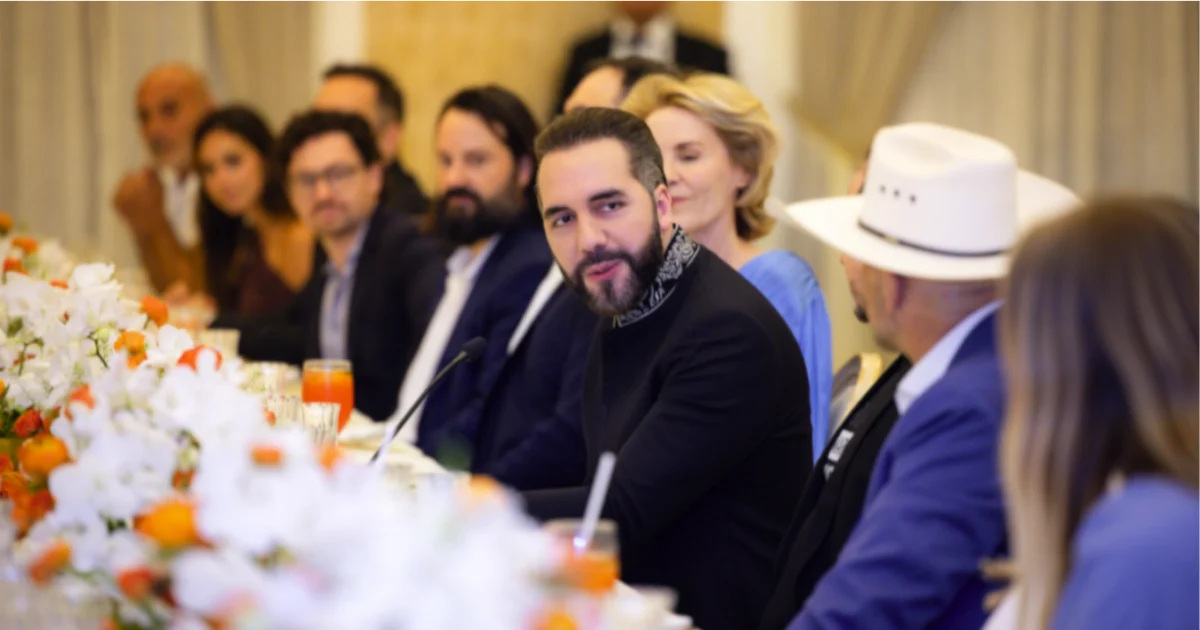
This November 10, amidst the Bitcoin Histórico conference unfolding in the Historical Center of San Salvador, a distinguished assembly of Bitcoin pioneers, investors, developers, and entrepreneurs convened for an exclusive dinner with President Nayib Bukele. The event, orchestrated by The Bitcoin Office, an integral part of the Office of the President and spearheaded by influential figures Stacy Herbert and Max Keiser, provided a unique platform for dialogue between the nation’s leader and key stakeholders in the global Bitcoin ecosystem. The three-hour engagement, stretching from approximately 7:30 PM to 10:30 PM local time, brought together around thirty prominent individuals, many of whom are frequent visitors and contributors to El Salvador’s burgeoning Bitcoin landscape.
The gathering, held at the nation’s presidential residence, offered a rare glimpse into the collaborative spirit driving El Salvador’s innovative approach to financial sovereignty. The diverse attendee list underscored the broad appeal and multi-faceted nature of the Bitcoin movement, encompassing individuals from nascent startups to established corporations, and from technical contributors to thought leaders in academia and media.
A Convergence of Minds: Key Attendees and Their Contributions
Among the notable attendees was Mexican billionaire Ricardo Salinas Pliego, the founder of Grupo Salinas, a conglomerate that includes Banco Azteca. Salinas, a vocal proponent of Bitcoin, has previously shared stages with Keiser and Herbert and is a significant figure in the Latin American business and investment community. His presence at the dinner, which included a private meeting with President Bukele, signals strong alignment and potential future collaborations. Reports indicate that Salinas gifted the President volumes one and two of "Manuscripts of the Conquistadors," works curated by Jorge Nikaido, Chief of Staff of Grupo Salinas, suggesting a shared interest in historical and foundational knowledge.
The dinner also featured a robust representation of the investment and entrepreneurial sector. Parker Lewis, founder of Unchained Capital, a prominent Bitcoin financial services company, was present. Mike Peterson, instrumental in the development of Bitcoin Beach, a community initiative fostering Bitcoin adoption in El Salvador, also attended. Other key figures included Katie Ananina of Citizen X, an organization focused on Bitcoin adoption and education, and Aleks Svetski, an entrepreneur and founder of Satlantis, a venture focused on space technology leveraging Bitcoin.
The critical infrastructure of Bitcoin was also represented by leading miners. Beau Turner, CEO of Abundant Mines, a significant player in Bitcoin mining operations, was in attendance. Nacho Pauls, CCO of OCEAN Mining, another major mining entity, and Adam Ortolf of Denver Bitcoin mining, contributed to the discussion on energy and infrastructure.
The technical and intellectual foundations of Bitcoin were highlighted by the presence of Jon Atack, a respected Bitcoin core contributor, and Giacomo Zucco, an engineer associated with Plan B Network, known for his analytical contributions to the space. The intersection of emerging technologies was evident with AI tech entrepreneurs Ginger Gaetz of the ANIA AI initiative and Marc Seal, Founder of Aevonix, showcasing the forward-looking vision of the attendees.
The academic and media landscape was prominently featured through Michael Goldstein, widely known as Bitstein and a co-founder of the Nakamoto Institute, a research and educational organization. Eric Yakes, an economist and author of "The 7th Property," a book exploring Bitcoin’s foundational principles, was also a guest. Independent journalist and podcaster Efrat Feningson provided a media perspective, while local Bitcoiner Michael Ruiz, founder of Build in El Salvador (BIS), a popular business club and Bitcoin meetup, offered insights from the ground level of community adoption.
Setting the Stage: An Evening of Unscripted Dialogue
The evening commenced with guests arriving at the Casa Presidencial, engaging in pre-dinner networking and conversation. Max Keiser, known for his charismatic presence, arrived with a distinctive gift, a Stetson El Presidente cowboy hat, which he playfully suggested might be a "magical artifact," adding a touch of characteristic flair to the proceedings.
Upon President Bukele’s arrival, he extended a warm welcome, greeting each guest with a handshake and promptly inviting them to be seated for dinner. According to Katie Ananina, the atmosphere was deliberately informal, eschewing grand speeches for a more conversational and open format, akin to an "open mic" session. This approach fostered an environment conducive to genuine exchange and exploration of ideas.
Stacy Herbert described the setting as imbued with the spirit of Bitcoin, noting that "President Bukele’s table was adorned with bitcoin orange florals." She highlighted the eclectic mix of attendees, stating, "we gathered anarchists, billionaire tycoons, Wall Street bankers, circular economy activists, VC investors, bitcoin miners, and content creators at the country’s equivalent of the White House." This diverse assembly underscored El Salvador’s ambition to be a global hub for innovation and forward-thinking economic policies.
The dinner featured a three-course meal, with steak as the main course, followed by a multi-layered chocolate dessert. Over the course of three hours, the conversation flowed, touching upon critical issues shaping both El Salvador and the broader implications of Bitcoin adoption. President Bukele actively engaged with the attendees, utilizing a dedicated microphone, while others were passed around, facilitating a dynamic exchange. Approximately six to seven major questions were posed and addressed throughout the evening, covering a spectrum of topics.
Energy Investments and Economic Development
A significant portion of the discussion revolved around El Salvador’s energy sector and its strategic alignment with the growing demands of the digital economy, particularly Bitcoin mining. Ricardo Salinas Pliego actively participated in this dialogue with President Bukele.
Beau Turner, one of the Bitcoin miners present, shared that President Bukele provided an overview of the nation’s current electricity generation capacity, stating it "is being roughly matched to the country’s current demand." The President elaborated on ambitious plans to significantly augment this capacity, detailing projects aimed at adding over a gigawatt of additional generation. These initiatives include leveraging geothermal energy, a renewable resource abundant in the volcanic nation, and incorporating generation from imported liquefied natural gas.
Turner further elaborated on the President’s strategic vision: "What stood out to me was how directly he connected those development plans with demand for compute. Bukele said they can develop this power knowing there are users who can put it to work, whether that’s Bitcoin mining or other data centers. The demand could come from the Salvadoran government’s own operations or from outside companies bringing equipment and investment into the country." This statement highlights a proactive approach to energy policy, directly linking infrastructure development to anticipated economic activity, with Bitcoin mining positioned as a key driver of demand.
The miners present responded positively to this forward-looking perspective. Ricardo Salinas Pliego, with his extensive experience in energy production through Grupo Dragón, which spans geothermal, wind, solar, and natural gas generation across Mexico, offered valuable insights and expressed potential interest in contributing to El Salvador’s energy expansion. This convergence of government policy and private sector expertise in energy infrastructure is crucial for supporting the scalability of operations within El Salvador.
Addressing Immigration and Societal Integration
The topic of immigration, a subject of increasing relevance in the context of El Salvador’s embrace of Bitcoin, was also brought to the forefront. Max Keiser’s remarks, emphasizing the potential for global citizens, particularly Bitcoiners, to migrate to El Salvador, naturally led to a deeper discussion on this theme.
Michael Ruiz, who moved to El Salvador three years ago and has become a prominent figure in the local Bitcoin community, posed a question regarding potential societal friction, specifically concerning gentrification and any resentment from the local population towards Western migrants. He referenced negative online commentary that has labeled some Bitcoiners as "colonizers," indicating an awareness of the sensitive nuances of cultural integration.
President Bukele responded by posing a direct question to the attendees: "When you go out, walk around, and interact with Salvadorans, what are the interactions like?" For those who have spent time in El Salvador, the answer is often overwhelmingly positive. Ruiz conveyed that Salvadorans are generally "very welcoming" and receive newcomers "with open arms," expressing happiness about the growing expatriate community. This anecdotal evidence suggests a strong sense of hospitality and acceptance within the broader Salvadoran society.
It is pertinent to note that current immigration trends in El Salvador indicate a larger influx from regional countries such as Honduras, Nicaragua, Guatemala, and Colombia, with a smaller but growing number of individuals from the United States. President Bukele addressed concerns about population density by humorously remarking on El Salvador’s capacity to host the world’s population, drawing a comparison to Manhattan’s density. While not a literal policy proposal, this statement served to contextualize the scale of potential immigration and underscore the nation’s openness. He further articulated a belief that "all great empires were built with immigrants’ help," revealing a mindset that views immigration as a catalyst for national growth and progress.
Regarding the specific issue of gentrification, President Bukele shared an illustrative anecdote about a local fisherman and house caretaker. The story depicted how an American buyer significantly increased the caretaker’s monthly wages from $300 to $800. This increase enabled the fisherman to purchase a motor for his boat, dramatically enhancing his fishing capacity and doubling his fleet, even allowing his son to acquire his own vessel. The President noted that the only complaints reportedly came from neighbors, implying that this positive economic uplift created a ripple effect, potentially pressuring others to increase wages for their own household staff. This narrative suggests that economic empowerment, driven by foreign investment and a rising cost of living, can have tangible benefits for local populations.
Critiques, Economic Growth, and Educational Advancements
The discussion also touched upon the international criticism El Salvador faces, despite its demonstrable economic progress. Efrat Feningson inquired, "How come you are criticized around the world despite El Salvador’s GDP growth, a strengthening economy and popularity at home, which I saw firsthand talking to locals and visiting some of the areas once worst hit by gang violence?"
President Bukele’s alleged response pointed to his outsider status: "Because I’m not part of their club. I’m not the kind of ruler they like." He posited that certain global actors, including central bankers and entities like the European Central Bank, utilize mainstream media to disseminate negative narratives and criticize leaders who deviate from established norms. He characterized some critics as operating within predefined narratives and exhibiting resistance to new paradigms, while others might not be inherently malicious but are rather "order followers."
Beyond these geopolitical critiques, the dinner also highlighted El Salvador’s significant advancements in education. President Bukele reportedly mentioned that private schools are increasingly adopting AI tutoring programs similar to those implemented by his administration in public schools. These programs have garnered international attention, with pilot initiatives achieving PISA test scores on par with those of Germany and Switzerland, a remarkable feat for a nation historically challenged by educational disparities. This achievement underscores the potential of technological integration in rapidly improving educational outcomes.
A "Renaissance 2.0": Reflections on the Bitcoin Histórico Conference
The overarching sentiment from the Bitcoin Histórico conference and the presidential dinner was one of optimism and forward momentum. Max Keiser eloquently summarized his vision: "Bitcoin Histórico promised two days of Excellence Only, as the Bitcoin Office likes to say, and it delivered big time. The National Palace was a regal setting to showcase the Renaissance 2.0 taking shape in El Salvador with presentations by the best Bitcoin minds and builders in the world. Audience members felt like they had been transported to a time and place found nowhere else in the world right now, where hope and happiness are in abundance. No doom." This reflection encapsulates the transformative atmosphere the conference aimed to cultivate.
Stacy Herbert further elaborated on the conference’s ethos and the dinner’s execution. "We promoted Bitcoin Histórico as an elevated bitcoin conference experience with Philosopher King meets Renaissance 2.0 vibes," she stated. "In every detail, my team and I achieved that, including with the official Bitcoin Office dinner at Casa Presidencial." Herbert emphasized the candid nature of the discussions, noting that "guests were free to ask any question they wanted, and that no topic was off limits."
She concluded with a powerful observation of President Bukele’s engagement: "They grilled the President for several hours. His wit, his charm, his intelligence – all unscripted – was there for all to see firsthand. And they will have walked away understanding why it is that El Salvador is winning under his leadership." This sentiment was corroborated by attendees interviewed by Bitcoin Magazine, reinforcing the impression of a leader who is both adept at engaging with global innovators and deeply committed to his nation’s progress.
The convergence of international Bitcoin thought leaders and the Salvadoran government, facilitated by events like the Bitcoin Histórico conference and the exclusive dinner at Casa Presidencial, signifies a pivotal moment. It underscores El Salvador’s commitment to fostering a sovereign financial future and attracting global talent and investment, while simultaneously addressing critical national development priorities. The discussions held that evening provided a tangible insight into the strategic thinking and collaborative spirit driving this ambitious national project.
