

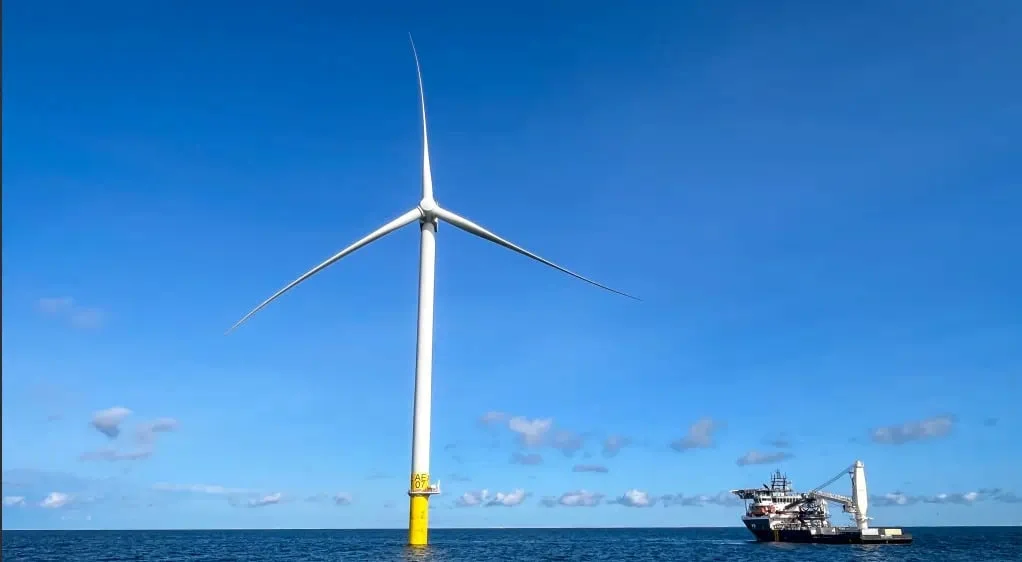
The Revolution Wind offshore wind farm has officially commenced full commercial operations, marking a historic achievement for the United States’ burgeoning offshore wind industry and providing a substantial boost to the New England power grid. Located approximately 15 miles south of Point Judith, Rhode Island, the 704-megawatt (MW) project represents the first utility-scale offshore wind farm in the country to serve multiple states, delivering clean electricity to both Rhode Island and Connecticut. After years of navigating a complex landscape of regulatory reviews, supply chain volatility, and macroeconomic shifts, the project now stands as a cornerstone of the region’s strategy to decarbonize its energy sector and stabilize long-term power costs for residents.
Developed by Danish energy giant Ørsted in partnership with Skyborn Renewables—a portfolio company of Global Infrastructure Partners—Revolution Wind features 65 Siemens Gamesa 11-megawatt turbines. The project is expected to generate enough renewable energy to power an estimated 350,000 homes across the two states. The completion of the facility follows the successful commissioning of South Fork Wind, a smaller 132-MW project that became the first operational utility-scale offshore wind farm in federal waters earlier in 2024. However, the scale of Revolution Wind significantly raises the stakes, more than quintupling the offshore wind capacity currently feeding the regional grid.
A Chronology of Development and Regulatory Hurdles
The journey of Revolution Wind from concept to commissioning spanned more than six years, reflecting the broader challenges faced by the American offshore wind sector. The project was originally selected through a competitive bidding process by Rhode Island and Connecticut in 2018. At the time, the project was hailed as a vanguard of the "Blue Economy," promising to revitalize local ports and create thousands of union jobs.
However, the timeline for completion was extended several times. Initially slated for operation in early 2024, the project encountered a series of regulatory bottlenecks at the federal level during the late 2010s and early 2020s. The Bureau of Ocean Energy Management (BOEM) underwent a rigorous environmental review process that was further complicated by the COVID-19 pandemic, which disrupted field surveys and public hearing schedules.
Construction finally commenced in 2023, following the project’s final investment decision. The onshore construction phase, which involved the installation of underground transmission lines and the expansion of substations in North Kingstown, Rhode Island, was managed in part by Eversource. Although Eversource was an original development partner, the company sold its 50% stake in the offshore portion of the project to Global Infrastructure Partners in 2024 as part of a strategic pivot to focus on its core regulated electric and gas utility business. Despite the sale, Eversource remained integral to the completion of the project’s terrestrial infrastructure.
The offshore installation phase reached a critical milestone in early 2024 with the placement of the first turbine. By March 2024, the project achieved "first power," sending its initial megawatts to the grid. Over the subsequent months, technicians completed the testing and commissioning of the remaining turbine array and the offshore substation, leading to the recent announcement of full commercial availability.
Technical Specifications and Infrastructure
Revolution Wind utilizes the Siemens Gamesa SG 11.0-200 DD offshore wind turbine, a model known for its reliability and efficiency in harsh maritime environments. Each turbine features a 200-meter rotor diameter and blades that sweep an area of approximately 31,400 square meters. These turbines are mounted on monopile foundations, which were fabricated using specialized steel components and driven into the seabed to ensure stability against the Atlantic’s powerful currents and storm surges.
The project’s infrastructure includes a high-voltage offshore substation, which collects the electricity generated by the turbines and steps up the voltage for efficient transmission. From there, two subsea export cables carry the power to a landfall point in Rhode Island. This interconnection is vital for the ISO New England (ISO-NE) grid, the independent system operator responsible for coordinating the movement of wholesale electricity across the six New England states.
The logistics of the project relied heavily on regional maritime infrastructure. The State Pier in New London, Connecticut, underwent a massive $300 million redevelopment to serve as a primary assembly and staging hub for the project. This investment allowed for the heavy-lift operations required to load turbine components onto specialized installation vessels. Simultaneously, the Port of Davisville in Rhode Island served as a secondary support base, underscoring the multi-state economic footprint of the development.
Economic Implications and Ratepayer Benefits
One of the most significant aspects of Revolution Wind is its impact on regional energy economics. Under the long-term power purchase agreements (PPAs) signed with local utilities, Rhode Island is contracted to receive 400 MW of the project’s output, while Connecticut will receive 304 MW.
The price of the electricity generated by Revolution Wind is set at approximately 9 cents per kilowatt-hour (kWh). In the context of New England’s historically volatile energy market—where prices often spike during winter months due to a heavy reliance on natural gas—this rate is considered highly competitive. According to data from the U.S. Energy Information Administration (EIA), the average retail price of electricity in New England has frequently exceeded 20 cents per kWh in recent years.

The Rhode Island Office of Energy Resources (OER) estimates that the project will provide $374 million in direct savings to ratepayers over the 20-year life of the contract. Furthermore, by increasing the supply of zero-marginal-cost electricity, the project is expected to exert downward pressure on wholesale market prices, potentially saving consumers an additional $139 million. For the average residential customer, these savings are projected to manifest as a reduction of $4 to $10 on monthly bills during the project’s first full year of operation.
Regional Energy Demand and the Strategic Role of Offshore Wind
The completion of Revolution Wind comes at a critical juncture for the New England power grid. According to the 2025 Capacity, Energy, Loads, and Transmission (CELT) Report issued by ISO New England, the region is facing a period of rapid demand growth. Annual electricity demand is projected to grow by 1.8% through 2045, a significant acceleration from the 0.9% growth forecast in 2018.
This surge in demand is driven by the electrification of heating and transportation as states move toward net-zero emissions targets. However, meeting this demand through land-based renewables is increasingly difficult. Southern New England, which includes Massachusetts, Rhode Island, and Connecticut, is densely populated with limited available land for large-scale solar farms. Onshore wind development is largely confined to the remote forests of northern Maine, where transmission constraints limit the ability to move power to southern load centers.
Offshore wind is uniquely positioned to address these challenges. By utilizing the consistent and powerful winds found off the Atlantic coast, projects like Revolution Wind can provide high-capacity factors that rival traditional baseload power plants. The project’s ability to deliver large volumes of power directly to coastal population centers minimizes the need for extensive new overland transmission corridors, which often face intense local opposition.
Official Responses and Stakeholder Perspectives
The operational status of Revolution Wind has drawn praise from government officials and industry advocates who view it as a proof of concept for the viability of the U.S. offshore wind market.
"Today is a milestone for Rhode Island’s pioneering offshore wind industry, and we’re thrilled to see Revolution Wind reach full capacity," stated Joey Paolino, senior gubernatorial education principal of the national business association Advanced Energy United. His enthusiastic "Spin baby spin!" remark reflected the sentiment of many proponents who have waited years to see the project cross the finish line.
State leaders in Connecticut also highlighted the project’s role in meeting statutory climate goals. Connecticut has a mandate to achieve a zero-carbon electric grid by 2040, and the 304 MW provided by Revolution Wind is a substantial step toward that objective. Officials noted that the project not only provides clean energy but has also served as a catalyst for local job creation, with hundreds of union workers employed during the construction phase at the New London State Pier.
However, the road to completion was not without its critics. Commercial fishing groups and some coastal residents expressed concerns regarding the impact of the turbines on navigation, marine life, and viewsheds. In response, Ørsted and its partners implemented a series of mitigation measures, including a uniform grid layout for the turbines to facilitate safer navigation and extensive environmental monitoring programs to track the impact on local fish stocks and marine mammals.
Broader Impact on the U.S. Energy Landscape
Revolution Wind’s success is expected to provide momentum for other major projects currently in the pipeline. The U.S. offshore wind industry has faced significant headwinds recently, including high interest rates and inflation that led to the cancellation or renegotiation of several other contracts in the Northeast. The fact that Revolution Wind was able to reach commercial operations despite these pressures provides a sense of stability to investors and policymakers.
The project also serves as a model for inter-state cooperation. By sharing the costs and benefits of the project, Rhode Island and Connecticut were able to achieve economies of scale that might have been impossible for a single state acting alone. This collaborative approach is being mirrored in more recent solicitations, where Massachusetts, Rhode Island, and Connecticut have explored joint procurement strategies to further drive down costs.
As the turbines of Revolution Wind begin their 20-year service life, they represent more than just a source of electricity; they are a tangible symbol of the energy transition in progress. The project demonstrates that despite regulatory and economic hurdles, utility-scale offshore wind is a viable and necessary component of the American energy mix, capable of providing affordable, reliable, and clean power to millions of citizens while revitalizing the maritime heritage of the New England coast.
