

A Quarter Century of Multilateral Progress
The publication of the 2025 Annual Report coincides with the 25th anniversary of the IEA-OES, an organization founded to facilitate intergovernmental collaboration in the development of ocean energy. Over the past two and a half decades, the program has expanded its membership and influence, providing a platform for technical exchange, policy development, and the establishment of international standards. This year’s report emphasizes that the groundwork laid since 2000 has successfully positioned ocean energy as a "credible contributor" to the global net-zero transition.
In his address within the report, Matthijs Soede, Chair of IEA-OES, noted the profound evolution of the industry. He observed that while ocean energy was primarily a "research ambition" twenty-five years ago, the contemporary landscape features devices operating for extended durations, more robust regulatory frameworks, and a high degree of international alignment. This progress is not merely technical; it reflects a growing confidence among institutional investors and governments that marine energy can provide the predictable, high-density power necessary to complement intermittent sources like wind and solar.
The Strategic Roadmap: 300 GW by 2050
The 2025 report aligns its findings with the ambitious international roadmap titled "Ocean Energy and Net Zero: An International Roadmap to Develop 300 GW of Ocean Energy by 2050." This vision requires a massive scaling of current capacities, and the IEA-OES has structured its current work around four strategic pillars designed to address the remaining barriers to commercialization.
The first pillar, Market Pull, focuses on creating the economic conditions necessary for deployment, such as feed-in tariffs, contracts for difference (CfDs), and specialized auctions. The second, Technology Push, continues to support research, development, and demonstration (RD&D) to drive down the Levelized Cost of Energy (LCOE). The third pillar, Infrastructure, addresses the physical requirements of the industry, including dedicated test sites, specialized vessels, and port facilities. Finally, Regulatory Development aims to streamline the permitting processes and maritime spatial planning necessary to secure sea-room for large-scale arrays.
Technological Milestones and Global Project Highlights
The report provides a detailed account of operational successes in 2024 and 2025, which serve as proof-of-concept for the sector’s maturity. One of the most significant achievements highlighted is the continued success of the MeyGen Phase 1 project in the United Kingdom. As the world’s largest operational tidal stream project, MeyGen reached a cumulative generation milestone of 84 GWh. Located in the Pentland Firth, Scotland, the project has demonstrated that tidal energy can reliably deliver power to the national grid over several years, overcoming the harsh environmental conditions of high-flow marine environments.
In Asia, China’s "Endeavour" tidal unit has set a new benchmark for reliability, exceeding 40 months of continuous grid connection. This achievement is particularly notable as it demonstrates the long-term survivability of marine components and the effectiveness of modern anti-fouling and anti-corrosion technologies. The Chinese government’s sustained investment in ocean energy reflects a broader strategy to diversify its renewable portfolio and lead in offshore engineering.
Innovation in tidal energy was further bolstered by Minesto’s activities in the Faroe Islands. The company successfully upgraded its "Dragon 12" system, a 1.2 MW subsea kite that harvests energy from tidal flows. Unlike stationary turbines, Minesto’s kite technology uses the lift force of the water flow to fly the kite in a figure-eight pattern, significantly increasing the speed of the turbine relative to the water and allowing for energy extraction from lower-velocity currents.
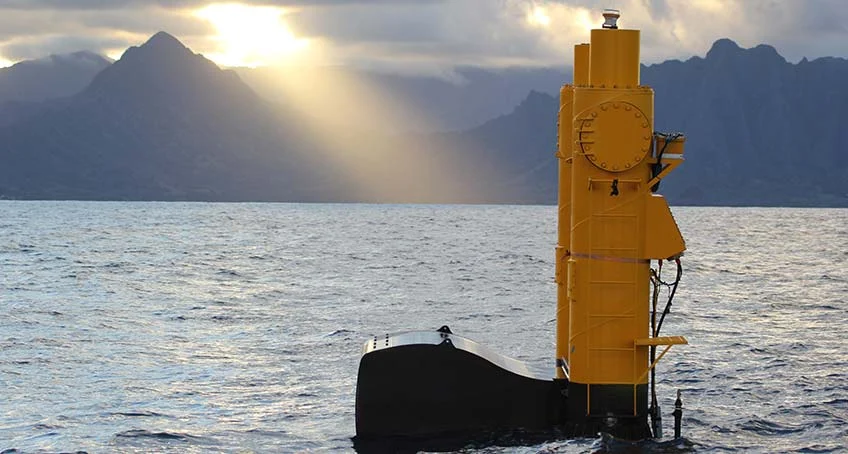
Wave energy also saw significant deployments, most notably with Ocean Energy Ltd’s deployment of the OE-35 buoy. This full-scale device was positioned at the United States Navy’s Wave Energy Test Site (WETS) near Kaneohe Bay, Oahu, Hawaii. The OE-35 project is a critical test of large-scale wave energy conversion, utilizing an oscillating water column to drive an air turbine. The involvement of the U.S. Navy highlights the strategic interest in marine energy for providing resilient power to coastal military installations and remote island communities.
The Shift Toward Hybrid Solutions and the Blue Economy
A prominent trend identified in the 2025 report is the emergence of hybrid offshore solutions. Rather than operating in isolation, ocean energy technologies are increasingly being integrated with other marine activities. This approach, often referred to as the "Blue Economy" strategy, aims to maximize the value of offshore infrastructure.
The report notes a surge in projects combining ocean energy with desalination, hydrogen production, and offshore monitoring. For island nations and remote coastal regions, these "power-at-sea" applications are often more economically viable than large-scale grid injection in the short term. By providing a local source of clean water and fuel, ocean energy can address the specific vulnerabilities of isolated communities.
Furthermore, the integration of ocean energy with offshore wind and solar is gaining traction. Co-locating wave or tidal arrays within offshore wind farms allows for shared use of subsea cables and maintenance vessels, significantly reducing capital and operational expenditures. These multi-source platforms also offer a more stable power output profile, as wave and tidal cycles often peak at different times than wind or solar availability.
Policy and Regulatory Evolution
The IEA-OES report emphasizes that 2025 was a year of "steady progress" regarding maritime planning. Several member countries have updated their regulatory frameworks to include specific provisions for ocean energy, moving away from ad-hoc permitting to more structured maritime spatial planning. This shift is crucial for de-risking projects and providing the long-term certainty required by institutional investors.
Even in jurisdictions where specific support schemes for ocean energy are not yet fully matured, the report found a clear trend toward integrating marine energy into broader national energy transition strategies. Governments are increasingly recognizing that to reach 100% renewable grids, they will need a diverse mix of resources. Ocean energy, with its high predictability—particularly in the case of tidal energy—is seen as an essential component for balancing the variability of other renewables.
Environmental Stewardship and Scientific Research
As the sector moves toward larger deployments, the IEA-OES remains focused on safeguarding marine ecosystems. The 2025 report highlights the value of global cooperation in sharing environmental monitoring data. By pooling results from various test sites around the world, the international community can better understand the interactions between marine energy devices and marine life, such as marine mammals, fish, and benthic habitats.
To date, the environmental impact of deployed devices has been found to be minimal, with many projects reporting no significant adverse effects on local biodiversity. This growing body of evidence is essential for speeding up the consenting process for future arrays, as it allows regulators to move from a precautionary "monitor-everything" approach to a more risk-based and efficient oversight model.
Analysis of Implications and Future Outlook
The findings of the IEA-OES 2025 Annual Report suggest that the ocean energy sector has reached a "tipping point." The transition from R&D to pre-commercial scale is no longer a goal but a current reality. However, to reach the 300 GW target by 2050, the report suggests that the pace of deployment must accelerate significantly.
The implications of this report are twofold. First, for the energy industry, it signals that ocean energy is ready to move beyond the niche and into the mainstream offshore energy market. The technological maturity demonstrated by projects like MeyGen and Minesto provides a template for global replication. Second, for policymakers, the report serves as a call to action to finalize the "Market Pull" mechanisms that will allow private capital to flow into the sector at scale.
As the IEA-OES enters its next 25-year cycle, the focus will likely shift from proving that the technology works to proving that it can be manufactured and deployed at the industrial scale necessary to impact global climate targets. The 2025 report confirms that the foundation is solid; the challenge for the coming decade will be the rapid industrialization of the world’s oceans as a source of clean, predictable, and sustainable power.
The full report, which includes detailed country-by-country updates and technical appendices on salinity gradient and ocean thermal energy conversion (OTEC), serves as the definitive record of the industry’s status as of mid-2025. It remains a vital resource for engineers, investors, and climate strategists working to harness the immense, untapped power of the world’s seas.
