

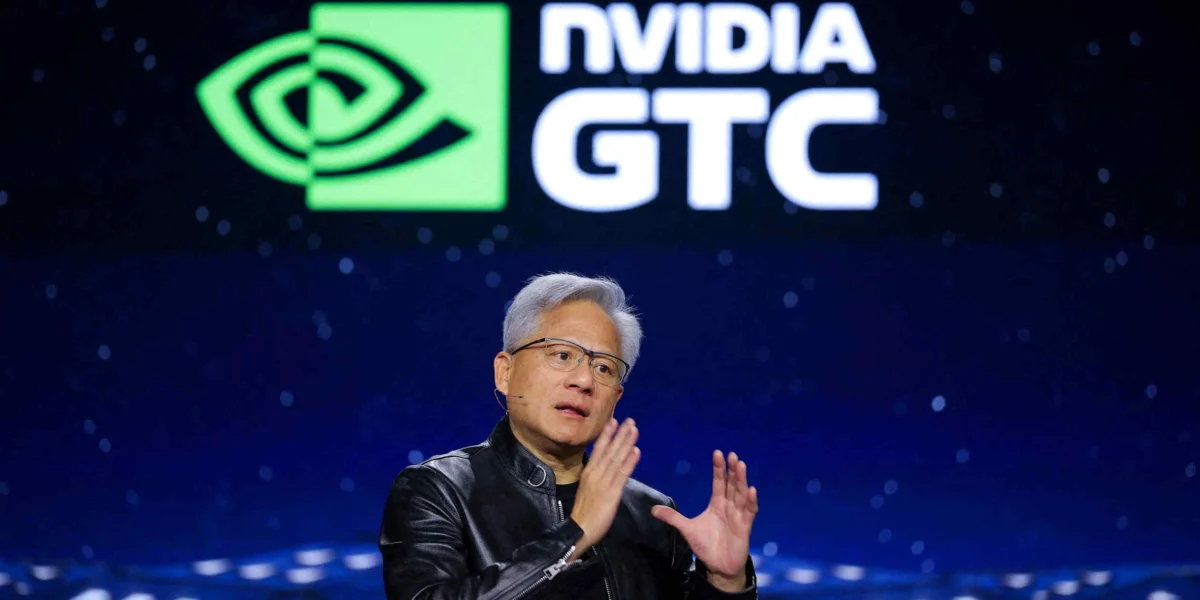
SAN JOSE, California – Jensen Huang, the visionary co-founder and CEO of NVIDIA, electrified a capacity crowd at the company’s annual GTC (GPU Technology Conference) on Monday, March 17, 2026, with a bold projection: NVIDIA anticipates achieving an astonishing $1 trillion in annual revenue within the next two years. This ambitious forecast, delivered from the stage of a San Jose arena, underscores the company’s dominant position at the epicenter of the global artificial intelligence revolution. While Huang painted a picture of unparalleled growth, a starkly different reality unfolded just outside the venue, where a truck adorned with three billboards served as a potent, albeit unsolicited, counterpoint to the boundless optimism radiating from within.
The Grand Vision: A Trillion-Dollar Future for NVIDIA
Huang’s pronouncement was the undisputed centerpiece of his keynote address at GTC 2026, an event that has become the de facto global summit for the AI industry. The sheer scale of the projected revenue dwarfs even the most optimistic predictions for many established tech giants. To put this into perspective, NVIDIA’s revenue for fiscal year 2024, which concluded in January 2024, was approximately $60.9 billion, and for fiscal year 2025, it is projected to reach over $80 billion. A leap to $1 trillion in revenue by early 2028 would represent an exponential acceleration in growth, indicative of the transformative impact AI is having across virtually every sector.
The core of NVIDIA’s dominance lies in its Graphics Processing Units (GPUs), initially designed for gaming but now the indispensable workhorses for training and deploying complex AI models. Huang detailed advancements in NVIDIA’s hardware and software ecosystem, emphasizing new architectures and platforms designed to further accelerate AI development and adoption. He highlighted the insatiable demand for computing power driven by the rapid proliferation of generative AI, large language models (LLMs), and sophisticated AI applications in fields ranging from autonomous vehicles and drug discovery to climate modeling and personalized healthcare.
Huang’s address outlined NVIDIA’s strategy to capture this burgeoning market. This includes not only the continued evolution of its H100 and subsequent generations of AI accelerators but also a significant expansion of its software and services offerings. The company is investing heavily in its CUDA parallel computing platform, its AI software libraries, and its burgeoning cloud services, aiming to provide an end-to-end solution for AI development and deployment. The vision is clear: NVIDIA seeks to be the foundational infrastructure provider for the AI era, analogous to how Intel dominated the PC processor market for decades.
The Unseen Reality: A Truck’s Silent Protest
While Huang captivated thousands inside the convention center, a more somber message was being broadcast to the streets of San Jose. A truck, strategically positioned to be visible to attendees and passing traffic, displayed three prominent billboards. Though the specific content of these billboards was not immediately detailed in initial reports, their presence served as a potent symbol of the external pressures and critical perspectives that often accompany such rapid technological and financial ascents.
The juxtaposition of Huang’s soaring rhetoric and the truck’s silent commentary speaks volumes about the complex landscape of the AI industry. Such a dramatic revenue projection, while exciting for investors and proponents of AI, also raises questions about the sustainability of such growth, the potential for market saturation, and the broader societal implications of unchecked technological advancement. It is plausible that the billboards addressed concerns related to the environmental impact of massive data centers powering AI, the ethical considerations of advanced AI systems, or perhaps even the competitive landscape and potential antitrust scrutiny that NVIDIA, as a dominant player, might face.
GTC: A Bellwether for the AI Industry
The NVIDIA GTC conference is more than just a product launch event; it is a critical barometer for the health and direction of the AI industry. Held annually, it brings together researchers, developers, enterprise leaders, and policymakers to discuss the latest breakthroughs, showcase applications, and forge partnerships. In recent years, GTC has transformed from a niche gathering for graphics enthusiasts into the premier global forum for AI innovation.
The 2026 edition, held from March 17-20, was particularly significant. The rapid advancements in generative AI and LLMs over the past few years have spurred unprecedented investment and development. Companies across all sectors are racing to integrate AI into their operations to gain a competitive edge, leading to a skyrocketing demand for the powerful computing hardware that NVIDIA provides. GTC 2026 served as NVIDIA’s platform to showcase its next wave of innovations designed to meet this demand and solidify its market leadership.
The conference typically features a series of technical sessions, hands-on labs, and presentations from industry leaders detailing how they are leveraging NVIDIA’s technology. This year’s event was no exception, with extensive coverage of new GPU architectures, AI software frameworks, and specialized solutions for various industries. The scale of participation, with thousands of attendees and millions more following virtually, underscores the profound impact of NVIDIA’s technology on the global economy and scientific research.
Supporting Data: The Pillars of NVIDIA’s Growth
NVIDIA’s trajectory has been nothing short of meteoric. The company’s revenue has seen dramatic increases, driven by several key factors:
- Demand for AI Accelerators: The core driver of NVIDIA’s growth is the surging demand for its high-performance GPUs, such as the H100 and its predecessors, which are essential for training and running large AI models. These chips offer vastly superior parallel processing capabilities compared to traditional CPUs, making them ideal for the computationally intensive tasks of AI.
- The Rise of Generative AI: The explosion in popularity and capability of generative AI models (e.g., for text, image, and code generation) has created an insatiable appetite for the computing power that NVIDIA’s hardware provides. Enterprises are investing heavily in AI infrastructure to leverage these capabilities.
- Expansion into New Markets: Beyond its traditional data center business, NVIDIA has made significant inroads into automotive (autonomous driving platforms), healthcare (AI for drug discovery and diagnostics), robotics, and industrial automation.
- Software Ecosystem Dominance: NVIDIA’s CUDA platform and its extensive suite of AI software libraries have created a powerful ecosystem that makes it difficult for competitors to gain traction. Developers are accustomed to using CUDA, creating a "stickiness" that reinforces NVIDIA’s market position.
- Strategic Acquisitions: NVIDIA has strategically acquired companies that complement its AI ambitions, such as Mellanox for high-speed networking and Arm Holdings (though this acquisition faced regulatory hurdles).
The projected $1 trillion revenue target implies an average annual growth rate of well over 100% for the next two years, a pace that is virtually unheard of for a company of NVIDIA’s current size. This growth would require sustained demand for its flagship AI chips and continued success in expanding its market share across diverse industries. It also suggests that NVIDIA plans to aggressively roll out new, more powerful, and more expensive hardware, alongside a substantial increase in its software and service revenues.
Timeline of Acceleration
NVIDIA’s current surge is the culmination of years of strategic investment and technological development.
- Early 2010s: NVIDIA begins to recognize the potential of its GPUs for scientific computing and machine learning, laying the groundwork for its AI strategy.
- Mid-2010s: The company formally launches its deep learning initiatives, heavily promoting its CUDA platform for AI research and development.
- Late 2010s: GPUs become increasingly integral to AI training, and NVIDIA solidifies its position as the leading provider of AI hardware.
- Early 2020s: The COVID-19 pandemic accelerates digital transformation and AI adoption. NVIDIA’s data center revenue begins to soar.
- 2022-2023: The mainstream emergence of sophisticated generative AI models, such as ChatGPT, triggers an unprecedented surge in demand for AI chips, catapulting NVIDIA’s stock and revenue to new heights. The H100 GPU becomes a critical bottleneck for many companies.
- 2024: NVIDIA continues to experience record-breaking revenue and profits, with its market capitalization reaching historic levels. The company announces its next-generation architectures and expands its software offerings.
- March 2026 (GTC): Jensen Huang projects the $1 trillion revenue milestone within two years, signaling NVIDIA’s confidence in its ability to sustain its hyper-growth phase.
This timeline highlights a consistent strategy of foresight, technological innovation, and market cultivation that has positioned NVIDIA at the forefront of the AI revolution.
Potential Reactions and Broader Implications
Huang’s $1 trillion revenue prediction is likely to elicit a range of reactions:
- Investors: NVIDIA’s shareholders will undoubtedly welcome this news, anticipating further stock appreciation. The company’s financial performance has already been a major driver of the stock market’s recent performance.
- Competitors: Rival chip manufacturers like AMD, Intel, and emerging AI chip startups will be keenly watching NVIDIA’s progress. They will need to accelerate their own innovation cycles and find ways to compete effectively against NVIDIA’s established ecosystem and performance lead.
- Customers: Businesses reliant on NVIDIA’s hardware will face decisions about their long-term supply chain strategies. The immense demand for NVIDIA’s chips has led to shortages and long lead times, prompting some to explore alternative solutions or build their own custom AI chips.
- Regulators: The sheer dominance of NVIDIA in a critical technological sector could attract increased scrutiny from antitrust regulators globally. Concerns about market monopolization and fair competition may arise.
- Public Discourse: The projected economic impact of NVIDIA’s growth will fuel broader discussions about the benefits and challenges of AI, including job displacement, ethical considerations, and the concentration of power in the technology sector.
The implications of NVIDIA reaching $1 trillion in revenue are far-reaching. It would signify the profound economic transformation driven by AI and firmly establish NVIDIA as one of the most influential companies in the world. It would also underscore the immense capital required to build and scale AI infrastructure, potentially creating a wider gap between tech giants and smaller players. The presence of the truck outside GTC serves as a reminder that as technology advances at an unprecedented pace, societal and ethical considerations must remain at the forefront of the conversation, ensuring that innovation benefits humanity broadly.
