

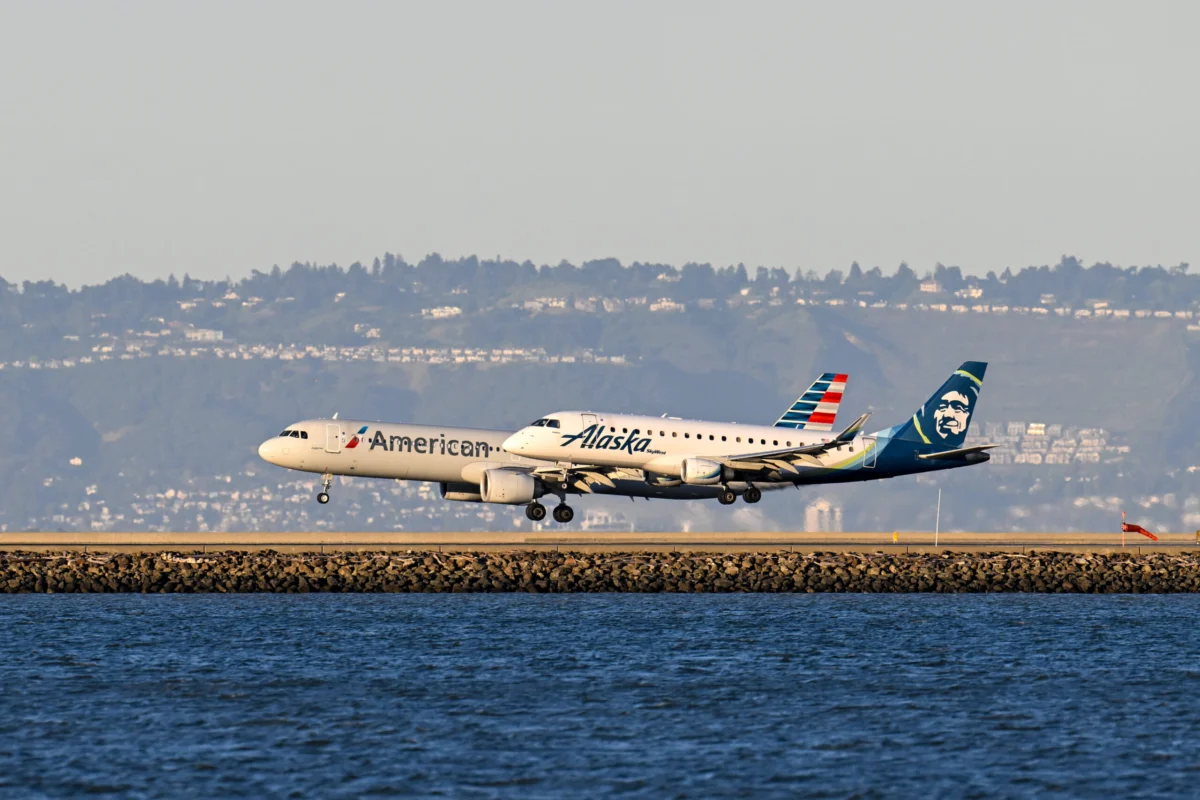
An American Airlines and an Alaska Airlines plane execute a near-perfect synchronized landing on the runway at San Francisco International Airport in San Francisco, California, on March 23, 2026, a striking visual testament to the constant, intricate dance of modern air travel. This precision, however, belies a complex and often volatile economic landscape that dictates the cost of air travel for millions. As Fall 2026 approaches, domestic airfare prices are exhibiting significant fluctuations, with holiday travel, particularly around Thanksgiving, seeing substantial increases, primarily driven by a global surge in jet fuel costs. Conversely, some routes offer surprising bargains, underscoring the nuanced and regionally disparate nature of the current aviation market.
The Soaring Cost of Holiday Travel: A Thanksgiving Premium
Analysis from flight-tracking site Hopper reveals a stark reality for travelers planning to fly during the Thanksgiving period in 2026: fares are up more than 30% compared to the previous year. This significant hike represents a direct consequence of airlines increasingly passing on the steep rise in jet fuel prices to their customers. The increase is not merely incremental but marks a substantial premium for one of the busiest travel periods of the year, forcing many families to re-evaluate their holiday budgets or travel plans. This surge is consistent with broader trends observed in the post-pandemic travel recovery, where demand has often outpaced capacity, giving airlines greater pricing power.
Jet fuel, a refined petroleum product, constitutes one of the largest operating expenses for airlines, often accounting for 20-30% of their total costs, a figure that can climb even higher during periods of price volatility. The global energy markets in 2026 have been characterized by persistent geopolitical tensions, supply chain disruptions, and a robust rebound in global demand following earlier economic slowdowns. Crude oil prices, the primary determinant of jet fuel costs, have remained elevated, reflecting a delicate balance between OPEC+ production decisions, non-OPEC supply, and global consumption patterns. Refining capacity, particularly for middle distillates like jet fuel, has also faced constraints, further exacerbating price pressures. For airlines, absorbing such a significant increase in fuel expenses without adjusting fares would severely impact their already thin profit margins, threatening financial stability.
Airlines’ Strategy and Consumer Impact in a High-Demand Environment
Airlines, having navigated the unprecedented challenges of the COVID-19 pandemic, are now operating in an environment marked by resilient demand and heightened operational costs. The decision to raise fares for critical periods like Thanksgiving is not taken lightly but is a strategic necessity. "Airlines are facing immense pressure from input costs, particularly fuel," an industry analyst, who requested anonymity to speak freely on pricing strategies, noted. "They have invested heavily in capacity restoration and fleet modernization, and now they must ensure profitability to sustain operations and future growth. Holiday demand, being relatively inelastic, provides the necessary leverage to implement these fare adjustments."
This elasticity of demand means that while some leisure travelers might defer or cancel trips due to higher prices, those with strong family or cultural commitments during Thanksgiving are often less sensitive to price increases. Airlines recognize this pattern, strategically adjusting pricing algorithms to maximize revenue during peak seasons. Major carriers such as American Airlines, Delta Air Lines, United Airlines, and Southwest Airlines have all been observed to fine-tune their pricing models in response to market dynamics and fuel costs. While some may initially absorb a portion of the fuel increases, sustained high prices inevitably lead to fare hikes across the board, sometimes appearing as direct fuel surcharges or integrated into the base fare.
Decoding Flight-Tracking Data: Hopper’s Insights and Beyond
Hopper, a prominent flight-tracking and booking app, plays a crucial role in providing transparency to consumers through its "good deal" fare tallies. Hopper’s methodology typically involves analyzing billions of historical and real-time flight prices to predict future price trends and identify optimal booking times. A "good deal" fare, in this context, refers to a price point that is significantly lower than the average historical price for a given route and travel period, or a price that is predicted to be at or near its lowest point before an anticipated increase. This predictive analytics approach, leveraging artificial intelligence and big data, has become an invaluable tool for travelers seeking to mitigate the impact of rising costs.
Other platforms like Google Flights, Expedia, and Skyscanner employ similar algorithms, contributing to a competitive landscape where data-driven insights empower consumers. The consistency across these platforms often reinforces the broader trends, such as the Thanksgiving fare surge, while also highlighting niche opportunities for savings. The International Air Transport Association (IATA) also provides global insights into airline economics, often publishing reports that contextualize regional fare trends within a broader global aviation framework, validating the macro-economic pressures driving these domestic fare adjustments.
The Geography of Airfare: Cheapest Routes Unveiled
Despite the overarching trend of rising costs, particularly for holiday travel, Fall 2026 presents a mosaic of pricing, with some routes offering surprising affordability. The cheapest flights in November are concentrated in specific regions, primarily benefiting from high competition, strategic hub operations, or shorter distances.
Atlanta’s Hub Power: Hartsfield-Jackson Atlanta International Airport (ATL), consistently ranked as the world’s busiest airport by passenger traffic, serves as a prime example. Its status as Delta Air Lines’ main hub means a vast network of routes and a high volume of daily flights. This extensive connectivity, coupled with competition from other major carriers, often leads to more competitive pricing on routes connecting Atlanta to various Midwest and Southeastern cities. Travelers flying from Atlanta to destinations like Charlotte, Nashville, Orlando, or even Chicago might find more budget-friendly options. The sheer frequency of flights on these corridors creates a supply-side pressure that can temper fare increases, even amidst higher fuel costs.
Island Hopping in Paradise (Hawaii): Intra-island flights within Hawaii also feature among the most affordable. These short-haul routes, connecting islands like Oahu, Maui, Kauai, and the Big Island, are essential for both tourists exploring the archipelago and local residents. Airlines such as Hawaiian Airlines, Southwest, and Mokulele Airlines operate frequent services, fostering robust competition. The short flight durations, typically under an hour, also contribute to lower operational costs per trip, making these segments relatively inexpensive compared to long-haul mainland connections.
Florida’s Internal Network: Similarly, flights within Florida represent another pocket of affordability. With major tourism hubs like Orlando (MCO), Miami (MIA), and Fort Lauderdale (FLL), alongside numerous regional airports, the state boasts a highly competitive and frequently served internal network. Whether for business or leisure, travelers moving between cities like Orlando and Tampa, or Miami and Jacksonville, often benefit from multiple airline options and high flight volumes, leading to more accessible price points.
The Premium on Remoteness and Exclusivity: Most Expensive Routes
In stark contrast to the bargain routes, certain flight paths in Fall 2026 command exceptionally high prices, reflecting unique geographical, logistical, and market dynamics.
Cape Cod’s Elite Corridors: Routes originating from the affluent islands off the coast of Cape Cod, Massachusetts—Nantucket (ACK) and Martha’s Vineyard (MVY)—to major East Coast hubs like New York (JFK/LGA/EWR) and Washington, D.C. (DCA/IAD), are consistently among the priciest. This phenomenon is attributable to several factors:
- Seasonal Demand and Affluent Clientele: These islands are popular summer destinations for high-income travelers, creating a concentrated demand for premium travel during peak seasons, which can extend into the shoulder months of fall.
- Limited Capacity and Infrastructure: The airports on these islands are smaller, with limited gate capacity and shorter runways, restricting the size and number of aircraft that can operate.
- Regional Carrier Dominance: Often served by smaller regional airlines with less competition, these routes lack the price-driving competition seen on larger corridors. The use of smaller turboprop or regional jet aircraft also entails higher operational costs per seat.
- Exclusivity Premium: The perception of exclusivity and convenience for a clientele willing to pay a premium further inflates fares.
Alaska’s Logistical Challenge: Taking the cake for the most expensive flights are trips originating in remote parts of Alaska bound for the East Coast. This seemingly paradoxical situation, given Alaska’s status as an oil-producing state, highlights a critical logistical challenge. While Alaska produces significant quantities of crude oil, it possesses limited refining capacity within the state. Consequently, a substantial amount of jet fuel and other refined petroleum products must be imported, often from refineries in the Lower 48 states or even international sources. This importation process involves complex and costly transportation logistics, including barges, pipelines, and trucks, all of which add to the final price of fuel at Alaskan airports.
The extreme distances involved in flying from remote Alaskan communities (e.g., Nome, Kotzebue, Utqiagvik) to the East Coast, often requiring multiple connections through Anchorage and then a major hub like Seattle or Chicago, also contribute significantly to the cost. Sparse populations mean fewer flights and less competition, leading to higher per-seat operating costs for airlines. The combination of geographical isolation, extensive flight durations, limited carrier options, and the unique fuel import paradox makes these routes exceptionally expensive.
Aviation’s Recent History: From Pandemic Collapse to Resurgent Demand (2020-2025)
The current airfare landscape cannot be fully understood without acknowledging the tumultuous period the aviation industry has experienced in recent years. The image of Hawaiian Airlines planes sitting idle at Daniel K. Inouye International Airport on April 28, 2020, due to the business downturn caused by the coronavirus disease (COVID-19), serves as a stark reminder of the industry’s near-total collapse. In 2020, global air travel plummeted, leading to massive financial losses for airlines, widespread layoffs, and government bailouts to prevent widespread bankruptcies. Fleets were grounded, and future capacity plans were drastically cut.
The period between 2021 and 2023 witnessed a gradual but robust rebound. Pent-up demand for travel, spurred by vaccine rollouts and easing restrictions, led to a surge in bookings. However, airlines struggled to rapidly restore capacity due to labor shortages (pilots, flight attendants, ground staff), maintenance backlogs for reactivated aircraft, and supply chain issues for new planes and spare parts. This imbalance between resurgent demand and constrained supply naturally led to initial fare increases. By 2024-2025, while capacity largely returned, the industry faced new challenges: persistent inflation, volatile fuel prices, and increased pressure on airport infrastructure. These cumulative factors have created the foundation for the pricing dynamics observed in Fall 2026, where airlines, having weathered existential threats, are now focused on sustainable profitability.
Broader Economic Ripple Effects
The elevated airfares for Fall 2026, particularly for holiday travel, are not isolated events but contribute to broader economic trends. They exacerbate inflationary pressures, as travel costs are a significant component of household budgets and influence the Consumer Price Index (CPI). For many families, higher airfares mean reduced discretionary spending elsewhere, potentially impacting other sectors of the economy, such as retail or hospitality.
Regions heavily reliant on tourism, like Hawaii or Florida, could see shifts in visitor demographics or travel patterns, though strong demand often mitigates significant downturns. For destinations like Nantucket and Martha’s Vineyard, where a premium is already factored in, the impact might be less pronounced on the high-end market but could deter more budget-conscious travelers. The overall effect is a tightening of belts for consumers, prompting more strategic and often earlier planning for major travel events.
Looking Ahead: The Future of Air Travel Pricing
The factors influencing airfare in 2026 are likely to persist and evolve. Sustainability initiatives, such as the development and adoption of Sustainable Aviation Fuels (SAF), while crucial for environmental goals, currently come at a premium, which could eventually be reflected in ticket prices. Technological advancements in aircraft design and operational efficiency might offer some relief in the long term, but significant investment costs must first be recouped. Global economic growth and a continued human desire for connection and exploration suggest that demand for air travel will remain robust. However, the interplay of geopolitical stability, energy policies, airline capacity decisions, and consumer purchasing power will continue to dictate the price of taking to the skies.
Navigating the 2026 Travel Landscape: Advice for Consumers
For travelers planning trips in Fall 2026 and beyond, informed decision-making is paramount.
- Early Booking Rewards: As evidenced by the Thanksgiving surge, booking well in advance, often 2-3 months out for major holidays, remains the most effective strategy to secure better fares.
- Flexibility is Key: Being flexible with travel dates, even shifting by a day or two, can yield significant savings. Mid-week travel often presents cheaper options than weekend departures.
- Leveraging Tools: Utilizing flight-tracking apps like Hopper, Google Flights, and others for fare alerts and predictive insights can help identify "good deals" as they emerge.
- Considering Alternatives: For shorter distances, or where airfare is prohibitively high, exploring alternative modes of transport such as trains or buses might be a more economical choice.
- Loyalty Programs: For frequent travelers, airline loyalty programs and co-branded credit cards can offer benefits like mileage redemption or companion passes, offsetting some of the increased costs.
In conclusion, the 2026 domestic airfare market is a dynamic and multifaceted environment, shaped by a confluence of global fuel price volatility, robust passenger demand, and specific regional market characteristics. While synchronized landings at busy airports symbolize efficiency, the underlying economics of aviation require a more complex and adaptable approach from both airlines and travelers alike, ensuring that the skies remain accessible, even if at a higher price.
