

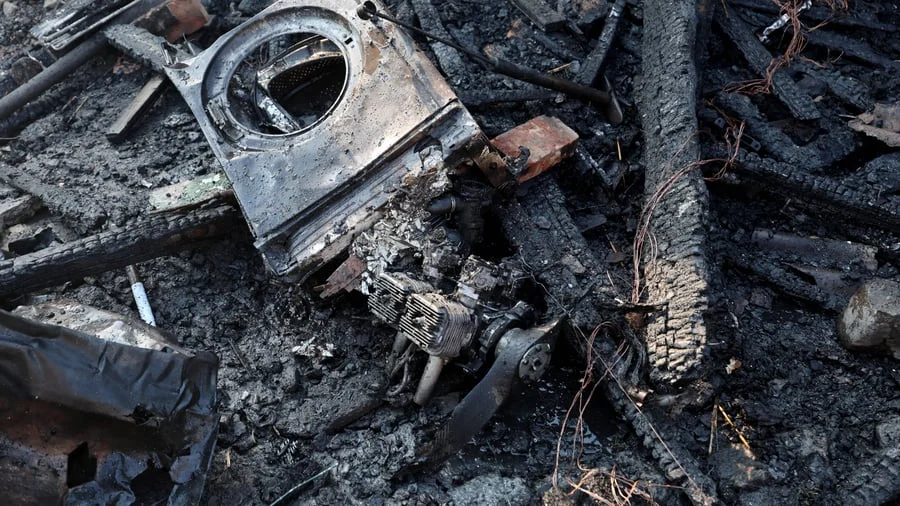
Just hours after a temporary ceasefire expired, Russia launched a renewed wave of drone attacks on Ukraine, according to Kyiv’s military. Air defense forces reported significant drone activity overnight targeting the capital, Kyiv, and other cities including Zaporizhzhia, Dnipro, Kharkiv, and Kherson. The northern Sumy and southern Mykolaiv regions were also reportedly affected. The ceasefire, which had been in effect since Saturday, concluded overnight, signaling a potential escalation in hostilities.
In Kyiv, military administrator Tymur Tkatchenko stated on Telegram that drone debris had fallen onto the roof of a 20-story residential building. Information regarding casualties or the extent of damage was not immediately available. The Kyiv Independent newspaper reported explosions in the capital. This renewed aerial assault follows a period of relative quiet, underscoring the fragile nature of the de-escalation efforts.
The recent ceasefire, brokered by U.S. President Donald Trump, marked the third and officially final day of a period that saw both sides largely refrain from aerial attacks. However, reports of ground engagements and enemy fortifications being breached persisted throughout this period, with each side claiming to have responded to the other’s actions. This pattern mirrored previous ceasefires observed during the Orthodox Easter period. Russia has maintained its destructive war of aggression against Ukraine for over four years.
Ukraine’s Drone Capabilities and NATO Discussions
Amidst the ongoing conflict, Ukraine has reportedly offered to supply Germany with long-range drones and missiles, potentially as a substitute for U.S. Tomahawk cruise missiles. Alonya Getmanchuk, Ukraine’s Ambassador to NATO, conveyed this to the German newspaper "Welt," stating, "We are capable of strengthening NATO’s capabilities for precision strikes deep into enemy territory and, at a certain point, also closing the alliance’s capability gaps." She indicated that these capabilities could fulfill the expectations previously held for American assistance. Getmanchuk further elaborated, "If NATO countries like Germany ask for it in the future, we could certainly offer our experience and effective weapons: long-range drones and missiles." This proposition highlights Ukraine’s efforts to bolster its defense capabilities and potentially contribute to broader European security architectures.
Corruption Allegations Surface
Further complicating the domestic landscape, Ukrainian authorities have identified the former chief of staff to President Volodymyr Zelenskyy, Andriy Yermak, as a suspect in a corruption investigation. Anti-corruption authorities announced that Yermak is suspected of involvement in a criminal organization allegedly involved in laundering approximately $10.5 million through a luxury residential project outside Kyiv. While Ukrainian law prohibits naming suspects, local media identified Yermak. He has denied owning property in the project to Radio Liberty but declined further comment. A spokesperson for Zelenskyy stated it was too early to issue a statement. This development could have significant political ramifications for the Ukrainian government as it navigates internal challenges alongside the external conflict.
Russian Economic Forecasts Downgraded
On the economic front, Russia has significantly revised its growth forecasts downward. Deputy Prime Minister Alexander Novak informed the newspaper "Vedomosti" that the gross domestic product (GDP) is now expected to grow by only 0.4 percent in 2026, a sharp decrease from the previous projection of 1.3 percent. Projections for 2027 have also been reduced, with an anticipated growth of 1.4 percent, down from 2.8 percent. For 2029, the government anticipates a 2.4 percent growth. The oil price assumption for budget planning in 2026 remains unchanged at $59 per barrel, but has been lowered to $50 for 2027-2029. These revisions reflect the ongoing impact of international sanctions and the sustained costs of the conflict on the Russian economy.
EU’s New Sanctions Against Russia’s Defense Industry
The European Union is preparing to implement a 21st sanctions package targeting Russia’s defense industry. EU foreign policy chief Kaja Kallas announced that member states are currently deliberating the proposals. Additionally, member states may introduce measures against Russia’s so-called "shadow fleet," which has been implicated in circumventing oil price caps. This follows the EU’s approval of its 20th sanctions package and a €90 billion loan for Ukraine in the previous month. The continuous imposition of sanctions highlights the EU’s commitment to pressuring Russia economically and militarily.
German-Ukrainian Defense Cooperation
Ukrainian President Volodymyr Zelenskyy has expressed optimism about expanding joint defense production projects with Germany, describing current initiatives as "just the beginning." During a meeting with German Defense Minister Boris Pistorius in Kyiv, Zelenskyy stated that there are currently six such projects underway. He also thanked Germany for its continued assistance in Ukraine’s air defense efforts against Russian attacks, requesting that specifics remain undisclosed to maintain an element of surprise for Russia. Minister Pistorius’s visit to Ukraine underscores the deepening strategic partnership between the two nations in defense matters.

Diplomatic Maneuvers and Mediation Proposals
In parallel with the military developments, diplomatic efforts and proposals for mediation continue to emerge. Finland’s President Alexander Stubb has called for direct talks with Russia, stating, "It is time to start talks with Russia. When that will happen, I do not know." He suggested that if U.S. policy towards Russia and Ukraine appears to diverge from European interests, Europe must engage directly. Stubb indicated discussions among European leaders about who will initiate contact, acknowledging the uncertainty surrounding the timing and modality of such engagement. He emphasized the importance of coordination among European nations, particularly those bordering Russia, and with key allies like Germany, France, the UK, and Poland.
However, Germany’s government has dismissed suggestions of former Chancellor Gerhard Schröder acting as a mediator. A government spokesperson described Putin’s proposal of Schröder as a "sham offer" and part of Russia’s "hybrid strategy" aimed at division. The spokesperson emphasized that Germany and Europe remain open to negotiations but require genuine willingness from Putin, evidenced by an immediate ceasefire. Schröder’s long-standing ties to Russian energy companies and his close relationship with Putin have drawn significant criticism, particularly since the full-scale invasion of Ukraine in 2022, making his potential mediation role highly contentious. EU Foreign Policy Chief Kaja Kallas echoed this sentiment, deeming it unwise for Russia to nominate a negotiator for the EU and noting Schröder’s potential conflict of interest due to his advocacy for Russian state-owned companies.

EU Sanctions on Deportation of Ukrainian Children
The EU has also taken action against individuals responsible for Russia’s program of deporting and forcibly adopting Ukrainian children. Foreign ministers agreed on further sanctions against over twenty individuals and organizations implicated in this program. These measures include asset freezes and entry bans into the EU. The targeted individuals include leaders of camps housing Ukrainian minors and entities involved in indoctrination and militarized education. The EU estimates that approximately 20,000 Ukrainian children have been forcibly transferred to Russia or occupied territories since 2022, with only about 2,100 successfully repatriated.
Economic Repercussions and Energy Security
The ongoing conflict continues to have significant economic repercussions. Russia’s downgrade of its economic growth forecast signals ongoing challenges. Meanwhile, Germany is grappling with energy security concerns. Minister of Economic Affairs Katherina Reiche visited the PCK oil refinery in Schwedt, highlighting the impact of Russia’s halting of oil transit from Kazakhstan. The refinery is crucial for supplying fuel to large parts of northeastern Germany and Berlin. Efforts are underway to secure alternative oil supply routes to maintain its operational capacity. The visit also included the handover of funding for a planned production facility for synthetic aircraft fuels, underscoring Germany’s commitment to diversifying its energy sources and supporting green aviation initiatives.

International Reactions and Ceasefire Violations
Reports of ceasefire violations persist, with both sides accusing each other of breaches. The Ukrainian General Staff reported numerous engagements along the front line, and regional governors detailed civilian casualties from drone and artillery attacks. Russia’s Ministry of Defense claimed to have registered numerous Ukrainian violations and responded with missile, artillery, and drone strikes. The news agency Reuters was unable to independently verify these claims. The three-day ceasefire, facilitated by the U.S., was intended to include the exchange of 1,000 prisoners of war from each side. However, the continued reports of hostilities cast doubt on the effectiveness and adherence to such agreements.
Broader Context and Future Implications
The current situation underscores the complex and multi-faceted nature of the conflict. The renewed drone attacks following the ceasefire highlight Russia’s continued military objectives. Ukraine’s efforts to secure advanced weaponry and its proposals for defense industry cooperation with allies like Germany indicate a strategic focus on long-term security and self-sufficiency. The ongoing corruption investigations within Ukraine present an internal challenge that could impact its stability and international standing. Meanwhile, Russia’s economic forecasts reflect the sustained pressure of sanctions. The diplomatic landscape remains fluid, with various proposals for mediation, though trust and tangible progress appear elusive. The international community continues to navigate the humanitarian, economic, and geopolitical ramifications of this protracted conflict, with a persistent focus on sanctions, humanitarian aid, and the elusive path to a lasting peace. The dynamic interplay between military actions, economic pressures, and diplomatic initiatives will continue to shape the trajectory of the conflict in the coming months.
