

Tokyo and Washington have orchestrated a complex and strategically ambiguous currency operation, with Japan executing a record intervention on Thursday followed by a series of undeclared sales of the US Dollar on Friday, pushing the USD/JPY pair significantly lower. This coordinated effort, unprecedented in its scale and subtlety, aimed to curb the rapid depreciation of the Japanese Yen, which has been severely weakened by a persistent interest rate differential and global economic pressures. The market remains on high alert, interpreting Friday’s actions as a calculated maneuver designed to amplify the impact of the initial, overt intervention without depleting Japan’s limited quota for official market operations.
A Week of High Stakes: Chronology of Intervention
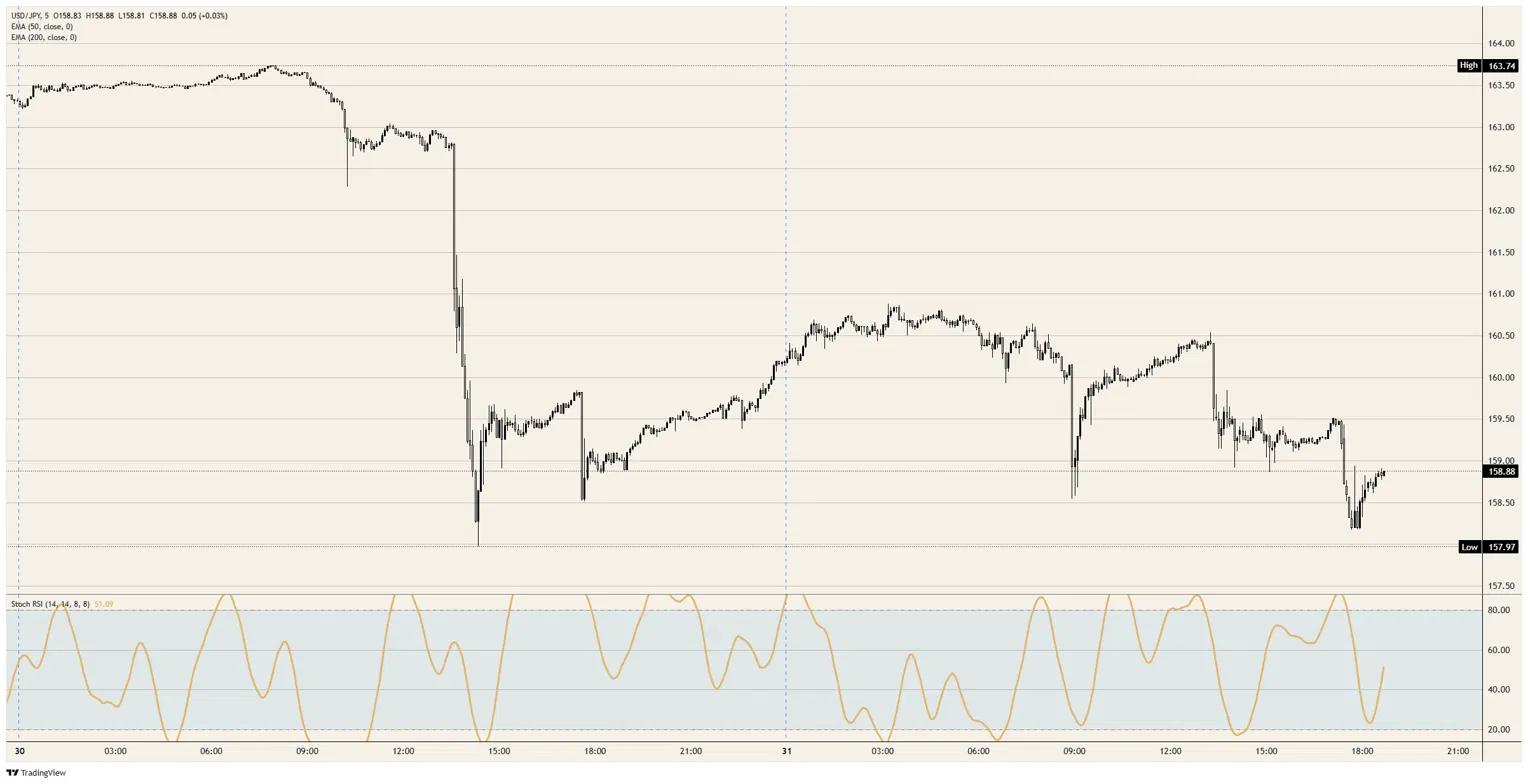
The dramatic sequence of events began to unfold on Thursday, when the Japanese Ministry of Finance (MoF), through the Bank of Japan (BoJ), conducted what is now estimated to be its largest single-day currency intervention in history. The catalyst was a confluence of factors: a weaker-than-expected Gross Domestic Product (GDP) print in Japan, showing an annualised growth of 1.5% against a consensus of 2.1%, which initially pressured the Yen. This was immediately followed by a "rate check" from the Federal Reserve Bank of New York, acting as a fiscal agent for the US Treasury, signaling an imminent move. The intervention itself was swift and decisive, estimated at around $53 billion from central bank account data, taking the Dollar from the 163.00 handle to just under 158.00 within a mere sixty minutes. This aggressive action caught a market carrying significant net short Yen positions, estimated at $11.65 billion, forcing a rapid unwinding.
Hours later, the Bank of Japan concluded its monetary policy meeting, holding its key interest rate at 1.00% with an 8-1 vote, despite one member advocating for a quarter-point increase. The BoJ, however, issued a cautious warning that underlying inflation could continue to run above its target, highlighting the persistent challenges in normalizing monetary policy amidst a backdrop of global inflation and a weak domestic currency. The significant gap between the BoJ’s 1.00% rate and the US Federal Reserve’s upper bound of 3.75% remains a primary driver of Yen weakness.
Friday’s activity proved to be a masterclass in strategic ambiguity. Since the Tokyo morning, the Dollar was observed being sold in three separate, distinct "lurches," yet no official entity claimed responsibility for any of these moves. The first dip saw the Dollar slide to the 158.50 area in the London morning, only to be quickly bought back. A second, more pronounced decline occurred around 13:15 GMT, coinciding with a headline indicating the US Treasury might enter the market and had advised banks to be ready for further action. The session low near 158.00 was eventually printed hours later in the New York afternoon. By the close of the session, USD/JPY was trading just under 159.00, a significant Yen and a half beneath where the day had begun, leaving market desks in a state of confusion, unable to differentiate between a genuine market liquidation and a covert operation.
The Mechanics of Covert Intervention and US Complicity
The "deniable" nature of Friday’s Dollar sales is a crucial element of Tokyo’s strategy. Having expended a record sum on Thursday to forcefully reset market expectations and break existing speculative positions, Japan can now exert influence with a fraction of the cost, or even without direct expenditure, by allowing market participants to price in the possibility of further intervention rather than the fact. This psychological leverage is immensely powerful. Every sudden drop in USD/JPY can be attributed to market dynamics, yet traders are acutely aware of the invisible hand.
The involvement of the United States, though subtle, adds a critical layer of international legitimacy and weight to Tokyo’s actions. The rate check preceding Thursday’s move originated from the Federal Reserve Bank of New York, acting specifically as a fiscal agent for the US Treasury. This distinction is vital: it was not the Federal Reserve acting on its own monetary policy mandate, which would require separate authorization from the Federal Open Market Committee (FOMC) and has not been granted. Instead, the coordination is purely fiscal, underscoring a joint recognition of the Yen’s "badly undervalued" status, as stated by US Treasury Secretary Janet Yellen on Thursday, who also noted that currency markets tend to overshoot.
The US participation, while a signal of support, is measured. The last direct American operation in the USD/JPY pair was in March 2011, a $1 billion intervention split between the Exchange Stabilization Fund (ESF) and the central bank’s own portfolio, notably aimed at weakening the Yen after the Great East Japan Earthquake, rather than supporting it. The scale of American financial commitment is dwarfed by Tokyo’s recent expenditure; the ESF’s net position at the end of 2023 was $43.6 billion, less than what Tokyo spent in a single hour on Thursday. This reinforces the understanding that American money serves primarily as a political signal, endorsing Japan’s concerns, rather than providing significant financial backing for the intervention itself.
International Guidelines and Strategic Ammunition
Japan’s intervention strategy is meticulously aligned with international norms, particularly those set by the International Monetary Fund (IMF). IMF guidelines stipulate that up to three episodes of intervention within a six-month period are considered consistent with a free-floating exchange rate. Crucially, three consecutive days of operations are counted as a single episode. Finance ministry officials had previously indicated in May that two such "windows" remained before November, following the April campaign. Thursday and Friday’s actions, being consecutive, effectively constitute the second of these windows, and are counted as a single, unified episode. This strategic timing means that today’s (Friday’s) activity is "free" on the only meter Tokyo is actively monitoring, preserving its operational flexibility for future contingencies.
Furthermore, Japan’s vast foreign exchange reserves provide ample "ammunition" for such operations. The nation holds approximately $1.4 trillion in total reserves, with a little under $1.2 trillion of that in foreign currency assets. The previous intervention campaign from April to May, which ran about $74 billion over a month, barely dented this formidable pile. Thus, the binding constraint for Tokyo is not the financial capacity, but rather the "permission" – the diplomatic leeway and alignment with international guidelines – to act without being labeled a currency manipulator or causing undue friction with major trading partners. With the current "window" now utilized, only one such opportunity remains before November, according to the MoF’s self-imposed framework.
The Policy Conundrum: A Machine Manufacturing Yen Sellers
The fundamental challenge for the Japanese Yen persists despite these massive interventions. The yawning interest rate differential between Japan and the United States remains the primary structural weakness. With the BoJ holding at 1.00% while the Federal Reserve maintains an upper bound of 3.75% (and potentially higher, with futures still pricing at least one more increase at roughly 59% before September 16), the incentive for investors to sell Yen and buy higher-yielding Dollars is immense.
Beyond monetary policy, other factors exacerbate the Yen’s plight. Japan, a major energy importer, faces a continuously high energy import bill denominated in Dollars, further pressuring the Yen. Domestically, a government elected on a platform of increased spending adds to the fiscal burden, potentially fueling inflation and further eroding the Yen’s purchasing power. These combined forces create what some analysts describe as a "machine that manufactures Yen sellers faster than any operation can retire them." While interventions can provide temporary relief and correct extreme overshoots, they do not address these deep-seated economic disparities.
Market Outlook and Key Data Points
The market’s immediate response to the intervention has been a bearish bias on USD/JPY, particularly as long as the 50-day Exponential Moving Average (EMA) caps rallies and the specter of an "unnamed bidder with an American co-signer" remains active. The 50-day EMA, currently just under 161.50, capped Friday’s rebound near 161.00 and now stands as the first line of resistance. Above it lie the 163.00 level and the four-decade high just short of 164.00.
On the support side, the 200-day EMA near 158.00 has been rigorously tested twice in two sessions – by Thursday’s flush just beneath it and by Friday’s low just above. A daily close beneath 158.00 would open the door to the 155.00 area, with the year’s base near 152.00 as the ultimate support. Conversely, a daily close back above 161.50 would invalidate the current bearish call, suggesting the market has assessed Tokyo’s remaining intervention windows and found them insufficient to sustain a prolonged Yen rally.
Looking ahead, several key data releases will provide crucial insights into the effectiveness of the intervention and the broader economic landscape. Monday will bring the first "hard read" on the precise size of Thursday’s operation when the central bank account data clears. Alongside this, the manufacturing survey at 14:00 GMT, with a consensus of 54, will offer a glimpse into Japan’s industrial health. Wednesday features private payrolls data, expected at 75K, down from 98K, which could influence US monetary policy expectations. However, official confirmation from Japan’s finance ministry regarding the intervention’s scale will not arrive until its monthly figure is released late in August, a delay that deliberately maintains the strategic ambiguity Tokyo finds so valuable.
The most critical data point for currency markets will arrive on Friday, August 7, at 12:30 GMT, with the release of the US Nonfarm Payrolls report. Consensus estimates project 91K new jobs against a prior 57K, with unemployment at 4.3% (up from 4.2%) and average hourly earnings at 0.3% month-over-month. With no FOMC meeting scheduled in August, these two payroll reports (July’s and August’s) will be the primary drivers influencing market expectations for the Federal Reserve’s next policy move ahead of the September 16 FOMC meeting. Any signs of a robust US labor market could strengthen the Dollar and renew pressure on the Yen, testing Tokyo’s resolve and the efficacy of its strategic interventions. The delicate balance between overt and covert actions, coupled with the underlying economic realities, ensures that the USD/JPY pair will remain a focal point for global financial markets in the weeks to come.
