


Gold prices experienced a significant downturn on Friday, tumbling by nearly 1.50%, as the US Dollar staged a notable recovery in the wake of recent foreign exchange market interventions by Japanese authorities. The precious metal, trading as XAU/USD, settled at $4,045, marking a challenging end to the week for bullion investors. This decline reflects a complex interplay of a strengthening Greenback, soaring US Treasury yields, and renewed hawkish sentiment emerging from the Federal Reserve, despite a recent decision to keep interest rates steady.
Market Dynamics Unpacked: The Dollar’s Resurgence and Japanese Intervention Aftermath
The immediate catalyst for Friday’s gold sell-off was the US Dollar’s rebound. Just a day prior, the Greenback had plummeted to a 30-day low against a basket of six major currencies, as measured by the US Dollar Index (DXY), following aggressive intervention by Japanese authorities in the foreign exchange markets. Japan’s move was widely understood as an attempt to shore up the beleaguered Japanese Yen, which had been facing persistent depreciation pressures against the stronger dollar due to diverging monetary policies between the Bank of Japan (BoJ) and the Federal Reserve. While the intervention initially provided significant downward pressure on the DXY, pushing it to a low of 99.91 at one point and briefly offering a tailwind for gold, its effect proved to be largely temporary. By Friday, the DXY, despite still being marginally down by 0.05% on the day, had recovered much of its ground, signaling a return of confidence in the US currency. This recovery of the dollar directly impacted gold, which is priced in USD, making it more expensive for holders of other currencies and thereby diminishing its appeal. The inverse correlation between the US Dollar and gold is a well-established market dynamic, with a stronger dollar typically exerting downward pressure on the yellow metal.
Federal Reserve’s Stance and Dissenting Voices Fuel Uncertainty
Adding to gold’s woes was the escalating hawkish rhetoric from within the Federal Reserve. Although the US central bank decided to keep interest rates unchanged on Wednesday, providing some initial relief to markets, the subsequent release of dissenting votes from three key Federal Open Market Committee (FOMC) members injected a fresh wave of uncertainty and contributed to a higher interest rate outlook. These dissents underscored persistent concerns about inflation and the need for further monetary tightening, directly contradicting the market’s initial interpretation of the Fed’s pause.
Dallas Fed’s Lorie Logan was among the dissenters, explicitly stating her preference for raising interest rates. Logan articulated a view that inflation risks were still tilting upward, suggesting that a rate hike would be crucial to "improve the balance of the outlook." Her comments highlighted a proactive approach to preempt potential inflationary resurgence. Similarly, Beth Hammack from the Cleveland Fed voiced concerns that the current policy rate was "still not restrictive enough," emphasizing that inflation had remained "too high for too long." This perspective indicates a belief that current monetary policy settings are insufficient to bring inflation back to the Fed’s target in a timely manner. Rounding out the hawkish trio, Minneapolis Fed’s Neel Kashkari advocated for a 25 basis points rate increase, favoring a "gradual approach to monetary policy rather than bolder actions." Kashkari’s stance, while still calling for a hike, suggests a preference for consistent, measured tightening rather than aggressive, large-scale adjustments, yet still signals a bias towards higher rates.
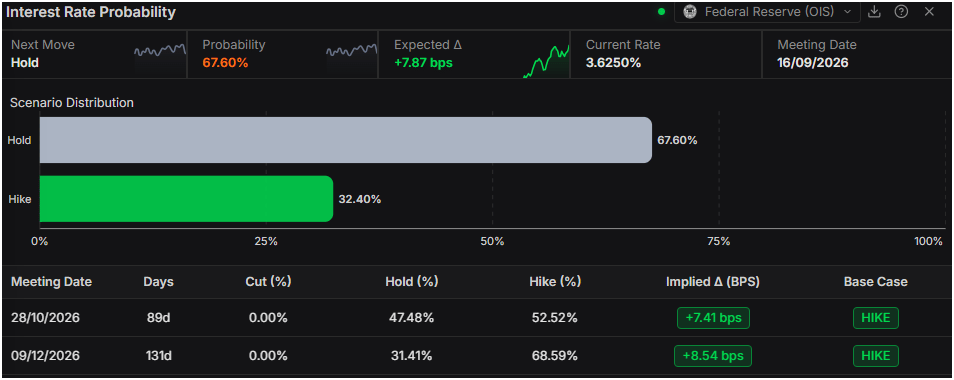
These explicit calls for rate hikes from influential FOMC members sent a clear signal to the market: the debate over further tightening is far from over. This re-emergent hawkish sentiment directly impacted money markets, where hawkish bets had been trimmed significantly following the July meeting. Prior to the meeting, the odds for a rate hike in September were nearly 60%. However, as of Friday, these chances had been reduced to just 31%, with the odds for a hold increasing to nearly 70%, according to Prime Terminal data. The dissenting voices, however, could potentially re-ignite expectations for future hikes, keeping investors on edge.

Treasury Yields Soar: A Reflection of Monetary Policy Expectations
In direct response to the renewed hawkish undertones from the Fed and the recovering dollar, US Treasury yields experienced a significant surge. The yield on the benchmark US 10-year Treasury note climbed almost seven and a half basis points, reaching 4.745%. This sharp increase in yields is particularly detrimental to gold, a non-yielding asset. When bond yields rise, the opportunity cost of holding gold, which offers no interest or dividends, increases. Investors tend to shift capital from non-yielding assets like gold to income-generating assets like Treasury bonds, which are considered safe-haven alternatives. This dynamic amplified the selling pressure on gold, as higher yields make fixed-income investments more attractive relative to bullion. The upward trajectory of Treasury yields suggests that investors are increasingly pricing in a scenario where interest rates might remain elevated for an extended period, or even face further increases, despite the recent pause by the Federal Reserve.
Navigating Economic Indicators: Growth, Inflation, and Consumer Sentiment
The economic landscape also presented a mixed picture, contributing to market volatility. On Thursday, fresh US economic data revealed a softer-than-projected economic growth for the second quarter of 2025. Gross Domestic Product (GDP) growth slowed to 1.5% quarter-over-quarter, a noticeable deceleration from the 2.1% recorded in the first quarter. This slowdown in economic expansion typically might be seen as a factor that could encourage a more dovish stance from the Fed, potentially supporting gold as a safe haven amid growth concerns.
However, concurrently, the Federal Reserve’s preferred inflation gauge, the Core Personal Consumption Expenditures (PCE) Price Index, offered a glimmer of relief, albeit a modest one. The Core PCE came in at 3.3% year-over-year, a slight dip from the previous month’s 3.4%. While any decrease in inflation is welcomed by the US central bank, the figure remains significantly above the Fed’s long-term 2% target, underscoring the persistent inflationary pressures. This combination of slowing growth and stubbornly high inflation presents a challenging dilemma for the Fed, known as "stagflationary" concerns, making its policy path highly scrutinized.
Amidst these macro indicators, consumer sentiment showed signs of improvement. The University of Michigan Consumer Sentiment Index for July rose to 55.2, an increase from its preliminary reading of 54.4. This broad-based improvement was observed across various demographic groups, including those defined by income, education, wealth, age, and political affiliation, as noted by Joanne Hsu, the Director of the Survey of Consumers. "Broad-based improvements were seen across all groups by income, education, wealth, age, and political party," Hsu wrote. Despite this optimism about the economic outlook, inflation expectations remained anchored, with one-year expectations stable at 4.2% and five-year expectations holding at 3.3%. The stability of longer-term inflation expectations is a critical factor for the Fed, as unanchored expectations can lead to a more entrenched inflationary environment. While improving consumer sentiment could signal resilience, the broader economic context still points to a careful balancing act for policymakers.
Geopolitical Undercurrents: Oil Prices and Global Instability
Beyond the domestic economic and monetary policy narratives, geopolitical factors continued to exert influence on financial markets. An escalation of tensions in the Gulf region, referred to in some reports as a "Gulf War" scenario in Q2 2025, played a significant role in driving up crude oil prices. The US crude benchmark, West Texas Intermediate (WTI), surged above $84.00 per barrel. Rising oil prices are a significant headwind for gold for several reasons. Primarily, higher energy costs contribute to broader inflationary pressures across economies, which in turn can compel central banks to maintain or even accelerate monetary tightening cycles. This aggressive stance by central banks typically strengthens the dollar and pushes up bond yields, both of which are negative for gold. Moreover, while gold is often seen as an inflation hedge, persistent and supply-side driven inflation, particularly from energy, can paradoxically reduce its appeal by bolstering the case for tighter monetary policy. The ongoing instability in crucial oil-producing regions thus adds another layer of complexity to the gold market’s dynamics.
Gold’s Technical Outlook: Key Levels and Momentum Shift
From a technical perspective, gold’s price trajectory took a distinct bearish turn after two days of strong gains. The yellow metal retreated sharply, falling below the critical $4,100 level. The momentum shift was clearly indicated by the Relative Strength Index (RSI) crossing below 50, a widely watched technical indicator signaling decreasing buying interest and an increasing likelihood of further downward movement.
For traders and investors, key support and resistance levels are now in focus. On the downside, immediate support is identified at the July 24 low of $4,022. A decisive breach of this level would expose the psychologically important $4,000 mark. Should selling pressure intensify further, the next significant support lies at the June 17 daily low of $3,959.
Conversely, for a bullish reversal and continuation, gold buyers would need to reclaim the $4,100 threshold with conviction. Surpassing this level would open the path towards the July 22 daily high of $4,165. A successful push beyond $4,165 could see gold testing the 50-day Simple Moving Average (SMA), currently positioned at $4,185, a key indicator of intermediate-term trend. The ultimate resistance level in the near term is the July 6 peak at $4,202, which would signify a strong recovery in buying momentum. The daily chart clearly illustrates these pivotal levels, emphasizing the current struggle between bullish and bearish forces.
Broader Implications and The Road Ahead for Gold
The current market environment underscores the multi-faceted nature of gold pricing. While gold traditionally serves as a safe-haven asset, particularly during times of geopolitical instability or economic uncertainty, its performance is heavily influenced by the relative strength of the US Dollar and the trajectory of interest rates. The recent confluence of a recovering dollar, hawkish signals from the Federal Reserve, and rising Treasury yields has created a challenging environment for bullion.
In the long term, gold continues to be revered as a crucial store of value and a hedge against inflation and currency depreciation, qualities that are independent of any specific government or issuer. This intrinsic value, coupled with its finite supply and historical significance, underpins its enduring appeal. Central banks globally remain the largest holders of gold, consistently adding to their reserves. In 2022, central banks acquired a record 1,136 tonnes of gold, valued at approximately $70 billion, marking the highest yearly purchase since records began, according to the World Gold Council. Emerging economies, notably China, India, and Turkey, have been particularly active in increasing their gold reserves, aiming to diversify assets and bolster confidence in their respective currencies and economies during turbulent times. High gold reserves are often perceived as a sign of a nation’s solvency and economic strength.
However, in the immediate future, gold’s path will likely remain dictated by the ongoing tug-of-war between inflationary pressures, central bank monetary policies, and global economic growth prospects. Any significant shift in the Federal Reserve’s stance, either towards more aggressive tightening or a more dovish pivot due to a deteriorating economic outlook, would likely trigger substantial movements in gold prices. Similarly, the stability of the US Dollar and the direction of Treasury yields will continue to be paramount. While geopolitical tensions and oil prices offer a constant undercurrent of support for gold’s safe-haven appeal, the more immediate factors of monetary policy and currency strength appear to be the dominant drivers for the yellow metal in the current climate. Investors will be keenly watching upcoming economic data and Federal Reserve communications for clues on gold’s next major move.
