

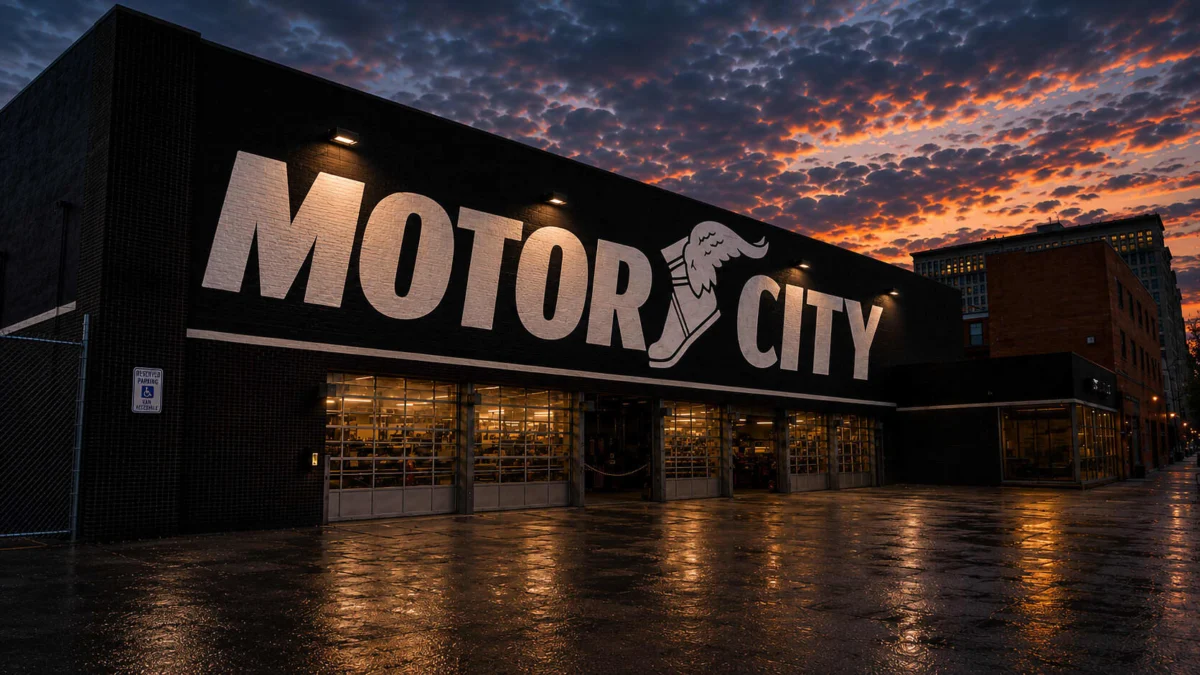
DETROIT – Goodyear Tire & Rubber Co., a venerable institution in the automotive world, is charting a challenging course toward revitalization under CEO Mark Stewart, who is spearheading the "Goodyear Forward" turnaround plan amidst significant financial pressures and a fiercely competitive global market. The company recently unveiled its "Motor City Garage" concept retail store within one of its Detroit tire shops, an event timed with the renowned Woodward Dream Cruise, symbolizing a blend of its storied heritage with a modern vision for consumer engagement. This revamped facility, featuring a freshly painted black facade emblazoned with "Motor City" alongside Goodyear’s iconic winged foot logo, served as the backdrop for Stewart’s discussions on transforming a historically "dirty business" into an attractive prospect for both investors and consumers.
A New Face for Tire Retail in the Motor City
The launch of the "Motor City Garage" concept in Detroit is more than a mere rebranding; it represents a strategic pivot towards enhancing the customer experience within the often-overlooked realm of tire service. Despite the stylish touches, including a DJ spinning music in the waiting room, the authentic aroma of rubber and oil still permeates the air, underscored by the rhythmic sounds of tire changes in the bays. This juxtaposition of a modern, inviting aesthetic with the gritty reality of a working tire shop embodies Stewart’s broader ambition: to make Goodyear’s operations more appealing and efficient without losing touch with its core identity.
The decision to unveil this concept in Detroit, a city synonymous with automotive innovation and culture, during the Woodward Dream Cruise, was a calculated move. The Dream Cruise, an annual spectacle that draws hundreds of thousands of car enthusiasts and classic vehicles along a 16-mile stretch of Woodward Avenue, provided an unparalleled platform for Goodyear to showcase its renewed commitment to the consumer and its roots in the automotive industry. This event offers a unique demographic, from classic car collectors needing specialized tires to daily drivers looking for reliable service, making it an ideal proving ground for a new retail concept aimed at broader appeal.
The "Goodyear Forward" Imperative: A Chronology of Change
The "Goodyear Forward" transformation plan did not emerge in a vacuum. Its genesis can be traced back to 2023 when activist investor Elliott Investment Management revealed a significant stake in Goodyear, subsequently advocating for strategic and operational changes. Elliott’s involvement led to the appointment of three new board members and spurred a comprehensive review of the company’s structure and strategy. Mark Stewart, an automotive veteran who previously held a leadership position at Stellantis, was appointed CEO in January 2024, tasked with executing and refining this ambitious turnaround.
Upon his arrival, Stewart inherited a plan already in motion but quickly made it his own, intensifying efforts to cut costs and optimize the company’s portfolio. To date, the "Goodyear Forward" plan has reportedly slashed approximately $1.5 billion in annualized costs from the business, a testament to the rigorous efficiency drives undertaken across the organization. This financial discipline is crucial as Goodyear grapples with a substantial debt load and the imperative to generate meaningful cash flow, a challenge Stewart openly acknowledges has plagued the company for an extended period.
"We have made so much progress, and when you think about it from the standpoint of the Goodyear Forward program, it was really to get our feet back on the ground towards being the iconic company that we always were," Stewart stated during an interview at the Detroit shop, emphasizing the foundational nature of the restructuring. He added, "We’re working on getting to that double-digit margin, and we’re working on meaningfully generating cash flow. It’s been a long time since Goodyear’s done that. That we absolutely must do."
Navigating a Labyrinth of Financial and Market Challenges
Despite the strategic initiatives and cost-cutting measures, Goodyear’s financial performance continues to reflect the profound challenges it faces. The company’s capital expenditures were roughly $2 billion combined in 2024 and 2025, with expectations of $725 million for the current year, indicative of necessary investments in its infrastructure and product development. However, its debt remained stubbornly high at more than $7 billion at the end of the second quarter, placing a significant burden on its balance sheet.
Through the first half of the year, Goodyear reported a net loss of $453 million, with an operating income of $131 million, translating to a modest 1.6% margin. This stands in stark contrast to Stewart’s initial goal under the turnaround plan to reach a 10% operating margin by the end of last year. While the company achieved 8.5% in the fourth quarter of the previous year, the broader goal remains elusive.
Goodyear’s struggles are compounded by a confluence of external economic and geopolitical factors. Stewart does not shy away from acknowledging these headwinds, including tariffs on imported goods, persistently inflated raw material costs, and the aggressive expansion of cheaper Chinese tire products globally. "We still have a lot of geopolitical headwinds that we’re working through… a lot of headwinds with raw material indexes and a bit of the hangover from the tariff environment," he explained, pointing out the inherent cost advantages enjoyed by overseas manufacturers.
Analysts echo these concerns. Bill Selesky, an Argus analyst, noted in an August 17 investor brief: "Goodyear has faced many big challenges over the past few years, ranging from slower consumer (and commercial) demand, to rising raw material costs, to higher capital expenditures (capex), to low-priced Asian imports (into the U.S.), and, more recently, to trade and tariff legislation. It hasn’t been easy for Goodyear." The market has reacted negatively, with Goodyear shares falling over 50% since Stewart’s appointment in January 2024 and down 27% year-to-date, closing recently at $6.35. FactSet-compiled analyst ratings average a "hold" with a price target of $7.60, reflecting cautious optimism rather than strong conviction.
The company anticipates raw material costs to be roughly flat year-over-year but forecasts a $200 million headwind during the second half, largely attributed to higher commodity costs stemming from the conflict in the Middle East. Such global instabilities add layers of complexity to Goodyear’s already arduous path to recovery.

Strategic Repositioning: Premiumization and Portfolio Optimization
A core tenet of Stewart’s adapted "Goodyear Forward" strategy is a decisive pivot toward the premium tire segment. This involves divesting lower-margin assets, such as the Dunlop brand, and concentrating resources on higher-end products. This year alone, Goodyear plans to launch over 1,600 new products, with the majority targeting these more lucrative, higher-margin segments. This strategic shift is a direct response to the intensifying competition from non-U.S. brands, particularly Chinese manufacturers like Sumitomo and Yokohama, which have aggressively expanded their global presence with cheaper products in lower-end market segments.
"We are not going to compete against a $6 or $10 converted tire. That’s not who we are as Goodyear," Stewart firmly stated, referring to the manufacturing cost required to transform raw materials into a finished tire. This stance underscores Goodyear’s commitment to quality, performance, and brand value, rather than engaging in a price war it deems unsustainable and incongruent with its identity. The move into premium segments also aligns with evolving automotive trends, such as the proliferation of electric vehicles (EVs) and luxury SUVs, which often require specialized, high-performance tires that command higher prices and offer better margins.
While Goodyear’s U.S. operations have been a significant drag on its financials, its Asia-Pacific region stands out as a beacon of success. In the second quarter, this segment generated $63 million in operating income, boasting an impressive operating margin of 12.7%. This regional strength provides a blueprint for what is achievable and highlights the potential for similar performance across other markets, provided strategic adjustments take hold.
Difficult Decisions: The Fayetteville Plant Closure
To further streamline operations and improve profitability, Goodyear made the difficult decision to close its manufacturing plant in Fayetteville, North Carolina. This closure, slated for next year, is expected to significantly improve the Americas segment’s operating income by $270 million annually. While acknowledging the hardship this decision imposes on employees and the community, Stewart underscored its necessity. "We absolutely didn’t take that lightly, but we just didn’t have a pathway to be competitive out of that facility," he said, indicating that the plant’s operational costs and efficiencies were simply no longer sustainable in the current competitive landscape. This move, though painful, is a critical step in the company’s broader efforts to optimize its manufacturing footprint and enhance overall competitiveness.
The Enduring Icon: Leveraging the Goodyear Blimps
Beyond financial restructuring and market repositioning, the "Goodyear Forward" strategy places renewed emphasis on brand reinforcement and customer connection through marketing and advertising. A cornerstone of this effort, both physically and financially, involves the company’s iconic Goodyear blimps. These aerial giants have served as flying billboards for over a century, embodying Goodyear’s legacy and capturing public imagination.
Stewart’s team has embraced the blimps with renewed vigor, transforming them into dynamic marketing tools. "The blimp team and the marketing team have really embraced it. So we do a lot of activation around the blimp to literally sell tires," Stewart explained. The strategy involves leveraging social media platforms to tout the aircraft and their intrinsic connection to tires, as well as launching "buy to fly" campaigns, offering tire retailers and consumers the chance to win flights aboard the blimps.
At the Detroit event, Goodyear orchestrated a rare double-blimp appearance, along with a collection of smaller "mini blimps," maximizing visibility and engagement during the Woodward Dream Cruise. This spectacular display served as a powerful reminder of Goodyear’s enduring brand presence and its commitment to innovation, even in its marketing approach. "We’ve always made the tires worth bragging about," Stewart asserted, "We’re just reminding people now, and that ties into our marketing and advertising as well." The blimps, therefore, are not just relics of a bygone era but active instruments in Goodyear’s modern marketing arsenal, bridging historical nostalgia with contemporary brand activation.
The Road Ahead: A Long Haul to Sustained Profitability
Goodyear’s journey through the "Goodyear Forward" plan is far from over. While the initial two-year plan was set to conclude last year, Stewart and his executive team are continually evaluating and adapting their strategy. The company anticipates that its cash burn will continue into 2027, albeit moderating as the benefits of the Fayetteville plant closure and other efficiency measures begin to materialize.
Stewart’s commitment to reaching double-digit operating margins and consistently generating cash flow is unwavering. He acknowledges the path is arduous but frames it as essential for restoring Goodyear to its former glory. The eventual announcement of the "next challenges" beyond the current iteration of "Goodyear Forward" will signal the evolution of this ongoing transformation.
Goodyear’s narrative is a compelling case study of an iconic American company grappling with the complexities of global competition, technological shifts, and demanding financial markets. Its success hinges not only on strategic acumen and operational efficiency but also on its ability to reconnect with consumers and adapt its legendary brand to the demands of the 21st century automotive landscape. The "Motor City Garage" and the soaring blimps are visible symbols of this ambitious journey, aiming to prove that even a century-old tire manufacturer can reinvent itself for a prosperous future.
