

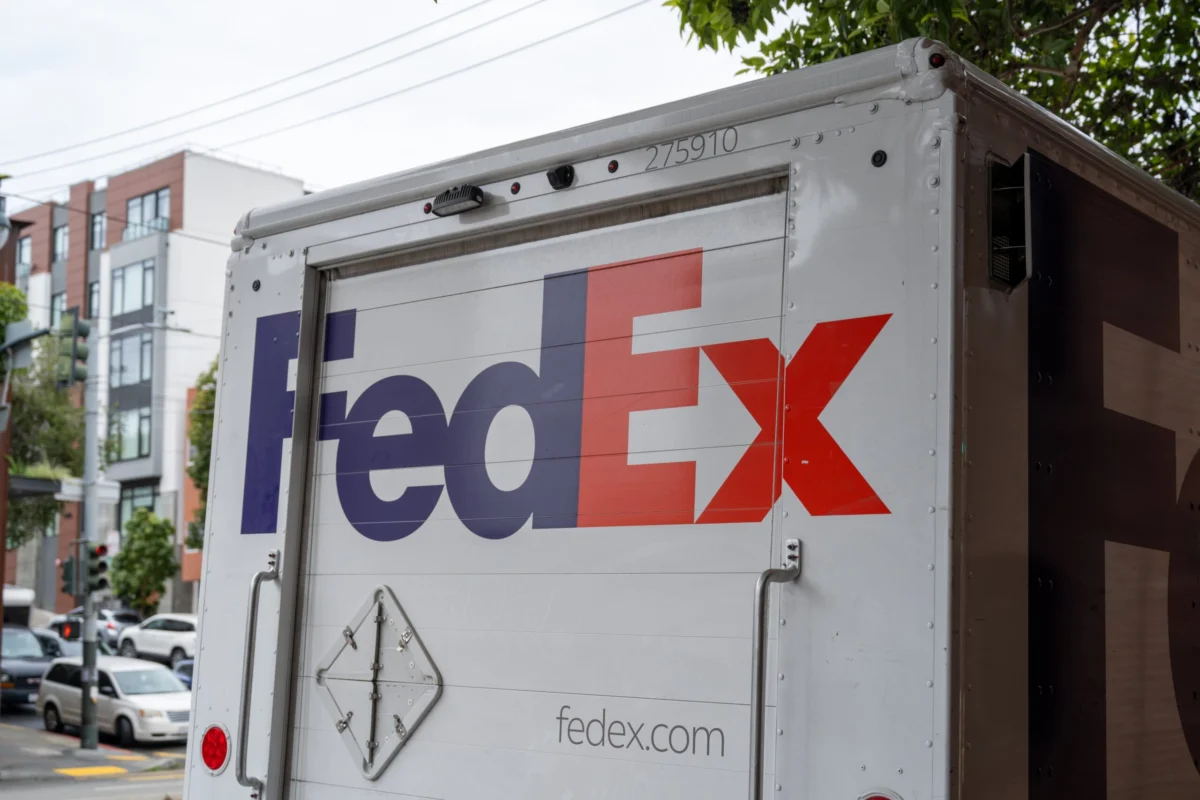
FedEx Corporation (NYSE: FDX) on Thursday delivered a stellar performance for its fiscal third quarter, significantly surpassing Wall Street’s expectations for both earnings and operational income. The global logistics giant also raised its full-year guidance for fiscal 2026, projecting accelerated revenue growth and higher adjusted earnings per share, signaling strong underlying business momentum and effective execution of its strategic initiatives. The positive financial revelations sent FedEx shares climbing approximately 9% in extended trading, reflecting renewed investor confidence in the company’s trajectory and its ambitious transformation agenda.
Strong Fiscal Third Quarter Performance Outshines Estimates
For the quarter ended February 29, 2026, FedEx reported adjusted operating income of $1.68 billion, a substantial beat against analyst estimates of $1.39 billion, as compiled by LSEG. This robust operational performance underscores the company’s ability to manage costs effectively and drive efficiency across its vast global network despite a dynamic macroeconomic environment. Net income for the quarter stood at $1.06 billion, or $4.41 per share, marking a significant improvement from $909 million, or $3.76 per share, reported in the same period a year ago. After adjusting for spin-off costs and other one-time items, FedEx’s adjusted earnings per share (EPS) reached an impressive $5.25, further solidifying the company’s strong financial health and operational discipline. The adjusted EPS figure notably exceeded analyst consensus, which had anticipated a lower outcome.
The strong earnings beat is a testament to FedEx’s ongoing efforts to streamline its operations and enhance profitability. The company has been navigating a complex global supply chain landscape, characterized by evolving consumer demands, inflationary pressures, and geopolitical uncertainties. Its ability to not only meet but exceed financial targets indicates a successful adaptation to these challenges and a robust execution of its strategic roadmap.
Elevated Fiscal 2026 Guidance Signals Confidence
Building on its strong quarterly performance, FedEx significantly upgraded its financial outlook for fiscal year 2026. The company now anticipates revenue growth of 6% to 6.5%, an increase from previous projections and comfortably above analyst estimates of a 5.6% rise. This revised revenue guidance reflects optimism about sustained demand for its services and the positive impact of its strategic growth initiatives.
Even more notably, FedEx raised its fiscal 2026 adjusted EPS expectations to a range of $19.30 to $20.10 per share. This represents a substantial increase from its previous guidance, which was set between $17.80 and $19.00 per share. The upward revision in EPS guidance is a strong indicator of management’s confidence in its ability to generate higher profits through continued operational efficiencies, cost reductions, and strategic investments. Such a positive revision often signals to investors that the company foresees stronger future profitability and sustained growth, contributing to the immediate positive market reaction.
Strategic Pillars: Network 2.0 and Digital Transformation
At the heart of FedEx’s improved financial performance and optimistic outlook lies its transformative "Network 2.0" initiative. This ambitious program is designed to optimize the efficiency of FedEx’s package processes by leveraging advanced automation and artificial intelligence (AI) across its global network. Initially, the company had projected approximately $1 billion in cost reductions from this initiative. However, in a significant update, FedEx announced that it now expects these savings to exceed $1 billion, underscoring the profound impact of its efficiency drive.
Network 2.0 aims to integrate FedEx’s disparate ground and express networks in North America, creating a more cohesive, flexible, and cost-effective system. This involves consolidating sorting facilities, optimizing routing algorithms, enhancing last-mile delivery capabilities, and implementing state-of-the-art automation technologies in hubs and sort centers. The expanded savings projection indicates that the implementation of AI-driven logistics, predictive analytics for demand forecasting, and automated handling systems are yielding greater benefits than initially anticipated. These technological advancements are crucial for reducing operational expenses, improving service reliability, and enhancing the overall customer experience in an increasingly competitive logistics landscape.
CEO Raj Subramaniam emphasized the critical role of these initiatives, stating, "Team FedEx delivered another quarter of strong financial results and excellent service for our customers, powered by disciplined operational execution, the resilience of our global network, and the accelerating impact of our advanced digital solutions." His statement highlights the interconnectedness of operational rigor, network robustness, and technological innovation as key drivers of the company’s success. The "advanced digital solutions" encompass a broad spectrum of technologies beyond Network 2.0, including enhanced customer-facing platforms, real-time tracking, data analytics for supply chain optimization, and potentially blockchain for improved transparency and security in logistics.
The FedEx Freight Spin-Off: Unlocking Shareholder Value
A significant strategic move on FedEx’s horizon is the planned spin-off of its less-than-truckload (LTL) freight business, FedEx Freight, into a separate publicly traded company. The company reiterated that the spin-off remains on track to be completed on June 1. This divestiture is a pivotal element of FedEx’s broader strategy to simplify its portfolio, sharpen its focus on its core express and ground package delivery businesses, and unlock greater shareholder value.
The rationale behind the spin-off is multifaceted. By separating FedEx Freight, both entities can pursue distinct growth strategies, capital allocation priorities, and operational structures tailored to their respective markets. FedEx (post-spin) can concentrate resources on its highly competitive package delivery segments, investing in automation, AI, and digital solutions to enhance efficiency and customer service. Meanwhile, FedEx Freight, as an independent entity, will have the flexibility to pursue its own growth initiatives within the LTL market, which often operates with different dynamics and competitive pressures compared to small package delivery. This could include strategic acquisitions, specialized service offerings, and optimized pricing strategies.
Analysts generally view the spin-off positively, anticipating that it will allow investors to value each business more appropriately, potentially leading to an overall increase in shareholder value. The LTL market is a critical component of the North American supply chain, characterized by high barriers to entry and strong demand for reliable, efficient freight services. An independent FedEx Freight would be a formidable player, benefiting from its established network, customer base, and operational expertise.
Navigating Geopolitical Headwinds and Macroeconomic Landscape
While FedEx reported strong results, CEO Raj Subramaniam acknowledged potential external challenges, noting "modest" headwinds from disruptions related to the Iran war. He clarified that the Middle East represents a "relatively small part" of FedEx’s total revenue, suggesting a limited direct impact on the company’s top line. However, the broader implications of geopolitical instability, particularly in key global shipping lanes and energy-producing regions, cannot be entirely dismissed.
Indirect impacts could include volatility in fuel prices, which significantly affects the operating costs of air and ground fleets. Disruptions to global trade routes, even if not directly involving FedEx’s primary operational areas, can create ripple effects across the supply chain, potentially leading to shifts in demand or increased logistical complexities. FedEx’s ability to absorb such "modest" headwinds, as indicated by its raised guidance, speaks to the resilience of its global network and its proactive measures to manage risks, including diversified operational hubs and agile route planning.
The broader macroeconomic environment also plays a crucial role in the logistics industry. While e-commerce growth has stabilized somewhat after the pandemic surge, consumer spending remains a key driver for package volumes. Business-to-business (B2B) shipments, often tied to industrial production and inventory cycles, also influence demand. FedEx’s strong performance suggests that it is effectively capitalizing on existing market opportunities while demonstrating an ability to mitigate the impact of inflationary pressures and potential slowdowns in certain economic sectors through its cost-saving initiatives and operational efficiencies.
Competitive Landscape and Industry Position
FedEx operates in a highly competitive global logistics market, facing formidable rivals such as UPS, DHL, and various regional and specialized carriers. The industry is constantly evolving, driven by increasing customer expectations for speed, reliability, sustainability, and transparency. Companies are investing heavily in technology to optimize last-mile delivery, enhance supply chain visibility, and reduce their carbon footprint.
FedEx’s strategic focus on Network 2.0 and digital transformation positions it strongly within this competitive arena. By leveraging automation and AI, FedEx aims to not only cut costs but also improve service levels, making its offerings more attractive to businesses and consumers alike. The emphasis on "excellent service for our customers" articulated by Subramaniam underscores a commitment to differentiation beyond price, focusing on the overall value proposition.
The spin-off of FedEx Freight further refines FedEx’s strategic focus, allowing the core package business to concentrate on areas where it can achieve maximum competitive advantage. This strategic clarity is vital in an industry where operational scale, technological innovation, and customer-centricity are paramount for sustained success.
Historical Context and Future Outlook
FedEx has undergone significant transformation in recent years, responding to shifts in global trade, the rise of e-commerce, and the need for greater operational efficiency. The company has faced periods of investor scrutiny regarding its cost structure and network integration. The current robust performance and optimistic outlook represent a culmination of sustained efforts to address these challenges and position FedEx for long-term growth.
The strategic investments in technology, the relentless pursuit of operational excellence through initiatives like Network 2.0, and the strategic portfolio optimization through the FedEx Freight spin-off are all integral parts of a cohesive plan. These actions are designed to enhance profitability, improve service quality, and deliver greater value to shareholders.
Looking ahead, the successful execution of the FedEx Freight spin-off, the continued realization of cost savings from Network 2.0, and the ability to adapt to an ever-changing global economic and geopolitical landscape will be critical determinants of FedEx’s continued success. The company’s strong fiscal third-quarter results and optimistic guidance provide a clear indication that FedEx is on a solid path to achieving its strategic objectives and reinforcing its position as a leader in the global logistics industry.
