

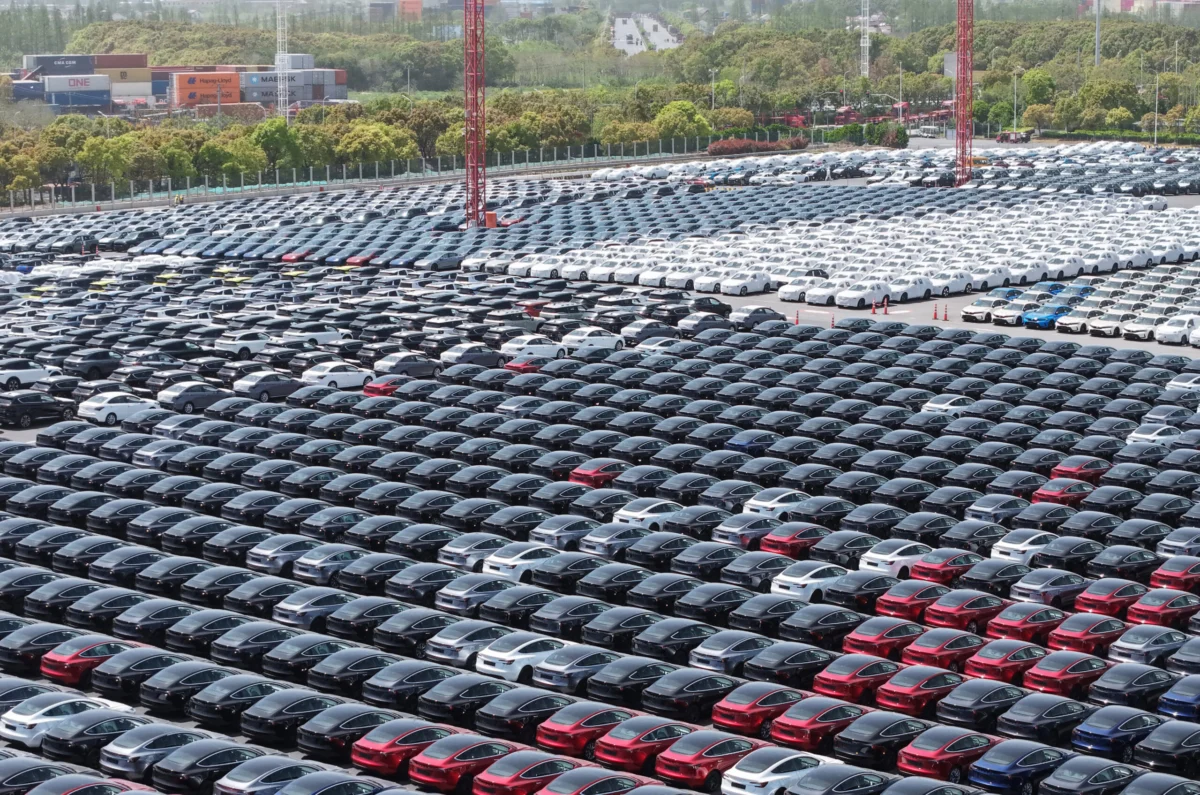
A stark reality confronts China’s automotive industry: its once-booming domestic market is in a precipitous decline, forcing manufacturers to aggressively pursue overseas sales even as global trade tensions mount. A visit to car dealerships in Beijing offers a visceral understanding of this crisis, revealing empty showrooms and a palpable sense of desperation among sales professionals. The traditional "golden September and silver October" season, typically the peak period for vehicle purchases, has been anything but golden in 2026. This year, the period has been characterized by unprecedented sluggishness, rivaling even the depths of the COVID-19 pandemic’s initial impact.
Li Ke, a veteran car salesman with 26 years of experience, articulates the dramatic shift. "In past years, customers would come to the showrooms nonstop," he recounted during an interview in his deserted showroom, located within a sprawling complex of dealerships on the outskirts of the Chinese capital. "We would have deals to sign every day. But nowadays we see only two to three deals a week. It’s a dramatic drop." This anecdotal evidence is underscored by sobering official statistics. Passenger car retail sales in China through September 2026 totaled 13.33 million units, representing a significant 21.7% fall from the previous year. Projections for the full year 2026 indicate an expected drop of 22% to 18.5 million vehicles, placing domestic sales below levels recorded during the first year of the pandemic, a period marked by severe economic disruption.
Erosion of Consumer Confidence and Policy Shifts
The primary drivers behind this domestic market collapse are deeply rooted in broader economic anxieties that have gripped Chinese households. An unstable job market, exacerbated by record youth unemployment rates that peaked above 20% before official data was suspended, has severely curtailed household income expectations. Simultaneously, a protracted downturn in the property sector, where many Chinese families hold the majority of their wealth, has further eroded consumer confidence and spending power. The continued slide in property prices, coupled with concerns over the financial health of major developers, has made consumers extremely cautious about making large-ticket purchases like automobiles. This environment fosters a mentality of saving rather than spending, prioritizing financial security over discretionary consumption.
Compounding these economic headwinds, the Chinese government has also scaled back crucial incentives that previously fueled automotive demand. Sales professionals lament the reduction or elimination of cash-for-clunkers subsidies, which encouraged vehicle upgrades, and tax breaks for electric vehicles (EVs), which had been instrumental in accelerating the country’s transition to new-energy vehicles (NEVs). These policy shifts, likely driven by budgetary constraints and a perceived maturity of the EV market, have removed a significant impetus for consumers who were previously swayed by financial advantages. The withdrawal of these stimuli comes at a particularly inopportune time, as the market is already grappling with a deep crisis of confidence.
The Unprecedented Decline in the EV Sector
Even the electric vehicle segment, once heralded as a shining beacon of innovation and growth within the Chinese automotive landscape, has succumbed to the prevailing market downturn. While gasoline car sales have been in a consistent decline due to China’s ambitious transition towards electrification, the new-energy vehicle sector, encompassing battery electric vehicles (BEVs) and plug-in hybrids (PHEVs), has also seen a significant contraction. According to the China Passenger Car Association, sales of NEVs dropped by 12.8% from January through September 2026. This decline in a strategically important sector highlights the depth of the current economic malaise, demonstrating that even technologically advanced and environmentally friendly options are not immune to the pervasive consumer caution.
"Customers are watching every penny," Li Ke observed, reflecting the shift in consumer behavior. "When looking at all the new functions on all these new models, they are weighing what is most practical, economic and worth their money over the long term. We don’t see impulse buying. Because of the bad economy, people are taking more time to replace their cars." This sentiment underscores a fundamental change in purchasing habits, moving away from aspirational or technologically driven decisions towards pragmatic, value-focused considerations. Consumers are now meticulously calculating the long-term cost of ownership, fuel efficiency, and overall utility, rather than being swayed by the latest features or brand prestige.
Chronology of a Crisis: From Boom to Bust
The trajectory of China’s automotive market can be traced through distinct phases over the past two decades. From the early 2000s to the mid-2010s, it experienced explosive growth, fueled by rising disposable incomes, rapid urbanization, and a relatively stable economic outlook. Government policies actively encouraged car ownership, viewing it as a symbol of prosperity and a driver of industrial development.
- 2000s-2010s: Golden era of growth, China becomes the world’s largest automotive market by volume.
- Mid-2010s: Introduction of aggressive NEV subsidies and policy support, spurring rapid adoption and local innovation.
- 2018-2019: First signs of slowdown appear, partly due to maturing market, trade tensions, and tightening credit.
- 2020: Initial COVID-19 pandemic shock, temporary market collapse, followed by a V-shaped recovery driven by government stimulus and pent-up demand.
- 2021-2022: Post-pandemic recovery attempts, but shadowed by property market woes, zero-COVID policies, and supply chain disruptions. Intense price wars begin in the EV sector.
- 2023-2026: Deepening crisis of consumer confidence, property market downturn accelerates, government scales back auto incentives, leading to the current market contraction. Export drive intensifies dramatically.
This chronology illustrates a shift from a period of almost uninterrupted expansion to one of increasing headwinds, culminating in the current severe downturn. The once robust domestic demand, particularly for internal combustion engine (ICE) vehicles, has been steadily eroding, while even the nascent EV market, despite its strategic importance, has proven vulnerable to broader economic pressures.
The Price War: A Domestic Battleground Driving Exports
The fierce competition within China’s domestic automotive market has escalated into bruising price wars in recent years. This intense rivalry, particularly acute in the electric vehicle segment where dozens of domestic and international brands vie for market share, has led to significant margin erosion across the industry. Major players, from global giants like Tesla to local champions like BYD, Nio, and Xpeng, have engaged in successive rounds of price cuts, creating a challenging environment for profitability. This cutthroat competition, coupled with existing overcapacity in manufacturing, has been a key reason why Chinese carmakers have increasingly cast their eyes overseas. Unable to sustainably generate sufficient profits or absorb existing inventory within a contracting home market, exports have become not merely an opportunity but a strategic imperative for survival and growth.
Industrial profits for the first nine months of 2026, as reported by China’s National Bureau of Statistics, showed an overall increase of 15.5% from the same period in 2025. However, September data revealed signs of weakness relative to the preceding eight months, indicating a potential deceleration in the broader industrial recovery. More tellingly, the auto manufacturing industry specifically saw its profits shrink by a staggering 22.8% from January to September compared with the previous year. This stark divergence highlights the unique challenges facing the automotive sector, significantly underperforming the general industrial landscape. The pressure on profitability is immense, impacting everything from research and development budgets to dealership viability. To preserve cash, Li Ke’s dealership, for instance, made the difficult decision to relocate from a pricey streetside space to a less trafficked location that rents at a fraction of the cost. With profit margins already eroding, Li sees little point in offering further discounts, emphasizing that the bigger hurdle remains the prevailing Chinese consumer attitude toward big-ticket purchases. "Chinese buyers would rather wait," he concluded, encapsulating the market’s cautious mood.
The Export Imperative: A Double-Edged Sword
China’s automotive industry, once primarily focused on satisfying its vast domestic market, has rapidly transformed into a global export powerhouse. In 2023, China officially surpassed Japan to become the world’s largest exporter of automobiles, a testament to its burgeoning manufacturing capabilities and aggressive internationalization strategy. This export surge is overwhelmingly driven by electric vehicles, where Chinese manufacturers have achieved significant technological advancements and cost efficiencies. Brands like BYD, SAIC, Geely, Chery, and Great Wall Motors are expanding their presence across Europe, Southeast Asia, Latin America, and other emerging markets, offering competitive pricing and increasingly sophisticated models. For many of these companies, overseas sales represent a vital lifeline, offsetting the severe slump in domestic demand and allowing them to maintain production volumes.
However, this aggressive export drive is a double-edged sword, and Beijing is acutely aware of the growing international backlash. The rapid influx of competitively priced Chinese vehicles, particularly EVs, has raised alarms in major economies like the United States and Europe. These concerns stem from fears of unfair competition, accusations of state subsidies distorting market dynamics, potential national security implications, and the imperative to protect domestic automotive industries. The U.S. has maintained significant tariffs on Chinese goods, and the Inflation Reduction Act (IRA) explicitly aims to incentivize North American EV production, effectively limiting Chinese market access. In Europe, the European Commission has launched an anti-subsidy investigation into Chinese EV imports, signaling a potential imposition of tariffs designed to level the playing field.
Analysts widely agree that these coordinated trade barriers pose a significant threat to China’s export-led automotive strategy. Should the U.S. and Europe enact substantial tariffs or other protectionist measures, it could severely constrain the growth potential of Chinese automakers in crucial, high-value markets. This would force Chinese manufacturers to seek out alternative markets, potentially intensifying competition in other regions and further pressuring margins globally. The implications extend beyond just auto sales, touching upon geopolitical relations, global supply chain resilience, and the future of industrial policy in major economic blocs. The current situation places China’s government in a delicate balancing act: promoting its advanced manufacturing capabilities globally while navigating an increasingly protectionist international trade environment.
Official Responses and Broader Implications
While the original article does not provide direct official government statements, the severity of the domestic automotive slump and the strategic importance of the industry imply a high level of concern within Beijing. The government’s actions suggest a multifaceted approach:
- Potential for Future Stimulus: Given the critical role of consumer spending and the auto industry in the broader economy, there is always the potential for renewed government stimulus measures targeted at vehicle purchases, albeit likely more focused and less broadly applied than in previous years.
- Focus on Export Quality and Innovation: Beijing is likely to continue encouraging Chinese automakers to enhance their technological competitiveness, improve brand perception, and focus on high-quality manufacturing to withstand international scrutiny and competition. This strategy aims to shift the narrative from "cheap" to "innovative" and "reliable."
- Diplomatic Engagement: The government is undoubtedly engaging in diplomatic efforts to counter trade protectionism, arguing against what it perceives as unfair trade barriers and advocating for open markets. This includes emphasizing the benefits of competition and technological exchange.
- Balancing Domestic and International Pressures: The challenge for policymakers is to find a balance between stimulating flagging domestic demand and managing the fallout from a booming export sector that is increasingly facing global resistance.
From an industry perspective, the current climate necessitates adaptation. Chinese automakers are exploring strategies such as localized production overseas to bypass tariffs, strengthening their global supply chains, and investing heavily in research and development to maintain a technological edge. The emphasis is shifting from sheer volume to profitability and sustainable international growth. For consumers, the waiting game continues. A significant recovery in consumer confidence hinges on a stabilization of the job market, a rebound in the property sector, and sustained positive economic growth indicators that signal a return to prosperity. Until then, the cautious approach to big-ticket purchases will likely persist.
The crisis in China’s domestic automotive market is a complex confluence of economic anxieties, policy shifts, and intense internal competition. It has irrevocably altered the industry’s trajectory, compelling a dramatic pivot towards international markets. However, this export-led survival strategy is fraught with challenges, particularly the escalating global trade tensions that threaten to erect formidable barriers. The coming years will be a test of resilience for Chinese automakers and a crucial period for the global automotive landscape, as the industry navigates a transformative era defined by overcapacity, technological disruption, and geopolitical maneuvering. The outcome will not only shape the future of China’s automotive giants but also redefine the competitive dynamics of the entire global auto sector.
