

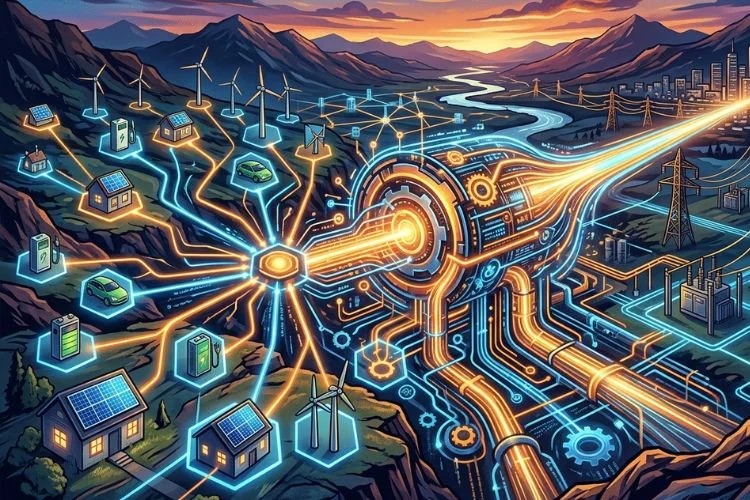
The North American power grid is currently navigating its most significant transformation since the dawn of electrification, as utilities face a unprecedented convergence of surging demand and a radical shift in how energy is generated and managed. For several decades, electricity demand across the United States and Canada remained relatively flat, characterized by predictable growth patterns that allowed for long-term planning of centralized power plants. However, this era of stability has ended. The rapid expansion of data centers fueled by artificial intelligence (AI), the massive industrial push toward electrification, the proliferation of electric vehicles (EVs), and increasingly stringent reliability requirements have created a "hockey stick" growth curve in demand. This shift is occurring just as millions of distributed energy resources (DERs)—including residential battery systems, smart thermostats, and flexible industrial loads—are being connected to the distribution edge, creating a vast but largely untapped reservoir of capacity.
The central challenge facing modern utilities is no longer the adoption of these green technologies, but rather their operationalization. While consumers have purchased millions of devices capable of supporting the grid, these assets remain "operationally invisible" to the system operators who need them most. Transforming a fleet of disconnected household batteries and EVs into a cohesive, dispatchable resource—often referred to as a Virtual Power Plant (VPP)—requires a fundamental overhaul of grid management, data integrity, and settlement processes.
The Drivers of a New Demand Era
The urgency of this transition is underscored by the sheer scale of new load coming online. According to recent projections from the International Energy Agency (IEA), data centers, AI, and the cryptocurrency sector are expected to double their global electricity consumption by 2026. In the United States alone, data center demand is forecast to reach 35 gigawatts (GW) by 2030, up from 17 GW in 2022. This industrial demand is compounded by the electrification of transportation; the Edison Electric Institute (EEI) estimates that there will be 26 million EVs on U.S. roads by 2030, each representing a significant flexible load that can either strain or support the grid depending on how it is managed.
Historically, utilities met rising demand by building more centralized generation—coal, gas, or nuclear plants—and expanding transmission lines. However, the timeline for such projects has stretched to a decade or more due to permitting hurdles and supply chain constraints. In contrast, distributed resources can be deployed almost instantly by consumers and businesses. The Department of Energy (DOE) "Pathways to Commercial Liftoff" report suggests that VPPs could provide between 80 and 160 GW of peak capacity by 2030, potentially saving utilities and ratepayers billions of dollars in avoided infrastructure costs.
From Individual Assets to Grid-Scale Solutions
A significant misconception in the current energy discourse is the idea that the mere existence of distributed assets equates to grid value. A residential battery in a garage or an EV plugged into a home charger does not inherently stabilize the grid. For these resources to function as a dependable alternative to a gas-fired "peaker" plant, they must be discoverable, measurable, and dispatchable.
To bridge this gap, the industry is shifting its focus toward the orchestration of these assets. The regulatory environment has paved the way for this transition, most notably through the Federal Energy Regulatory Commission (FERC) Order 2222. Issued in 2020, this landmark ruling mandates that regional transmission organizations (RTOs) and independent system operators (ISOs) allow DER aggregators to participate directly in wholesale energy markets. This policy effectively treats a collection of smart thermostats or home batteries as a single power plant, allowing them to bid into the market alongside traditional generators.
However, the implementation of FERC 2222 has revealed deep-seated operational hurdles. Orchestrating a VPP involves managing thousands, and eventually millions, of devices from different manufacturers, each with its own communication protocol and performance characteristics. Utilities must establish rigorous telemetry standards to ensure they have real-time visibility into what these assets are doing. Without high-fidelity data, a grid operator cannot rely on a VPP to prevent a blackout during a heatwave.
The Technical Roadblock: Operational Complexity
The experience of early-stage VPP operators, such as those working with the OpenVPP project—a community-based initiative focused on EV participation—highlights the immense complexity of real-time orchestration. Even with a relatively small fleet of a few hundred vehicles, operators must constantly monitor a multitude of variables: the state of charge of each battery, the availability of the vehicle (whether it is plugged in), the reliability of the local Wi-Fi or cellular connection, and the specific charging behavior of the user.
This operational complexity compounds exponentially as the system scales. For a VPP to move from a pilot program to a core grid resource, it requires a "shared operational layer." Currently, many utility programs are fragmented. The process of qualifying an asset might happen in one software system, the real-time monitoring (telemetry) in another, and the financial compensation (settlement) in a manual spreadsheet. This fragmentation prevents VPPs from reaching the "utility-grade" reliability necessary for grid operations.

Furthermore, the industry must look to historical precedents for standardization. Distributed generation, such as rooftop solar, only moved from a niche hobby to a mainstream energy source after the adoption of common interconnection standards like IEEE 1547. This standard provided a universal definition of how a solar inverter should connect to the grid and how it should behave during a power surge or outage. A similar level of standardization is now required for the software and data layers of VPPs.
The Critical Role of Measurement and Settlement
Perhaps the most overlooked aspect of grid modernization is the "settlement" process—the mechanism by which participants are paid for their performance. In a traditional power plant, a revenue-grade meter measures exactly how many megawatt-hours are sent to the grid, and the operator is paid accordingly. In a VPP, the "meter" is often the software inside a smart device or an EV charger.
If a utility calls for a "dispatch event"—asking 10,000 homes to reduce their air conditioning load for two hours—it must be able to prove that the reduction actually happened. This requires sophisticated Measurement and Verification (M&V) protocols. If the data is inaccurate, or if the payment process is opaque, consumer trust erodes. Without trust, participation rates will plummet, and the VPP will fail.
The financial stakes are high. Studies by the Brattle Group indicate that by integrating DERs into a coordinated VPP framework, U.S. utilities could save upwards of $10 billion annually in system costs. These savings come from "peak shaving"—reducing the maximum demand on the grid, which in turn reduces the need to operate expensive, high-pollution peaking plants and defers the need for multi-billion dollar substation upgrades.
A Chronology of Modernization
The path to the current state of the grid can be viewed in three distinct phases:
- The Deployment Phase (2010–2020): Characterized by subsidies and incentives (like the Investment Tax Credit) that drove the rapid adoption of rooftop solar, smart thermostats, and early-model EVs. The focus was on "getting hardware in the ground."
- The Regulatory Phase (2020–2024): Defined by FERC Order 2222 and state-level mandates in California, New York, and Texas that required utilities to create pathways for these resources to enter the market.
- The Operational Phase (2025 and Beyond): The current era, where the focus has shifted to software orchestration, data integrity, and real-time settlement. This phase is defined by the move from "pilot programs" to "dispatchable capacity."
As this third phase unfolds, the industry is increasingly looking toward platforms that can provide a unified layer of control. Solutions like Grid Rails, which focus on real-time management and settlement, represent the next generation of grid infrastructure. These platforms aim to treat distributed resources not as isolated gadgets, but as a coordinated network of flexible capacity that can respond to grid signals in seconds.
Broader Implications and the Future Grid
The successful coordination of distributed energy resources has implications that extend far beyond utility balance sheets. It is a critical component of national energy security and decarbonization goals. As the climate changes, extreme weather events are putting more stress on aging infrastructure. A grid supported by millions of localized batteries and flexible loads is inherently more resilient than one dependent solely on a few large power plants and long-distance transmission lines.
Moreover, the integration of VPPs democratizes the energy transition. It allows everyday consumers—the "prosumers"—to become active participants in the energy economy, earning revenue from their EVs and home batteries while contributing to a more stable and sustainable grid.
In conclusion, the next chapter of grid modernization will not be measured by the number of EVs sold or the total wattage of solar panels installed. Instead, it will be defined by the sophistication of the digital infrastructure that connects them. The challenge for today’s utilities is to build the trust, standards, and operational frameworks necessary to turn a fragmented landscape of devices into a powerful, invisible engine for the 21st-century grid. The opportunity to lower costs, improve reliability, and meet the surging demand of the AI era is within reach, provided the industry can master the art of coordination.
