

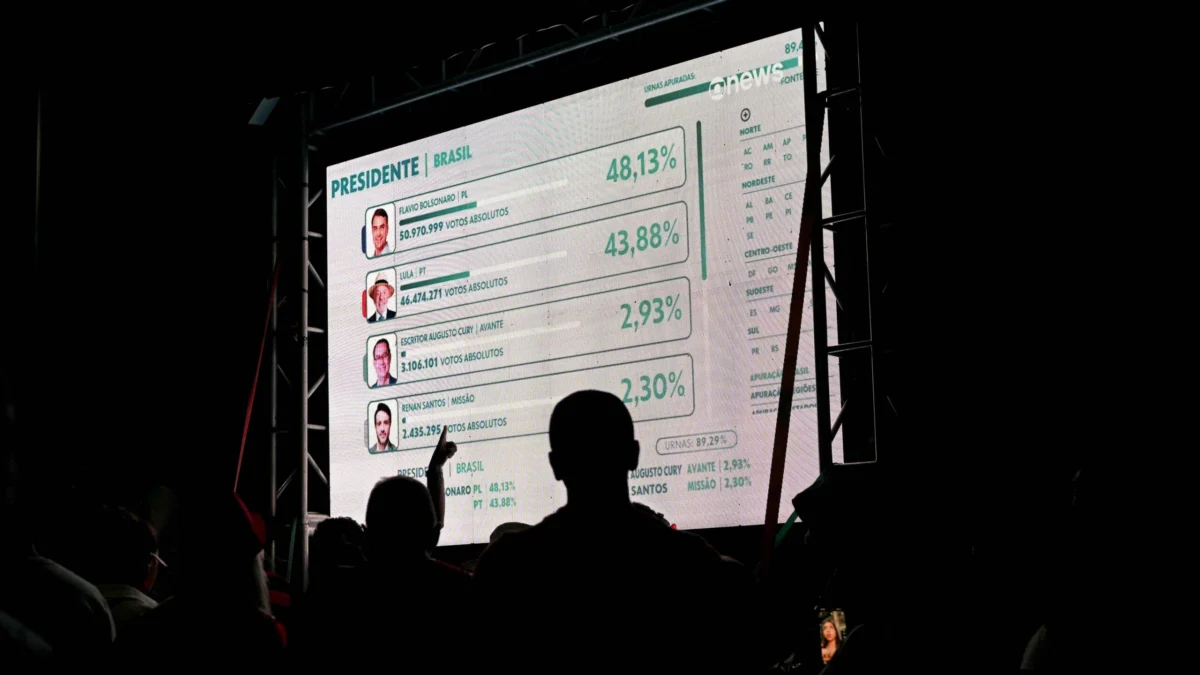
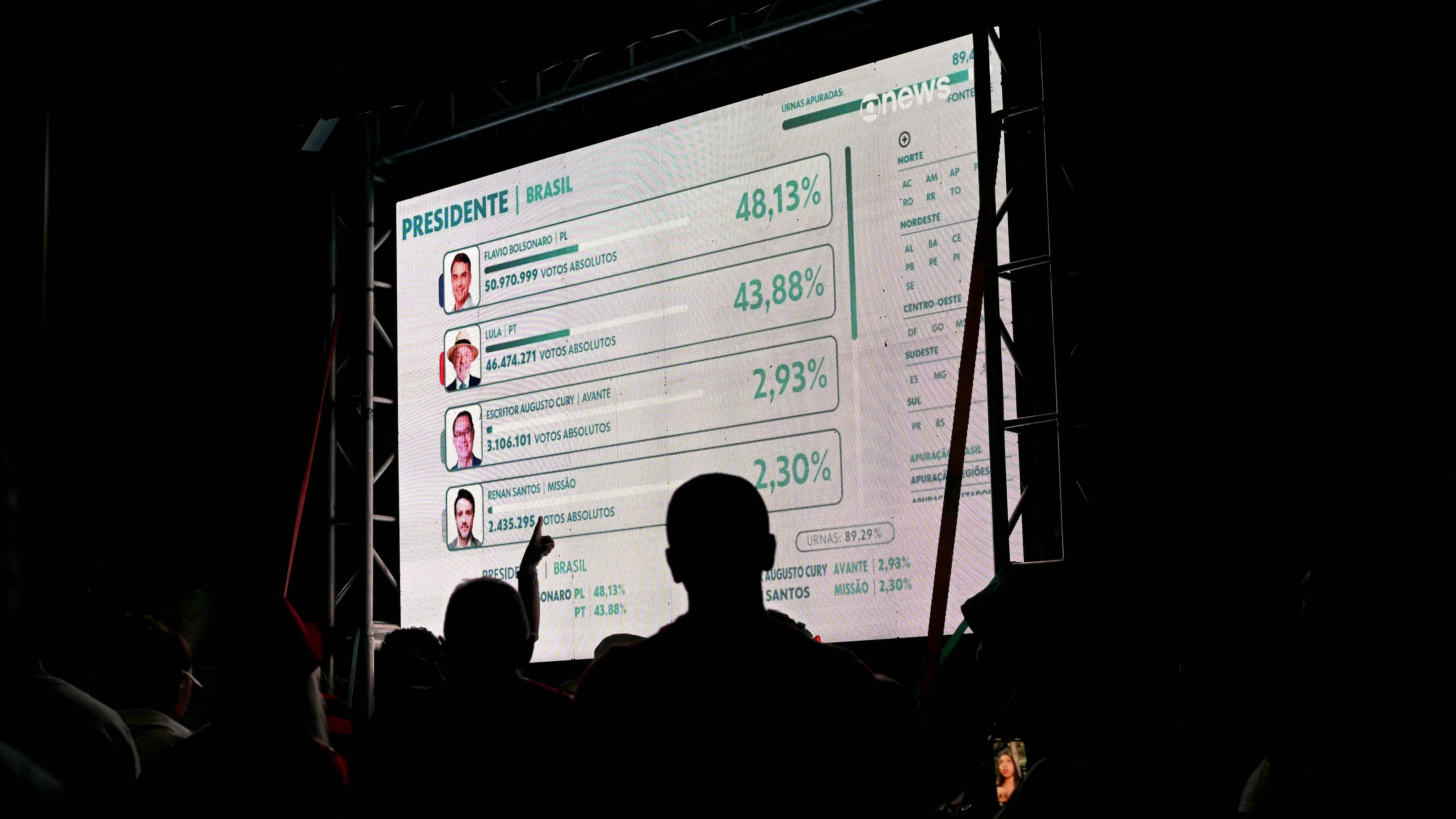
The presidential election in Brazil has been propelled into a decisive runoff, pitting incumbent left-wing President Luiz Inácio Lula da Silva against right-wing Senator Flávio Bolsonaro. With 97 percent of the votes tallied, preliminary figures from the electoral authority reveal that Lula secured approximately 44.6 percent of the vote, while his right-wing rival garnered 47.4 percent. Neither candidate achieved the absolute majority required to secure victory in the first round, setting the stage for a high-stakes electoral battle on October 25th.
This outcome means that Brazilians will decide on that date whether the 80-year-old Lula da Silva, affectionately known as Lula, will embark on a fourth term in office, or if the 45-year-old son of former President Jair Bolsonaro will assume the reins of government. Approximately 159 million Brazilian citizens were eligible to participate in this pivotal election.
The two leading candidates represent starkly different visions for Brazil’s future. Lula, representing the Workers’ Party (PT), champions a continuation of his current administration’s policies, which emphasize social programs, public investment, and a more robust role for the state in the economy. His platform often highlights poverty reduction, income redistribution, and a focus on environmental protection, particularly in the Amazon rainforest.
In contrast, Flávio Bolsonaro, affiliated with the Liberal Party (PL), advocates for a leaner state apparatus, significant spending cuts, and a more assertive stance on law and order. His campaign has frequently focused on promises of economic liberalization, deregulation, and a crackdown on crime, resonating with a segment of the electorate concerned about public safety and economic stability. The electoral campaign has been characterized by intense polarization, reflecting deep divisions within Brazilian society.
A Look Back: Lula’s Previous Tenure and Current Challenges
Lula da Silva has a significant political history in Brazil, having previously served as president from 2003 to 2011. His earlier terms were marked by substantial economic growth and ambitious social welfare programs, such as "Bolsa Família," credited with lifting millions out of poverty. However, his current term, which began in 2023, has faced a mixed assessment. While the unemployment rate has declined and the minimum wage has been raised, and deforestation in the Amazon has seen a reduction, the administration is grappling with rising costs of living, substantial public expenditure and debt, and persistent corruption allegations that have shadowed his political career.
The Bolsonaro Legacy and a Son’s Ambitions
The political landscape has been profoundly shaped by the legacy of former President Jair Bolsonaro. Four years prior, he was defeated by Lula in a closely contested election. Jair Bolsonaro himself was later convicted for his alleged involvement in an attempted coup and received a prison sentence exceeding 27 years. His son, Flávio Bolsonaro, has positioned himself as the inheritor of his father’s political mantle, with a central campaign promise being an amnesty for his father. This ambition underscores the deeply personal and dynastic elements at play in the current political contest.
Bolsonaro Family Secures Congressional Gains
Beyond the presidential race, members of the Bolsonaro family have already achieved electoral successes, indicating their continued influence in Brazilian politics. Michelle Bolsonaro, the former First Lady, has been elected to the Senate representing the Federal District of Brasília. Another son, Carlos Bolsonaro, has also secured a Senate seat, this time representing the southern state of Santa Catarina. These victories demonstrate the enduring appeal of the Bolsonaro name and provide a base for future political maneuvers, regardless of the presidential election outcome.
Key Issues Shaping the Election
Crime and Security: A Pressing Concern
Crime remains a paramount concern for many Brazilians, with powerful drug cartking organizations like the Primeiro Comando da Capital (PCC) and Comando Vermelho (CV) exerting control over various regions and engaging in illicit activities. Violence against women is also a persistent and significant societal problem.
The candidates offer contrasting approaches to tackling these issues. Flávio Bolsonaro has proposed a particularly stringent approach, advocating for the creation of approximately half a million additional prison spaces and the establishment of high-security detention facilities modeled after those in El Salvador. He also pledges a more aggressive campaign against criminal organizations. Lula, on the other hand, emphasizes dismantling the financial structures that support organized crime, suggesting a focus on disrupting their economic power bases.
Foreign Policy Alignments and International Relations
The election has also had significant international dimensions. During his presidency, Jair Bolsonaro received political backing from then-U.S. President Donald Trump, who also criticized the criminal prosecution of Jair Bolsonaro. Flávio Bolsonaro has increasingly aligned himself with Trump’s political circle, having met with him previously at the White House in Washington. This alignment suggests a potential shift in Brazil’s foreign policy orientation towards closer ties with the United States under a Bolsonaro presidency.
Lula, conversely, has signaled a stronger commitment to defending Brazilian sovereignty and aims to stabilize relations with the United States, even amidst existing points of contention. His approach suggests a desire to maintain Brazil’s autonomy on the global stage and potentially reassert Brazil’s role in multilateral organizations.
The Shifting Political Landscape in Latin America
The influence of Donald Trump’s presidency has been noted as a factor in reshaping the political landscape across Latin America. In recent years, right-wing candidates have secured presidential victories in countries such as Bolivia, Chile, and Colombia. Concurrently, the United States has intensified its cooperation with Venezuela’s interim president, Delcy Rodríguez, particularly in the oil sector, following the apprehension of Venezuelan President Nicolás Maduro.
Brazil, as the largest economy and most populous nation in Latin America, holds considerable regional political sway. A victory for Lula would likely reinforce Brazil’s position as a counterweight to the prevailing rightward political trend in the region. Conversely, a presidency under Flávio Bolsonaro would likely see Brazil aligning more closely with Washington and other conservative governments in the region, potentially expanding Trump’s influence in Latin America.
The Supreme Court and Judicial Scrutiny
The electoral campaign was also marked by disputes surrounding the Supreme Court (STF). A focal point of contention was the case involving Daniel Vorcaro, the former owner of Banco Master, who is under federal police investigation for alleged multi-billion dollar financial offenses and corruption. News emerged of communications between Vorcaro and STF Justice Alexandre de Moraes, as well as a contract worth approximately 131 million reais between the bank and the law firm of Moraes’s wife.
Justice Moraes, who played a pivotal role in the legal proceedings against Jair Bolsonaro, has vehemently denied any wrongdoing. This case has sparked significant debate and disagreements among several STF justices, highlighting the politicization of the judiciary and its entanglement in the broader political narrative. Flávio Bolsonaro has repeatedly criticized Moraes and the court, while also facing scrutiny himself. Investigations into the financing of a film about his father, "Dark Horse," have reportedly involved payments from Vorcaro, a situation Flávio Bolsonaro denies any impropriety in.
The Road Ahead: Congressional Dynamics and Future Governance
Irrespective of the runoff’s outcome, the future Brazilian government will be reliant on securing majorities within Congress to effectively implement its agenda. Alongside the presidential election, legislative and senatorial seats were also decided on Sunday, shaping the composition of the country’s legislative branch. The ability of either Lula or Flávio Bolsonaro to forge working relationships and build coalitions in Congress will be critical to their success in governing the nation. The political fragmentation observed in the congressional elections suggests that legislative compromise and negotiation will be key challenges for the incoming administration.
The runoff election between Luiz Inácio Lula da Silva and Flávio Bolsonaro represents a critical juncture for Brazil, with profound implications for its domestic policies, its role in the region, and its international standing. The coming weeks will undoubtedly see an intensified campaign as both candidates seek to persuade the undecided voters and mobilize their bases for the decisive second round.
