


The Bitcoin price has demonstrated remarkable resilience, surpassing traditional safe-haven assets like gold and silver, as well as major U.S. equity indexes, in the wake of the recent escalation of the Iran-Israel conflict in 2026. In a period marked by heightened geopolitical tensions and surging oil prices, Bitcoin not only recovered from an initial dip but climbed above the $73,000 threshold, signaling a potential shift in its role within the global financial landscape. This performance is particularly noteworthy as expectations for near-term interest rate cuts by major central banks have receded, a factor that typically dampens risk appetite.
Initial Market Reaction and the "Risk-Off" Sentiment
The immediate aftermath of the initial strikes against Iran saw a predictable flight to safety across global markets. Bitcoin, often categorized as a high-beta asset, initially mirrored this sentiment. Market data indicates that within the first 24 hours following the commencement of hostilities, Bitcoin experienced a sharp decline. Traders, concerned about the potential for widespread economic disruption and increased market volatility, moved to de-risk their portfolios. This led to a significant liquidation event in the cryptocurrency derivatives markets, with approximately $300 million in leveraged positions being unwound over the initial weekend. Bitcoin briefly touched lows around the $63,000 to $64,000 range as uncertainty rippled through international financial systems.
This initial sell-off was consistent with Bitcoin’s historical behavior during periods of significant geopolitical shock. In such instances, digital assets with higher perceived risk often trade in correlation with other speculative instruments, experiencing a sharp decline as investors prioritize capital preservation. The broader market sentiment was characterized by a palpable "risk-off" environment, where traditional safe havens were sought after, and riskier assets were shunned.
The Divergence: Bitcoin’s Unexpected Rally
However, the narrative began to shift dramatically in the subsequent week. While traditional assets struggled to regain their footing, Bitcoin embarked on a robust recovery. Market data reveals that since the first strikes, Bitcoin’s price has surged by approximately 8%, reaching a one-month high above $73,000. This upward trajectory placed the digital asset significantly ahead of its traditional counterparts.
In stark contrast to Bitcoin’s ascent, gold, a perennial safe haven, saw a decline of roughly 3% from its pre-conflict levels. Silver experienced an even more pronounced downturn, dropping over 10% from above $90 to around $82. U.S. equity markets also faltered, with the S&P 500 and the Nasdaq Composite each registering losses between 1% and 2% during the same period.
This divergence is particularly striking given the macroeconomic backdrop. The conflict’s escalation coincided with a significant surge in energy prices. Crude oil, a bellwether for global economic stability and a key indicator of geopolitical risk, climbed by nearly 20%, breaching the $100 per barrel mark for the first time in nearly four years. This spike in oil prices was attributed to concerns about potential disruptions to vital shipping lanes and energy supply routes across the Middle East.
Historically, rising oil prices and the associated inflation concerns tend to create a challenging environment for risk assets. Higher energy costs can lead to increased inflation, prompting central banks to maintain or even raise interest rates, thereby tightening financial conditions and reducing liquidity. This, in turn, typically curtails investor appetite for speculative investments.

Factors Fueling Bitcoin’s Resilience
Several key factors contributed to Bitcoin’s unexpected recovery and outperformance:
Resetting Market Leverage and Renewed Speculative Interest
The initial sharp liquidation event in Bitcoin’s derivatives market, while painful for leveraged traders, served to clear out excess speculative positions. Following this deleveraging, a more sustainable form of market participation began to re-emerge. Derivatives data, as tracked by specialized market intelligence platforms, indicates a gradual rebuilding of open interest across major exchanges, returning to levels around 88,000 BTC. This increase in open interest, without reaching the extreme leverage ratios seen prior to the liquidation, suggests a renewed confidence among traders to re-enter the market. The reset in leverage likely created a more stable foundation for price appreciation.
Sustained Institutional Demand Through Spot ETFs
A critical driver of Bitcoin’s resilience has been the consistent inflow of institutional capital into U.S. spot Bitcoin Exchange-Traded Funds (ETFs). During the week of heightened geopolitical tension, these regulated investment vehicles attracted approximately $586 million in net inflows. This marked one of the largest weekly inflow periods of the year, underscoring a steady and significant demand for Bitcoin exposure.
The advent of spot Bitcoin ETFs has fundamentally altered the landscape for institutional investment in the asset. These products provide a regulated and familiar entry point for a broad range of investors, including financial advisors, institutions, and retail participants, allowing them to allocate capital to Bitcoin without directly managing private keys or navigating the complexities of cryptocurrency exchanges.
Robert Mitchnick, Head of Digital Assets at BlackRock, a prominent issuer of a Bitcoin ETF, commented on the behavior of ETF investors. Speaking on a financial news network, Mitchnick highlighted that the investor base for these products exhibits a "long-term accumulation pattern." He elaborated that approximately 90% of the investor base are characterized as "long-term buy and hold fundamental type investors." This indicates a strategic approach where investors are utilizing periods of price weakness, even during significant market volatility, to increase their holdings.
Mitchnick specifically pointed to the performance of the iShares Bitcoin Trust ETF (IBIT), which continued to attract substantial inflows despite the cryptocurrency’s price fluctuations. He noted that IBIT ranked among the largest ETF inflows globally in the preceding year, even during periods when the underlying asset experienced price declines. This sustained demand from long-term investors, unperturbed by short-term market gyrations, has provided a crucial support layer for Bitcoin’s price.
Expanded Investor Base and Deepened Liquidity
The proliferation of spot Bitcoin ETFs has had a profound impact on Bitcoin’s investor base and market liquidity. By offering a regulated avenue for investment, these products have broadened access to Bitcoin for a wider spectrum of institutional and retail investors. This expanded participation, coupled with the continuous inflow of capital, has deepened the overall market liquidity. In comparison to previous geopolitical episodes, the market now possesses greater capacity to absorb large buy and sell orders without experiencing the extreme price volatility that characterized earlier periods. This enhanced liquidity contributes to Bitcoin’s ability to function more effectively as a macro asset.
Bitcoin as a Macro Asset in a Volatile World
The recent performance of Bitcoin during the Iran-Israel conflict escalation provides compelling evidence of its evolving role in the global financial ecosystem. While factors such as oil prices, inflation expectations, and central bank monetary policy continue to influence its trajectory, Bitcoin has demonstrated an ability to recover with greater alacrity than many traditional benchmarks during periods of significant geopolitical stress.
This resilience suggests that Bitcoin is increasingly being recognized not just as a speculative digital asset, but as a liquid macro asset that can react to, and potentially hedge against, a range of global market forces. Its ability to decouple from traditional "risk-off" correlations, particularly in the face of inflation and geopolitical uncertainty, is a significant development.
The fact that Bitcoin outperformed gold, silver, and major equity indexes during this volatile period challenges traditional notions of safe-haven assets. While gold has historically been the go-to asset during times of geopolitical turmoil, Bitcoin’s recent performance indicates that it is emerging as a viable alternative, particularly for a generation of investors who are more digitally native and comfortable with alternative asset classes.
Broader Implications and Future Outlook
The sustained inflows into Bitcoin ETFs, even amidst geopolitical uncertainty and rising inflation concerns, signal a growing conviction among institutional investors about Bitcoin’s long-term value proposition. This trend is likely to continue as more financial institutions integrate digital assets into their investment strategies.
The increased liquidity and accessibility afforded by ETFs also reduce the barriers to entry for traditional investors, potentially leading to further price appreciation as demand continues to outstrip supply, especially in the context of Bitcoin’s fixed supply schedule.
While the immediate geopolitical situation remains fluid, Bitcoin’s ability to navigate this challenging macro environment and outperform traditional assets is a testament to its growing maturity as an asset class. The digital asset has solidified its position as a responsive and increasingly significant player in the global financial markets, capable of offering uncorrelated returns and acting as a potential hedge against systemic risks.
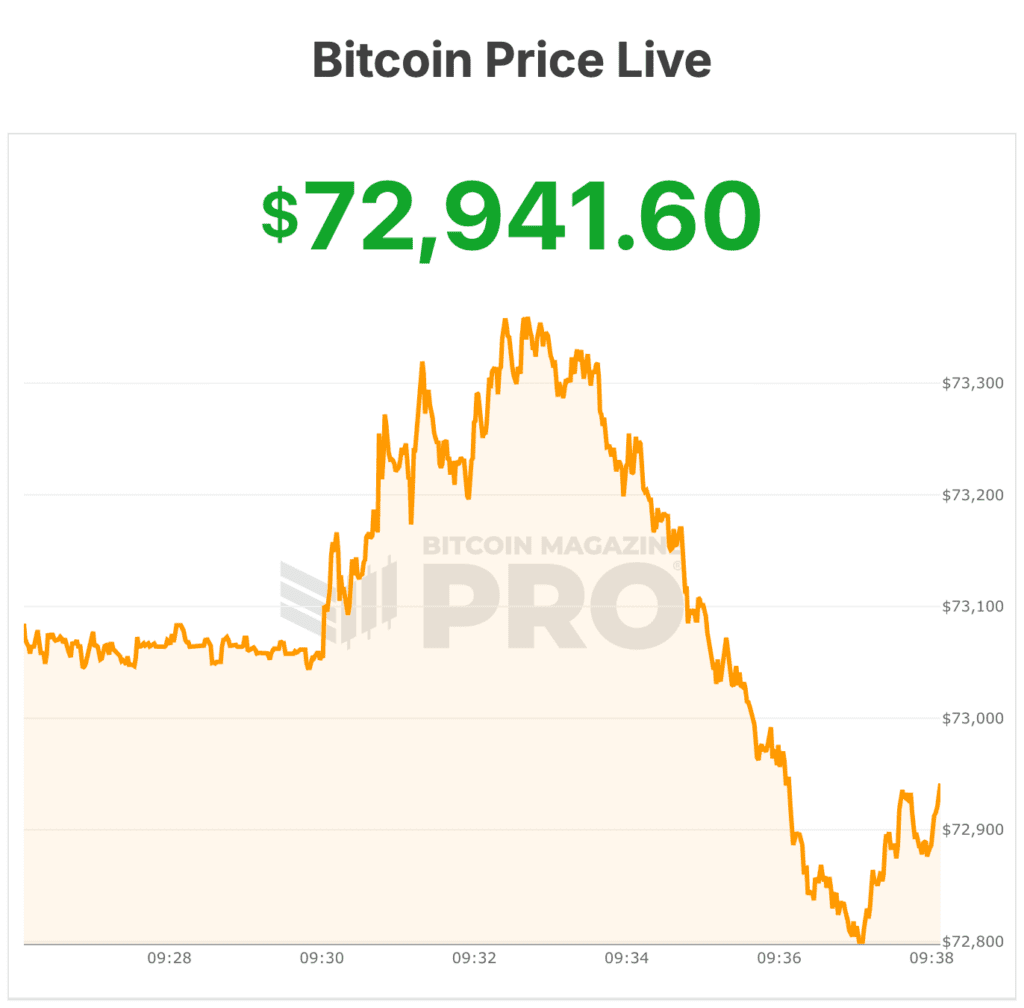
As of the latest reporting, Bitcoin is trading around $72,941, a level that underscores its recent strength and its ability to maintain momentum despite considerable global headwinds. The ongoing interplay between geopolitical events, macroeconomic trends, and the unique characteristics of Bitcoin will continue to shape its performance and its evolving role in the world of finance. The recent episode has undeniably reinforced its status as a dynamic and increasingly influential macro asset.
This article was compiled with data and analysis from Bitcoin Magazine’s internal market data, alongside publicly available financial market information. The events described are based on market movements and reported geopolitical developments in 2026.
